

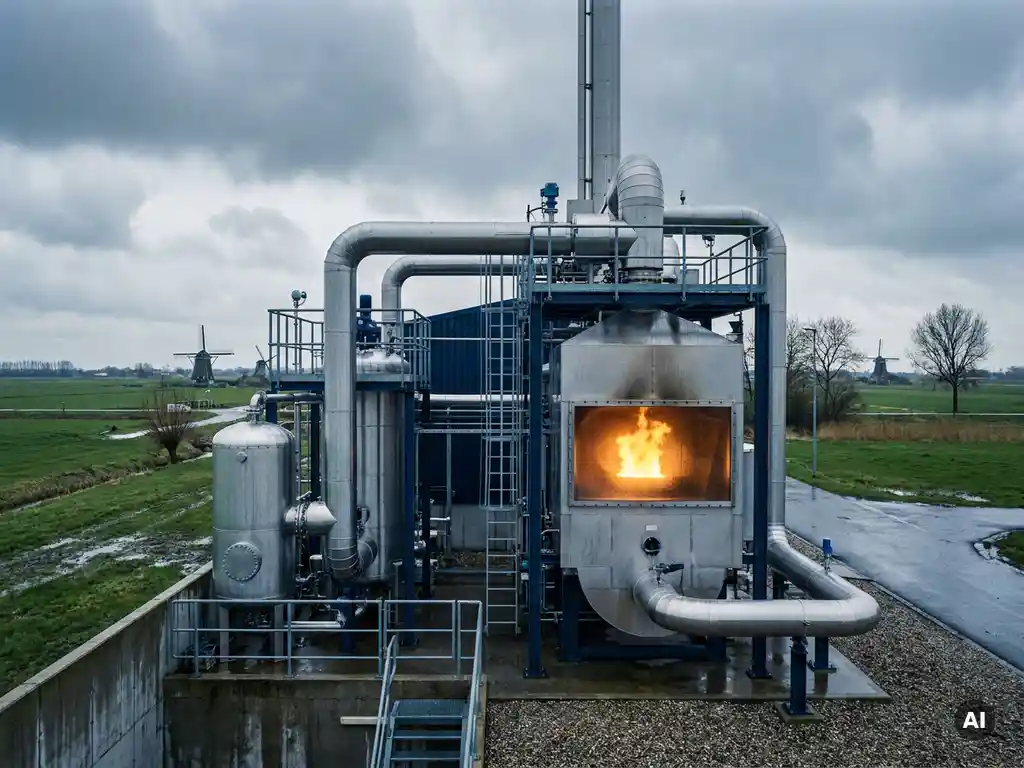
VEKI — short for Versnelde Klimaatinvesteringen Industrie — is a Dutch government subsidy scheme that helps industrial companies finance investments that reduce CO₂ and other greenhouse gas emissions. It is administered by the Netherlands Enterprise Agency (RVO) and forms part of the broader national subsidy framework under the Regeling nationale EZK- en LNV-subsidies. The scheme is designed specifically for energy-intensive industries where decarbonization requires significant upfront capital. This article unpacks who qualifies, what VEKI covers, how much funding is available, and how it stacks up against other Dutch industrial subsidies.
Who is eligible for VEKI funding in the Netherlands?
VEKI funding is available to industrial companies operating in the Netherlands that invest in production installations aimed at reducing CO₂ and other greenhouse gas emissions. Eligibility is tied to your company’s activity classification under the Dutch Standard Industrial Classification (SBI), and the investment must be made within your own business, not on behalf of a third party.
More specifically, eligible applicants fall under the following categories in the CBS Standard Industrial Classification:
- Main group C (Industry): companies that produce material goods through processing of raw materials, with a high degree of mechanization and automation
- Main group E (Waste and wastewater processing): specifically subgroups 37 and 38.2
- Main group D (Energy distribution): companies involved in energy distribution activities
One important nuance: the relevant SBI code is the one that corresponds to the actual activity through which the CO₂ reduction is achieved, not necessarily the code under which your company is registered with the Chamber of Commerce (KVK). So even if your registration code differs, you may still qualify based on the nature of the specific project.
Beyond sector classification, a few additional baseline conditions apply. The basic engineering of your project must be completed before you apply. Once a positive decision is issued, the project must start within one year, and the installation must be commissioned within four years. After commissioning, a ten-year operational period follows, and crucially, the installation must remain profitable without subsidy support after those ten years.
What types of investments does VEKI cover?
VEKI covers investments in production installations in the Netherlands that lead to a measurable, absolute reduction of CO₂ emissions by 2030. The subsidy applies to both investment costs and operating costs related to the qualifying installation. Projects must fall into one of two defined categories.
The two eligible project categories are:
- Category A — Direct CO₂ savings in the production process: This includes themes such as large-scale process efficiency improvements, electrification, and hydrogen. If your project replaces fossil fuel-based heat or energy with a cleaner alternative within your production process, this is the relevant category.
- Category B — Replacing primary fossil carbon in the product chain: This applies to projects that substitute fossil-derived raw materials with sustainable alternatives throughout the production chain.
There are also clear exclusions. VEKI does not fund new infrastructure projects, energy production through combined heat and power (CHP), hydrogen production via electrolysis, or electricity production from hydrogen. Applications with a bid above €300 per tonne of CO₂ avoided are also ineligible. If recycling is part of the project, the recycling quality must be at least equivalent to current standard methods; downgraded recycling is not supported.
The subsidy amount itself is calculated based on the gap between the cost price of the sustainable output and its market price. RVO provides mandatory calculation models that applicants must use to determine both the greenhouse gas reduction and the required subsidy level; you cannot self-calculate using your own methodology.
How much funding can industrial companies receive through VEKI?
The minimum VEKI application threshold is €30,000 in financial support, which makes it accessible to a wide range of project sizes. However, there is also a cap: bids above €300 per tonne of CO₂ avoided are excluded from the scheme. The actual subsidy amount varies per project and is determined by the difference between what it costs to produce sustainably and what the market will pay for the output.
Because the subsidy is performance-linked rather than fixed, the final amount is only confirmed after your project concludes. At that point, you submit a settlement request and RVO reconciles any over- or underpayment based on actual costs and revenues. For applications between €30,000 and €125,000, a board declaration alongside the settlement form is sufficient for this reconciliation. Larger projects require a more detailed final report.
The settlement review period is 13 weeks, with the possibility of a single extension of another 13 weeks. This timeline is worth factoring into your financial planning, particularly if your project’s cash flow depends on subsidy reimbursement at a specific point.
How does the VEKI application process work?
The VEKI application process runs through periodic open application rounds, which are announced by RVO on its website. In 2026, a new application round is expected to open in autumn, and while the exact dates had not been confirmed at the time of writing, RVO has indicated that a project idea assessment (projectideetoets) can already be requested ahead of the formal round opening.
The process broadly follows these steps:
- Project idea assessment: Before the formal round opens, you can submit your project concept for a preliminary review. This helps you identify whether your project is likely to qualify before investing time in a full application.
- Complete basic engineering: Your project’s basic engineering must be finalized before you apply. This is a hard requirement; applications for projects still in conceptual design are not accepted.
- Formal application during the open round: Submit your application during the designated window, using RVO’s mandatory calculation models to substantiate your projected CO₂ reduction and subsidy need.
- Decision and project start: If approved, you must start the project within one year of receiving the positive decision.
- Installation and operational phase: Commission the installation within four years of project start, followed by a ten-year operational period.
- Settlement request: After project completion, submit your settlement documentation for final subsidy confirmation.
Staying informed is straightforward. RVO recommends monitoring its VEKI page directly or signing up for email notifications to catch announcements as soon as they are published.
How does VEKI compare to other Dutch industrial subsidies like SDE++ and DEI+?
VEKI, SDE++, and DEI+ are all Dutch government instruments aimed at accelerating industrial decarbonization, but they serve different purposes and project stages. Understanding the distinction helps you identify which scheme, or combination, fits your situation.
VEKI versus SDE++
SDE++ (Stimulering Duurzame Energieproductie en Klimaattransitie) is primarily an operating subsidy that compensates for the price difference between sustainable energy production and the market rate over a long operational period. It is most commonly used for renewable electricity generation and large-scale industrial heat decarbonization projects. VEKI, by contrast, covers both investment and operating costs but is structured around a competitive bidding mechanism focused on CO₂ reduction cost-effectiveness. SDE++ suits projects with long operational revenue streams; VEKI is better suited to investments where the upfront cost gap is the primary barrier.
VEKI versus DEI+
DEI+ (Demonstratie Energie- en Klimaatinnovatie) supports the demonstration of innovative energy and climate technologies that are not yet commercially proven. It targets earlier-stage projects, typically those at pilot or demonstration scale, where the goal is to prove technical and commercial feasibility. VEKI, on the other hand, is aimed at investments in proven technologies that are ready for deployment but face a financial viability gap due to the cost difference versus fossil alternatives. If your technology is still in the demonstration phase, DEI+ may be the more appropriate starting point before scaling up with VEKI support.
Can VEKI be combined with other subsidies or funding sources?
Yes, VEKI can in principle be combined with other public funding instruments, but the rules around cumulation are strict and project-specific. The key principle is that total public support across all sources must not exceed the maximum allowable aid intensity under European state aid rules. In practice, this means you need to carefully map all funding sources, grants, loans, guarantees, and verify that the combined support stays within permitted limits.
For industrial companies exploring clean heat solutions, this stacking potential is particularly relevant. A project that qualifies for VEKI may also be eligible for EU-level instruments such as the EU Innovation Fund, regional development funding through bodies like Oost NL or Invest-NL, or sector-specific innovation grants. Each funding source has its own eligibility criteria, application windows, and reporting requirements, so early-stage financial planning should involve a clear overview of all available instruments and their interaction rules.
It is also worth noting that VEKI’s subsidy calculation, based on the gap between cost price and market price, is performed using RVO’s mandatory models. If you are combining VEKI with other subsidies, those other amounts will factor into the net subsidy need calculation, which may reduce the VEKI amount you are eligible for. Transparency about all funding sources in your application is both a legal requirement and a practical necessity for accurate subsidy sizing.
How RIFT helps industrial companies access clean heat funding
For sustainability managers working to decarbonize industrial heat, navigating subsidy schemes like VEKI is only one piece of the puzzle. The bigger challenge is identifying a technology that is commercially viable, operationally practical, and genuinely capable of eliminating fossil fuel dependence, without creating new dependencies on grid infrastructure or hydrogen supply chains that are not yet in place.
This is exactly where we come in. Our Iron Fuel Technology is designed for industrial companies that need reliable, high-temperature heat without direct CO₂ emissions, and without the barriers that make electrification or hydrogen impractical for many sites today. Here is what makes it relevant in the context of VEKI and broader decarbonization funding:
- Grid-independent operation: Iron Fuel Boilers do not rely on the electricity grid, making them a practical option where grid congestion limits electrification
- Drop-in compatibility: Our boilers are designed to integrate with existing industrial setups, reducing the engineering complexity and capital risk of switching away from natural gas
- Up to 95% energy efficiency: High thermal efficiency supports a strong business case, which is essential for VEKI applications where cost-effectiveness per tonne of CO₂ avoided is a key evaluation criterion
- Near-zero direct CO₂ emissions: The Iron Fuel Boiler produces just 10 kg of CO₂ per MWhth, stemming solely from a pilot safety flame, making it a strong candidate for Category A VEKI projects focused on direct emission savings in the production process
- RIFT claims the lowest NOₓ emissions of any fuel: Ultra-low NOₓ output strengthens the overall environmental profile of a VEKI application
- Long-term fuel supply security: Iron fuel is abundant, safe to transport in standard containers, and not subject to the same price volatility as natural gas or hydrogen, supporting the ten-year operational viability that VEKI requires
Whether you are building the business case internally, evaluating technology options, or preparing a VEKI application, we are happy to talk through how Iron Fuel Technology fits your specific situation. Get in touch with our team to start the conversation.
Frequently Asked Questions
What happens if my SBI code doesn't match the eligible categories, but the project itself clearly targets industrial CO₂ reduction?
Your eligibility is assessed based on the SBI code that corresponds to the actual activity through which the CO₂ reduction is achieved, not necessarily the code registered with the Chamber of Commerce (KVK). If your project involves an activity that falls under Main Group C, D, or E (subgroups 37 and 38.2), you may still qualify even if your KVK registration shows a different primary code. It is worth discussing this nuance directly with RVO or a subsidy advisor before assuming you are ineligible, as many companies are surprised to find they qualify based on project activity rather than company registration.
What is the 'project idea assessment' (projectideetoets) and should I request one before the application round opens?
The projectideetoets is a preliminary review offered by RVO that allows you to submit your project concept before the formal application round opens, giving you early feedback on whether your project is likely to meet VEKI’s eligibility criteria. It is strongly recommended, as it helps you avoid investing significant time and resources into a full application — including completing basic engineering — for a project that may not qualify. If RVO’s 2026 autumn round is your target, requesting this assessment as early as possible gives you the most lead time to refine your approach or pivot to a more suitable instrument like DEI+ if needed.
What are the most common mistakes companies make when preparing a VEKI application?
The most frequent pitfalls include applying before basic engineering is complete (a hard disqualifier), using self-developed calculation models instead of RVO’s mandatory tools, and underestimating the impact of combined subsidies on the net VEKI amount. Another common error is submitting a bid above €300 per tonne of CO₂ avoided without realizing this automatically excludes the application. Starting with a projectideetoets and engaging a subsidy specialist familiar with RVO’s calculation methodology significantly reduces the risk of these mistakes.
How should I handle the ten-year post-commissioning operational requirement in my financial planning?
The ten-year operational period means your installation must remain financially viable without subsidy support after the VEKI-funded phase ends — RVO will assess this as part of your application. In practice, this requires building a long-term business case that accounts for projected energy prices, raw material costs, and market conditions a decade out. Technologies with stable, non-volatile fuel supply chains and high energy efficiency are better positioned to meet this requirement, as they reduce exposure to the commodity price swings that can erode post-subsidy profitability.
If my project qualifies for both VEKI and SDE++, which one should I apply for first?
The right sequencing depends on your project’s profile: if it involves proven technology with a clear operational revenue stream over many years (such as large-scale heat decarbonization), SDE++ may offer more long-term financial certainty. VEKI is better suited when the primary barrier is the upfront cost gap rather than long-run revenue support. Since cumulation rules mean the two subsidies interact and can reduce each other’s net value, it is advisable to model both scenarios — ideally with a subsidy advisor — before committing to an application strategy, rather than applying for both simultaneously without understanding the interaction.
Can startups or scale-ups apply for VEKI, or is it only accessible to established industrial companies?
VEKI does not explicitly exclude startups or scale-ups, but several practical requirements make it more accessible to companies with operational maturity. Completed basic engineering, a demonstrated ability to commission within four years, and the requirement that the installation remain profitable without subsidy after ten years all imply a level of technical and financial readiness that early-stage companies may not yet have. For companies still in the demonstration or proof-of-concept phase, DEI+ is typically the more appropriate instrument, with VEKI becoming relevant once the technology is proven and ready for full-scale deployment.
How long does the full VEKI process take from initial project idea to receiving the final subsidy payment?
The timeline is substantial and should be factored into your project’s financial planning from the outset. After the projectideetoets and completing basic engineering, the formal application window, decision period, and one-year start deadline alone can span well over a year before construction even begins. Add up to four years for commissioning, ten years of operation, and then a settlement review period of up to 26 weeks, and the full cycle from idea to final payment can easily exceed 15 years for larger projects. This makes early engagement with RVO and careful cash flow planning essential, particularly for companies that cannot absorb long gaps between investment and reimbursement.
Related Articles
- How does iron fuel compare to hydrogen for industrial heat generation?
- What clean heat options exist for food and beverage manufacturers?
- Will EU ETS carbon prices keep rising and what does that mean for industry?
- What is VEKI?
- How does renewable energy create jobs?
This content was generated with the help of AI and it may contain mistakes