

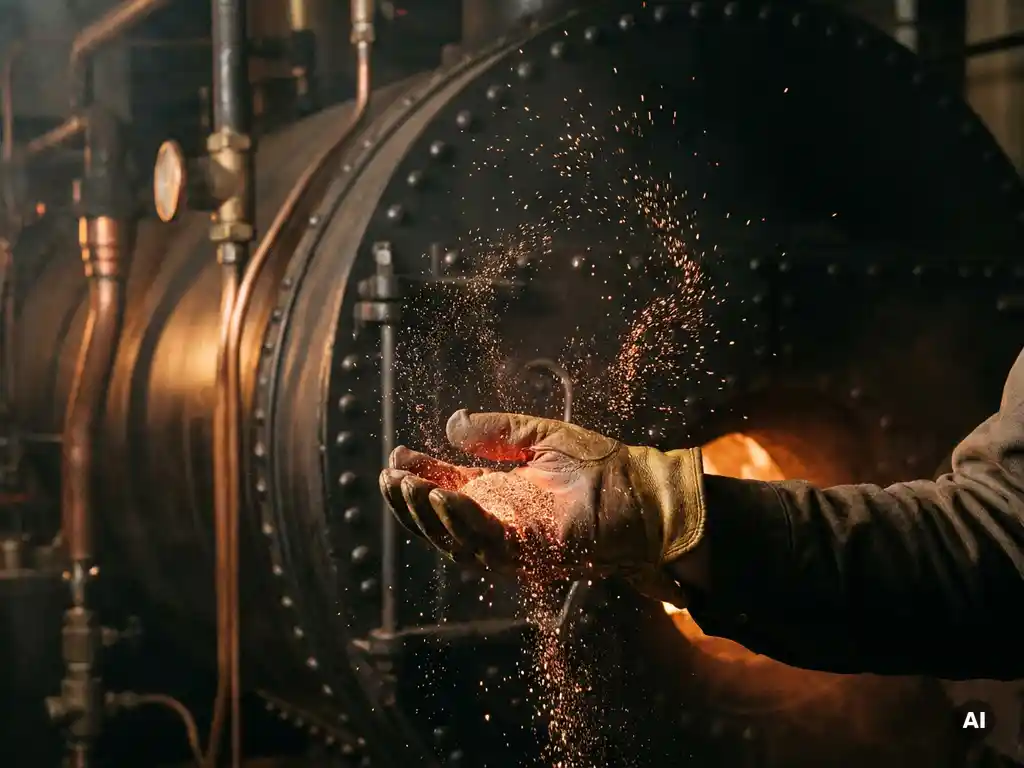
VEKI, short for Versnelde Klimaatinvesteringen Industrie (Accelerated Climate Investments Industry), is a Dutch government subsidy scheme administered by RVO (Rijksdienst voor Ondernemend Nederland) that helps industrial companies fund investments that reduce CO₂ and other greenhouse gas emissions. It is designed specifically for businesses whose clean energy projects would not be commercially viable within five years without financial support. The sections below answer the most common questions about eligibility, project scope, funding levels, and how Iron Fuel Technology fits into the picture.
Who can apply for VEKI funding?
VEKI funding is available to industrial companies operating in the Netherlands that want to invest in measures that reduce CO₂ emissions within their own business, where the payback period without the subsidy would exceed five years. The scheme targets businesses in manufacturing and related industrial sectors that are ready to make a concrete, investable step toward decarbonization.
To be eligible, applicants generally need to meet the following criteria:
- The company is classified under main category C (Industry) or E (waste and wastewater processing), including subgroups 37 and 38.2 of the CBS Standard Industry Classification (SBI 2025)
- The investment is made in a production facility located in the Netherlands
- The company retains ownership of the installation
- The project results in an absolute reduction of CO₂ emissions in the Netherlands by 2030 compared to current industrial emissions
- The investment would not be commercially viable within five years without the subsidy
It is worth noting that VEKI is not limited to large corporations. Small and medium-sized enterprises in eligible industrial sectors can also apply, provided their project meets the emissions reduction and viability criteria set out in the scheme’s guidelines.
What kinds of projects does VEKI support?
VEKI supports industrial projects that lead to a meaningful, measurable reduction in CO₂ or CO₂-equivalent greenhouse gas emissions within Dutch production processes. The scheme covers both investment costs (CAPEX) and operating costs (OPEX) related to the qualifying installation, and it is structured around two main project categories.
Category A: Direct emission savings in the production process
This category covers projects focused on large-scale process efficiency improvements, electrification of industrial heat or processes, and the switch to hydrogen as an energy carrier. If your company is replacing a fossil fuel-fired system with a cleaner alternative that directly reduces emissions at the point of production, this is the most likely fit.
Category B: Replacing primary fossil carbon in the product chain
This category targets projects where fossil-based raw materials or inputs are substituted with lower-carbon alternatives within the production chain. This is particularly relevant for sectors where carbon is embedded in the product itself, not just the energy used to make it.
Projects that fall outside VEKI’s scope include new infrastructure construction, hydrogen production via electrolysis, electricity generation from hydrogen, and energy from combined heat and power (CHP) installations. The scheme also excludes projects where the cost per tonne of avoided CO₂ exceeds €300.
How much funding can a company receive through VEKI?
The amount of VEKI funding a company can receive depends on the difference between the cost of producing with the new clean technology and the market price of the output, a gap that the subsidy is designed to bridge. The subsidy covers both investment and operational costs, and its exact value is calculated using RVO’s mandatory calculation models rather than a fixed percentage or cap.
VEKI operates as a tender scheme, meaning companies compete for funding by submitting a bid expressed in euros per tonne of CO₂ avoided. The lower your bid, in other words, the more CO₂ you avoid per euro of subsidy requested, the higher your project ranks in the allocation order. This competitive structure rewards efficiency and ambition.
Projects with bids above €300 per tonne of CO₂ avoided are automatically excluded. Beyond that ceiling, there is no single fixed maximum grant amount published for VEKI; the final subsidy is determined after the project is completed and verified against actual costs and emissions reductions. Interim advance payments are made during the project, and a final settlement is carried out at the end of the operating period.
How does the VEKI application process work?
The VEKI application process follows a structured sequence of preparation, submission, ranking, and post-project settlement. Because VEKI is a tender scheme with a fixed closing date, preparation well in advance of the deadline is essential.
- Complete basic engineering: Before applying, the basic engineering phase of your project must be finished. This phase forms the basis for calculating both the CO₂ reduction and the subsidy amount.
- Use the mandatory calculation models: Applicants must use RVO’s official CO₂ emission reduction model and the VEKI subsidy calculation method. Using your own figures or alternative models is not permitted.
- Prepare your project plan and climate plan: A documented project plan and a climate plan are required as part of the application. An auditor’s statement may also be needed depending on the subsidy amount requested.
- Arrange eHerkenning login credentials: You need eHerkenning at level 3 or higher with authorization for RVO services to submit your application through Mijn RVO.
- Submit your bid before the closing deadline: Applications are ranked by bid: the lowest bid per tonne of CO₂ avoided receives the highest ranking. RVO assesses completeness, eligibility, feasibility, and correct use of the calculation models.
- Receive a decision within 13 weeks: RVO aims to issue a decision within 13 weeks of the closing date, with one possible extension of a further 13 weeks.
- Start the project within one year of approval: Once a subsidy decision is granted, the project must start within one year and be fully operational within four years, followed by a 10-year operating period.
- Request final settlement after project completion: After the project ends, you submit a settlement request. RVO verifies actual costs and emissions reductions, and adjusts the final subsidy accordingly.
If you want to test the viability of your idea before committing to a full application, RVO offers a no-obligation project idea review (projectideetoets). A project advisor will assess your concept and flag any issues, or point you toward other relevant subsidies.
How does VEKI compare to other Dutch clean energy subsidies?
VEKI sits alongside several other Dutch industrial decarbonization schemes, but it has a distinct profile that makes it particularly suited to capital-intensive, high-impact projects. Understanding where it fits helps sustainability managers choose the right funding route for their specific situation.
The SDE++ (Stimulering Duurzame Energieproductie en Klimaattransitie) is the Netherlands’ largest clean energy subsidy and focuses primarily on the production of renewable energy and CO₂ reduction through energy generation. SDE++ is an operating subsidy paid over a long production period and is well suited to technologies like solar, wind, and geothermal. VEKI, by contrast, supports investment in production installations and covers both CAPEX and OPEX, making it more accessible for industrial process changes that do not primarily produce energy for the grid.
The NIKI (Nationale Investeringsregeling Klimaatprojecten Industrie) is a newer, large-scale tender scheme that overlaps in some ways with VEKI but targets even more transformative industrial investments, with a minimum subsidy request of €30 million. NIKI is designed for flagship decarbonization projects at significant scale. VEKI is generally more accessible for mid-sized investments that still require substantial support to cross the commercial viability threshold.
In short, VEKI is often the right starting point for industrial companies making a concrete, investable clean energy transition that is too large for standard business financing but not yet at the scale of a NIKI-eligible flagship project.
Can Iron Fuel Technology projects qualify for VEKI?
Yes, Iron Fuel Technology projects have strong potential to qualify for VEKI, provided the investment meets the scheme’s standard eligibility criteria, particularly the requirement that the project results in a measurable absolute reduction in CO₂ emissions at a Dutch production facility, and that it would not be commercially viable within five years without subsidy support.
Iron Fuel Technology fits squarely within VEKI’s Category A focus on direct emission savings in the production process. An Iron Fuel Boiler replaces a fossil fuel-fired heat source with a system that produces up to 95% energy efficiency and only 10 kg of CO₂ per MWhth, with that minimal CO₂ output stemming solely from the pilot safety flame, not from the combustion of iron fuel itself. For industrial companies in Food and Beverage, Specialty Chemicals, or Pulp and Paper, this kind of installation directly reduces Scope 1 emissions from heat generation, which is precisely what VEKI is designed to accelerate.
The competitive tender structure of VEKI also aligns well with Iron Fuel Technology’s cost profile. Because the technology is infrastructure-compatible and does not require a complete overhaul of existing boiler systems, the cost per tonne of avoided CO₂ can be competitive, which is exactly what determines ranking in the VEKI tender.
How RIFT helps you decarbonize industrial heat
We at RIFT develop and deliver industrial Iron Fuel Boilers, clean energy systems that replace fossil fuel-fired heat generation with a fully circular, carbon-free alternative. For sustainability managers evaluating VEKI as a funding route, our technology addresses the core requirement directly: a measurable, substantial reduction in CO₂ emissions from industrial heat, delivered through a system that integrates with existing infrastructure rather than replacing it entirely.
Here is what makes our Iron Fuel Boiler relevant to a VEKI application:
- Near-zero direct CO₂ emissions: Only 10 kg of CO₂ per MWhth, exclusively from the pilot safety flame, not from iron fuel combustion itself
- Up to 95% energy efficiency: Outperforming many conventional fossil fuel systems
- Drop-in compatible: Designed to complement existing boiler infrastructure, reducing the scale of capital disruption
- Grid-independent heat: No dependency on electricity grid capacity or hydrogen infrastructure
- Demonstrated at TRL7: Proven at megawatt-industrial scale in the Netherlands, giving funders and regulators a credible basis for assessment
- Backed by €113.8 million in funding: Including an EU Innovation Fund grant, signaling regulatory and investor confidence in the technology’s viability
If you are a sustainability manager exploring whether an Iron Fuel Boiler investment could form the basis of a VEKI application, or simply want to understand how our Iron Fuel Technology works in practice, we would be glad to talk through your specific situation. Get in touch with our team and let us help you build the business case for clean industrial heat.
Frequently Asked Questions
What is the minimum project size to make a VEKI application worthwhile for an Iron Fuel Boiler installation?
While VEKI does not publish a fixed minimum grant amount, the administrative effort of completing basic engineering, preparing a project plan and climate plan, and using RVO’s mandatory calculation models means the scheme is most practical for investments where the subsidy would meaningfully bridge a real commercial viability gap. For Iron Fuel Boiler projects, the relevant threshold is whether your current fossil fuel-fired heat system generates enough CO₂ to produce a competitive bid below €300 per tonne avoided — the higher your baseline emissions, the stronger your position in the tender ranking. If you are unsure whether your installation is large enough to justify a VEKI application, RVO’s no-obligation project idea review (projectideetoets) is a low-risk first step before committing to full preparation.
Can a company apply for VEKI and SDE++ for the same Iron Fuel Technology project?
Generally, the same costs cannot be double-subsidised under two Dutch schemes simultaneously, and RVO will assess whether overlapping support has been claimed. However, VEKI and SDE++ target different aspects of the energy transition — VEKI covers the investment and operational costs of a clean production installation, while SDE++ focuses on the revenue gap from producing renewable energy or reducing emissions over a long operating period. Whether a single Iron Fuel Boiler project could access both schemes in complementary ways depends on the specific project structure and which costs are allocated to each application. We strongly recommend seeking advice from a subsidy specialist or using RVO’s project idea review to clarify this before submitting.
What happens if my project's actual CO₂ savings fall short of what was projected in my VEKI application?
Because VEKI operates on a final settlement basis, RVO verifies actual costs and emissions reductions at the end of the project’s operating period and adjusts the final subsidy accordingly — meaning you may receive less than the initially awarded amount if real-world performance falls short of projections. This makes it critical to use conservative, well-documented assumptions in your application rather than optimistic estimates, and to ensure your installation is properly commissioned and monitored throughout the operating period. For Iron Fuel Boiler projects, RIFT’s demonstrated performance data at TRL7 megawatt-industrial scale provides a credible, defensible baseline for emissions reduction projections.
How long does the full VEKI funding cycle take from application to final payment?
The timeline is substantial: after submission, RVO aims to issue a decision within 13 weeks (with a possible 13-week extension), the project must then start within one year of approval and be fully operational within four years, followed by a 10-year operating period before final settlement is requested. In practice, companies should plan for a total cycle of approximately 15 years from application to final payment, with interim advance payments made during the project to support cash flow. This long horizon reinforces the importance of robust project planning and financial modelling before entering the tender.
What common mistakes should companies avoid when preparing a VEKI application?
The most frequent pitfalls include submitting an application before basic engineering is complete, using in-house figures instead of RVO’s mandatory CO₂ emission reduction model and subsidy calculation method, and underestimating the documentation required for the project plan and climate plan. Companies also sometimes overlook the need for eHerkenning credentials at level 3 or higher, which can cause last-minute delays before the fixed tender deadline. Starting the preparation process at least six months before the closing date and using RVO’s project idea review early are two practical steps that significantly reduce the risk of a rejected or incomplete application.
Does switching to an Iron Fuel Boiler also affect a company's Scope 2 emissions, or only Scope 1?
An Iron Fuel Boiler primarily reduces Scope 1 emissions — the direct greenhouse gas emissions from combustion at your own facility — by replacing fossil fuel-fired heat generation with a system that produces only 10 kg of CO₂ per MWhth from a pilot safety flame, rather than from the fuel itself. Scope 2 emissions (from purchased electricity) are not directly affected, since the Iron Fuel Boiler is grid-independent and does not require additional electricity to generate heat. This Scope 1 focus is precisely what VEKI is designed to fund, making the emissions reduction profile of an Iron Fuel Boiler a strong fit for the scheme’s eligibility and calculation requirements.
Is VEKI funding available on a rolling basis, or are there specific application windows companies need to plan around?
VEKI is a tender scheme with fixed closing dates, not a continuous open-application programme, which means missing a deadline requires waiting for the next round — potentially delaying your decarbonisation project and your access to funding by a year or more. RVO announces tender rounds and closing dates in advance, so monitoring the RVO website and setting internal preparation milestones well ahead of the deadline is essential. Given that basic engineering must be completed before you can apply, companies considering an Iron Fuel Boiler investment should begin the engineering and feasibility phase as early as possible to avoid being locked out of an upcoming tender window.
Related Articles
- What is net zero and how does renewable energy help achieve it?
- What role does renewable energy play in fighting climate change?
- How does biomass energy work?
- What are the main types of renewable energy?
- What countries use the most renewables?
This content was generated with the help of AI and it may contain mistakes