

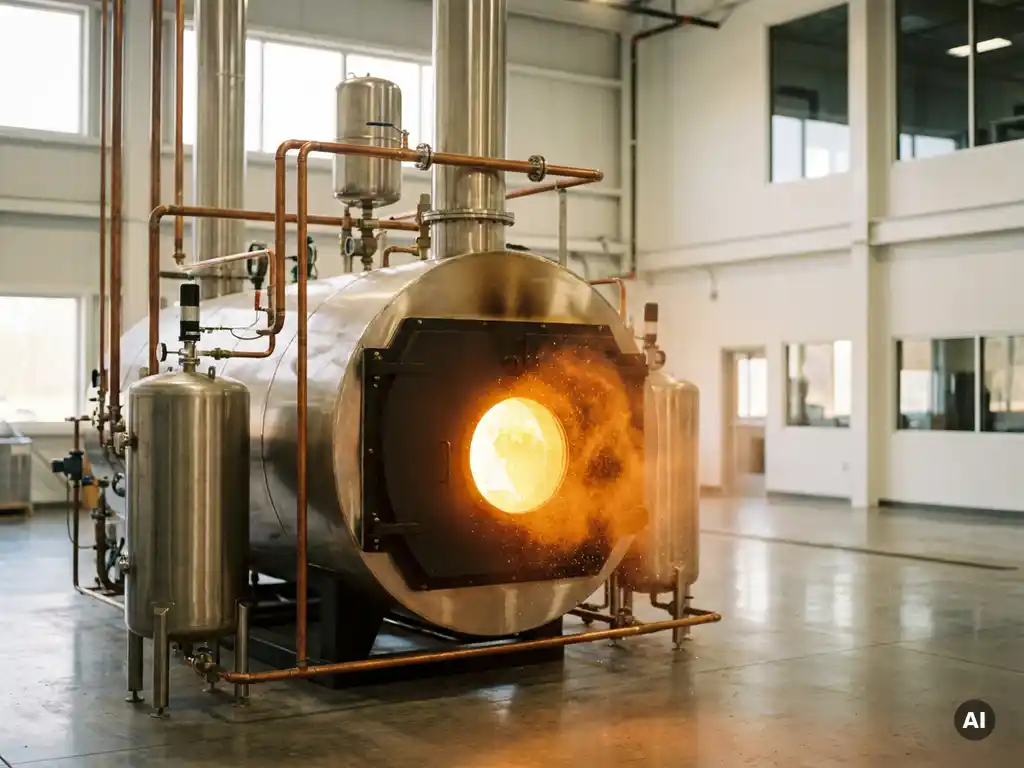
Several clean heat technologies are commercially available for industry today, including industrial heat pumps, biomass boilers, green hydrogen burners, and Iron Fuel Technology. The right choice depends on your process temperature requirements, available infrastructure, and decarbonization timeline. This article walks through the most pressing questions sustainability managers are asking right now, from which sectors face the toughest challenge to what a future-proof heat solution actually looks like.
Which industries are hardest to decarbonize with heat?
The hardest industries to decarbonize with heat are those that require consistently high process temperatures, typically above 200°C, where electrification is either technically limited or economically prohibitive. Food and beverage, specialty chemicals, and pulp and paper are among the most challenging, alongside cement, ceramics, and steel, where heat demand is enormous and continuous.
The core difficulty is structural. Industry accounts for roughly 37% of total global energy consumption, and around two-thirds of that goes to heat. Of that heat demand, approximately 80% is still met by fossil fuels. For high-temperature processes, alternatives like electric resistance heating or heat pumps often cannot reach the required temperatures or cannot do so cost-effectively at scale.
Grid congestion compounds the problem. Many industrial sites cannot access sufficient electrical capacity to electrify their heat processes even if they wanted to. Combined with volatile energy prices and the capital intensity of retrofitting, this leaves many companies in a difficult position: facing mounting pressure to reduce Scope 1 emissions from their EU ETS obligations, but without a clear, practical path forward.
The sectors RIFT focuses on, Food and Beverage, Specialty Chemicals, and Pulp and Paper, sit squarely in this gap. They need reliable, high-temperature heat, they operate continuously, and they cannot afford the operational disruption that comes with unproven or infrastructure-heavy solutions.
What clean heat technologies are available at commercial scale today?
The clean heat technologies available at commercial scale today include industrial heat pumps, biomass and biogas boilers, green hydrogen combustion systems, and Iron Fuel Technology. Each addresses a different segment of industrial heat demand, and none is a universal solution, the right fit depends on temperature range, site infrastructure, and total cost of ownership.
- Industrial heat pumps are well-suited to low- and medium-temperature applications (typically up to 150°C) and are commercially mature. They are highly efficient when electricity prices are stable and grid capacity is available.
- Biomass and biogas boilers are proven at scale and can reach higher temperatures. However, they are not fully carbon-free, face feedstock availability constraints, and are subject to tightening sustainability criteria under EU regulation.
- Green hydrogen burners can theoretically replace natural gas in existing combustion systems, but hydrogen infrastructure remains limited, transport and storage present safety and cost challenges, and supply security is not yet guaranteed across most European industrial regions.
- Iron Fuel Technology is a newer entrant that has reached Technology Readiness Level 7 (TRL7), demonstrated at megawatt-industrial scale in the Netherlands. Iron fuel burns to produce high-temperature heat with near-zero carbon emissions, and the resulting iron oxide is regenerated using hydrogen, completing a circular fuel cycle.
The EU Clean Industrial Deal, presented in early 2026, is actively mobilising over €100 billion to support clean manufacturing and industrial decarbonization, which is accelerating deployment timelines across all of these technologies. For sustainability managers evaluating options, the key question is not which technology is cleanest in theory, it is which one can actually be deployed at your site, at your required temperature, within your investment timeline.
How does electric heating compare to fuel-based clean heat?
Electric heating and fuel-based clean heat each have genuine strengths, but they serve different industrial contexts. Electric heating, through resistance elements, induction, or heat pumps, is clean at the point of use and highly controllable. Fuel-based clean heat, such as iron fuel or green hydrogen combustion, can reach higher temperatures and does not depend on grid capacity or electricity pricing.
The comparison comes down to three practical factors.
- Temperature range: Heat pumps typically max out around 150°C. Industrial electric resistance heating can go higher, but efficiency drops. Fuel-based combustion systems can reach 2,000°C or more, making them the only viable option for many high-temperature industrial processes.
- Grid dependency: Electrification relies on stable grid access and affordable electricity. In many European industrial regions, grid congestion is a real and growing constraint. Fuel-based clean heat systems are energy-carrier-independent, they do not compete for grid capacity, which also strengthens security of supply.
- CAPEX versus OPEX trade-offs: Electric systems often have lower upfront capital costs but can carry higher operating costs depending on electricity tariffs. Fuel-based systems require investment in combustion infrastructure but offer more predictable fuel cost structures, particularly when fuel supply agreements are in place.
For companies subject to EU ETS carbon pricing, both pathways reduce or eliminate direct CO₂ costs, but fuel-based clean heat can often be integrated into existing boiler infrastructure without a complete overhaul, which significantly lowers the transition barrier. Electrification, by contrast, frequently requires new electrical infrastructure investment that can take years to permit and build.
What are the barriers to adopting clean heat in industrial plants?
The main barriers to adopting clean heat in industrial plants are high upfront capital costs, infrastructure constraints, uncertainty about technology maturity, and the cost gap between fossil fuels and decarbonized alternatives. These barriers are real, but they are not uniform, their weight varies by sector, site, and company size.
CAPEX versus OPEX decisions are often the first sticking point. Clean heat systems typically require significant upfront investment, and internal approval processes for capital expenditure are lengthy. When fossil fuel alternatives appear cheaper on a short-term OPEX basis, especially during periods of lower gas prices, the business case for switching can be difficult to make internally, even when the long-term economics favour it.
Infrastructure limitations add another layer of complexity. Electrification requires grid capacity that many industrial sites simply do not have, and grid upgrades can take five to ten years. Hydrogen faces similar constraints, pipeline infrastructure is sparse, and delivered hydrogen costs remain high in most markets. Volatile energy prices make long-term financial planning harder, and companies are reluctant to commit to new energy systems without confidence in future cost trajectories.
Finally, technology maturity is a genuine concern. Sustainability managers are accountable for operational continuity, they cannot afford to bet a production line on a technology that has not been proven at scale. This is why TRL level matters: a solution demonstrated at TRL7 in real industrial conditions carries fundamentally different risk than a lab-stage concept.
What should industrial companies look for in a clean heat solution?
Industrial companies should look for a clean heat solution that delivers the required process temperatures, integrates with existing infrastructure, offers a credible total cost of ownership, and is backed by a reliable long-term fuel or energy supply. Technology maturity and regulatory alignment, particularly with EU ETS requirements, should also be central evaluation criteria.
A practical checklist for evaluating clean heat options includes:
- Temperature compatibility: Does the technology meet your specific process heat requirements, from steam generation to high-temperature combustion?
- Grid independence: Can the solution operate without relying on scarce grid capacity, reducing exposure to grid congestion and volatile energy prices?
- Integration with existing assets: Can it complement or replace your current boiler infrastructure without requiring a full plant rebuild?
- Emissions performance: Does it deliver verifiable reductions in Scope 1 CO₂ emissions, and how does it perform on NOx and other regulated pollutants?
- Supply security: Is there a credible, long-term fuel or energy supply agreement available, or is the supply chain still speculative?
- Commercial track record: Has the technology been deployed at industrial scale, and are there reference contracts you can evaluate?
- Financial structure: What does the CAPEX versus OPEX balance look like, and are there financing mechanisms, including EU Innovation Fund support, that can improve the business case?
The replacement of natural gas in industrial settings is not a single-technology problem, and the best solution for your plant may differ from a competitor’s. What matters is finding a solution that is commercially proven, operationally compatible, and financially viable within your decarbonization timeline.
How Iron Fuel Technology helps with decarbonizing industrial heat
We developed Iron Fuel Technology specifically to address the gap that electrification and hydrogen cannot fill for many industrial companies. Here is what that means in practice:
- High-temperature heat without CO₂: Our Iron Fuel Boiler produces steam, hot water, or hot air with up to 95% energy efficiency and just 10 kg of CO₂ per MWhth, a figure that comes solely from a pilot safety flame, not from the iron fuel combustion itself.
- No grid dependency: Iron fuel is stored and transported in standard containers. It does not require hydrogen pipelines or additional electrical grid capacity, making it viable for sites where electrification is not a realistic option.
- Drop-in compatibility: Our boiler system is designed to complement existing fossil fuel infrastructure, reducing the capital risk of transition and enabling a phased approach to decarbonization.
- Circular fuel cycle: After combustion, iron oxide is regenerated into iron fuel using hydrogen, completing a fully closed loop with zero CO₂ and zero NOx from the production process.
- Commercially proven: We have signed the world’s first commercial contract for industrial Iron Fuel Technology with Kingspan Unidek, and our technology is demonstrated at TRL7 at megawatt-industrial scale.
If you are a sustainability manager evaluating clean heat options for your facility, we are happy to discuss whether Iron Fuel Technology is the right fit for your process. Get in touch with our team to start the conversation.
Frequently Asked Questions
How do I know which clean heat technology is the right fit for my specific industrial process?
Start by mapping your process temperature requirements — this single factor eliminates many options immediately. If your process runs below 150°C, industrial heat pumps may be a strong candidate; above that threshold, fuel-based solutions like Iron Fuel Technology or green hydrogen become more relevant. From there, assess your grid capacity, existing boiler infrastructure, and decarbonization timeline to narrow down which commercially proven options are actually deployable at your site within your investment window.
What is TRL7 and why does it matter when evaluating clean heat solutions?
TRL stands for Technology Readiness Level, a scale from 1 (basic research) to 9 (fully commercial deployment), used widely in the EU and industrial sectors to assess how mature a technology is. TRL7 means the technology has been demonstrated in real operational conditions at relevant industrial scale — not just in a lab. For sustainability managers responsible for production continuity, this distinction is critical: a TRL7 solution carries significantly lower operational risk than an earlier-stage concept, and it is the minimum threshold most industrial operators should require before committing to a transition.
How does EU ETS carbon pricing affect the business case for switching to clean heat?
EU ETS carbon pricing directly increases the cost of maintaining fossil fuel-based heat by placing a price on every tonne of CO₂ your facility emits as a Scope 1 source. As ETS allowance prices rise — and they are structurally expected to increase over time — the OPEX gap between fossil fuels and clean alternatives narrows or reverses entirely, making the business case for clean heat progressively stronger. Companies that lock in clean heat solutions now are also hedging against future carbon price volatility, which is increasingly relevant for long-term financial planning and investor reporting.
Can clean heat technologies be implemented in phases, or does switching require an all-or-nothing commitment?
A phased approach is not only possible but is often the most practical and financially manageable path for industrial operators. Many clean heat systems, including Iron Fuel Technology, are designed to complement existing fossil fuel infrastructure rather than replace it outright, allowing you to decarbonize a portion of your heat demand first and scale up as confidence and budget allow. This reduces capital risk, allows your team to build operational experience with the new technology, and aligns with the incremental nature of most internal capital approval processes.
What financing options or subsidies are available to help offset the upfront cost of clean heat adoption?
Several EU-level funding mechanisms are available to industrial companies investing in clean heat, most notably the EU Innovation Fund, which supports large-scale deployment of low-carbon technologies, and funding mobilised under the EU Clean Industrial Deal, which is directing over €100 billion toward clean manufacturing. At the national level, many EU member states offer additional grants, tax incentives, or accelerated depreciation schemes for decarbonization investments. Working with a technology provider that has experience navigating these funding pathways can significantly improve the financial viability of your project.
What are the most common mistakes companies make when evaluating clean heat options?
The most frequent mistake is evaluating clean heat technologies on upfront CAPEX alone, without accounting for the full total cost of ownership, including future carbon costs, energy price exposure, and the cost of delayed action under tightening EU ETS obligations. A second common error is assuming electrification is always the default clean option, without first verifying that sufficient grid capacity is available at the site — an assumption that fails for a significant number of European industrial facilities. Finally, many companies underestimate the lead time required for permitting and infrastructure upgrades, which makes early-stage technology evaluation far more valuable than waiting until regulatory pressure forces a rushed decision.
How should I build an internal business case for transitioning to clean industrial heat?
A compelling internal business case needs to address both the financial and the risk dimensions of the transition. On the financial side, model the full cost comparison over a 10–15 year horizon, including projected EU ETS carbon costs, energy price scenarios, and available subsidies — not just today’s fossil fuel OPEX. On the risk side, frame inaction as a risk in itself: regulatory non-compliance, stranded fossil fuel assets, and reputational exposure to customers and investors increasingly demanding Scope 1 reductions. Anchoring your proposal to a commercially proven technology with reference contracts and a clear integration path will also significantly strengthen credibility with internal decision-makers.
Related Articles
- What should sustainability managers prioritize when evaluating clean heat technologies?
- What is a circular energy carrier and how does it work in industry?
- How can companies use renewable energy?
- What is clean energy and is it the same as renewable energy?
- What is a heat pump and how does it use renewable energy?
This content was generated with the help of AI and it may contain mistakes