

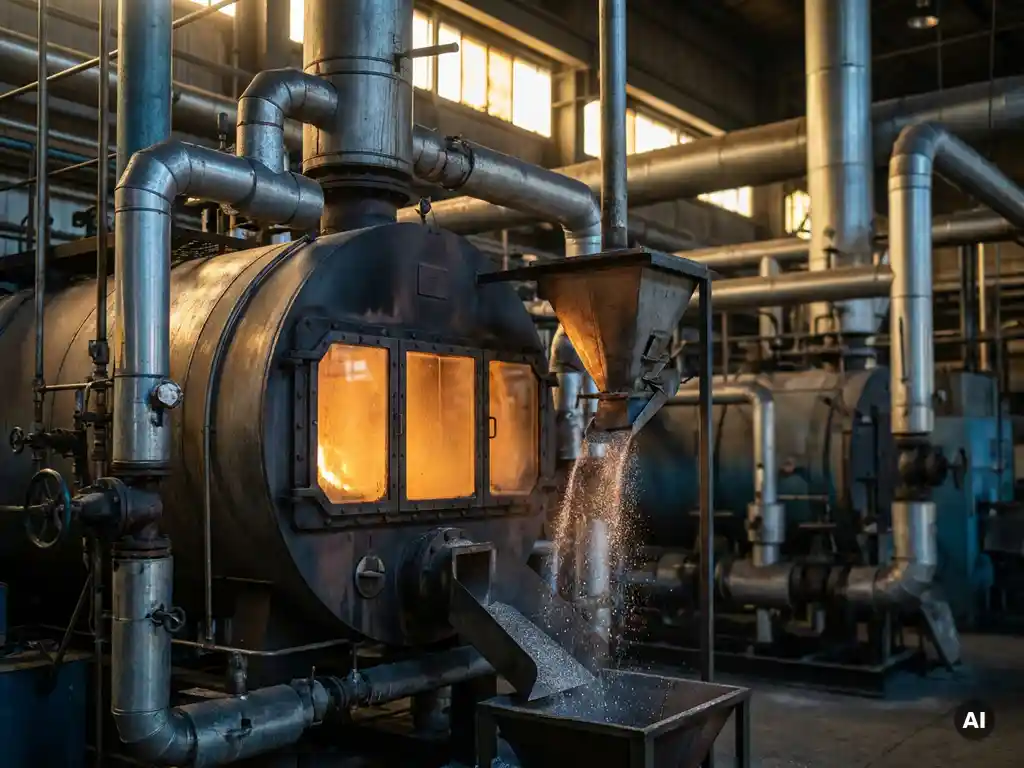
Yes, industrial boilers can be decarbonized without replacing existing infrastructure, and for many companies, that is precisely the most practical path forward. Technologies like Iron Fuel Technology allow industries to transition away from fossil fuels while keeping their current boiler setups largely intact, avoiding the cost and disruption of full system overhauls. Below, we answer the most pressing questions sustainability managers are asking about industrial boiler decarbonization in 2026.
What makes industrial boiler decarbonization so difficult?
Industrial boiler decarbonization is difficult because most available alternatives, electrification and hydrogen, are either too expensive, too infrastructure-dependent, or simply not suited to the high-temperature heat that industrial processes demand. For many facilities, switching to electricity means confronting grid congestion and prohibitive connection costs. Hydrogen, while promising, requires entirely new storage, transport, and safety infrastructure that most sites do not have.
The scale of the challenge is significant. Industry accounts for roughly 37% of total global energy consumption, and about two-thirds of that goes toward heat generation. Approximately 80% of that heat is still produced by burning fossil fuels. Decarbonizing that heat is not a marginal adjustment, it is a fundamental change to how energy-intensive industries operate.
For sustainability managers, the difficulty is not just technical. It is also financial and regulatory. The EU Emissions Trading System (EU ETS) is steadily increasing the cost of carbon, making fossil fuel dependence more expensive over time. At the same time, the upfront capital expenditure (CAPEX) required for clean heat technologies remains a real barrier, especially when weighed against volatile energy prices and uncertain payback timelines. Security of supply adds another layer of complexity: companies need to know that whatever replaces natural gas will be reliable, available, and competitively priced.
Can a new fuel replace fossil fuels in an existing boiler?
A new fuel can replace fossil fuels in an existing boiler, but it depends on the fuel’s combustion properties and how compatible it is with the boiler’s core components. Most industrial boilers are designed around the combustion characteristics of natural gas or heavy fuel oil. Switching fuels typically requires modifications to the burner system, but it does not necessarily mean replacing the entire boiler vessel, heat exchangers, or control systems.
Iron fuel, fine iron powder that burns with ambient air to produce high-temperature heat, is designed with this compatibility in mind. Rather than requiring a complete infrastructure overhaul, the Iron Fuel Boiler system is engineered to integrate with existing industrial setups. The combustion process produces steam, hot water, or hot air at temperatures reaching up to 2,000°C, making it suitable for the same high-temperature applications that currently rely on natural gas.
This drop-in compatibility is one of the most important practical advantages for companies evaluating the decarbonization of industrial heat. It means a transition to iron fuel does not force a complete redesign of production processes or require years of infrastructure development before any emissions reductions can be achieved.
How does iron fuel technology work in industrial heat applications?
Iron Fuel Technology (IFT) works by burning fine iron powder with ambient air to generate high-temperature heat, then regenerating the resulting iron oxide back into iron fuel using hydrogen, creating a fully circular, zero-carbon fuel cycle. The process functions much like a rechargeable battery: iron burns to release energy, and the “spent” iron oxide is recharged back into usable fuel.
In practical terms, the Iron Fuel Boiler burns iron fuel to produce thermal energy for industrial processes. The system has been demonstrated at megawatt-industrial scale at Technology Readiness Level 7 (TRL7) at a facility in Helmond, the Netherlands. It achieves an energy efficiency of up to 95%, which compares favorably to many traditional fossil fuel boilers.
On the production side, iron fuel is manufactured by converting hydrogen into iron powder at a dedicated Iron Fuel Production facility. The production demo operates in Arnhem and achieves an energy efficiency of 86%, with zero CO₂ and zero NOₓ emissions from the production process itself. To understand the full technical cycle in more detail, the Iron Fuel Technology overview explains how both systems interconnect.
One important practical advantage is logistics. Unlike hydrogen, iron powder is safe to transport in standard containers and does not require pressurized or cryogenic handling. This makes it far easier to integrate into existing supply chains without major infrastructure investment, a meaningful benefit for industries where grid congestion or hydrogen pipeline access is a limiting factor.
What emissions reductions can iron fuel deliver compared to fossil fuels?
Iron fuel combustion itself produces zero CO₂ emissions. The only source of carbon dioxide from the Iron Fuel Boiler system is the pilot safety flame, which results in just 10 kg of CO₂ per megawatt-hour of thermal energy (MWhth). For context, natural gas combustion typically produces around 200 kg of CO₂ per MWhth, making iron fuel a near-complete elimination of combustion-related carbon emissions.
On nitrogen oxide (NOₓ) emissions, RIFT states that the Iron Fuel Boiler achieves less than 5 mg/MJ, which RIFT claims is the lowest NOₓ output of any fuel. This is a significant advantage for facilities subject to air quality regulations and industrial emissions standards, where NOₓ limits are becoming increasingly stringent.
For the full production-to-combustion chain, using low-carbon hydrogen as feedstock and applying EU greenhouse gas (GHG) methodology, the system delivers a CO₂ reduction of 0.55 tonnes of CO₂ equivalent per tonne of iron fuel (tCO₂eq/t). It is important to note that this full-chain figure applies specifically when low-carbon hydrogen is used as defined under EU criteria, the reduction potential varies depending on the hydrogen source. These figures are based on TRL7 demonstration scale and may evolve as the technology scales to full commercial deployment.
Which industries are best suited for iron fuel boiler adoption?
Industries best suited for iron fuel boiler adoption are those that require high-temperature process heat, cannot easily electrify their operations, and face real constraints around hydrogen infrastructure. Food and beverage, specialty chemicals, and pulp and paper are the three sectors where iron fuel delivers the clearest fit, and where we at RIFT are focusing our initial commercial deployment.
These sectors share several characteristics that make them strong candidates:
- High and continuous heat demand – process heat is central to production, not peripheral
- Electrification barriers – grid congestion, connection costs, and power availability make full electrification impractical or uneconomical
- Hydrogen infrastructure gaps – on-site hydrogen storage and transport requirements create delays and costs that iron fuel avoids
- Regulatory pressure – EU ETS costs and net-zero commitments are creating urgency to replace natural gas
- Operational continuity requirements – these industries cannot afford long production shutdowns for infrastructure overhauls
The first commercial contract for Iron Fuel Technology was signed with Kingspan Unidek, a company in the building materials sector, covering delivery of an Iron Fuel Boiler and a long-term fuel supply agreement. This milestone demonstrates that the technology is moving beyond demonstration into real industrial deployment.
What does it cost to transition an industrial boiler to iron fuel?
The capital investment for an Iron Fuel Boiler system is €0.5 million per megawatt thermal (M€/MWth), with annual operations and maintenance (O&M) costs of 2.5% of the total system investment. Iron fuel itself is priced at €140 per tonne from RIFT’s production system, and the boiler consumes 0.52 tonnes of iron fuel per megawatt-hour of thermal energy (MWhth).
When evaluating the CAPEX versus OPEX balance, it helps to consider these costs alongside what they replace. EU ETS carbon prices are rising, increasing the long-term cost of fossil fuel use. Companies that delay decarbonization face both regulatory risk and value-at-risk exposure as carbon costs compound over time. Iron fuel’s relatively low boiler system investment, compared to full electrification or hydrogen infrastructure buildout, makes the business case more accessible for many industrial operators.
A practical way to think through the financial transition:
- Assess current heat demand – calculate your site’s MWth requirement to size the system and estimate capital costs
- Model fuel consumption – at 0.52 tonnes of iron fuel per MWhth, annual fuel volumes and costs can be projected with confidence
- Factor in carbon cost avoidance – EU ETS exposure on current fossil fuel use represents a real and growing cost that iron fuel eliminates
- Evaluate integration requirements – because the Iron Fuel Boiler is designed to complement existing infrastructure, transition costs are lower than full system replacement
- Consider long-term supply security – a long-term fuel supply agreement provides price stability and removes the volatility risk associated with fossil fuel markets
How RIFT helps decarbonize your industrial heat
We at RIFT develop and deliver Iron Fuel Boilers, purpose-engineered systems that replace fossil fuel-fired heat generation with a circular, carbon-free alternative. Our solution is built specifically for industries where electrification and hydrogen are not yet viable, offering a practical path to decarbonization without requiring a complete overhaul of existing operations.
Here is what working with us looks like in practice:
- Drop-in compatibility – our Iron Fuel Boiler integrates with existing industrial setups, minimizing disruption to your operations
- Up to 95% energy efficiency – outperforming many traditional fossil fuel systems
- Near-zero carbon combustion – just 10 kg of CO₂ per MWhth, from the pilot safety flame only
- Grid-independent operation – iron fuel does not rely on electricity grid access, making it resilient to grid congestion
- Long-term fuel supply agreements – providing price stability and security of supply from day one
- Proven at industrial scale – demonstrated at TRL7, with the world’s first commercial contract already signed
If you are a sustainability manager building the business case for industrial heat decarbonization, we would welcome the conversation. Get in touch with our team to explore what Iron Fuel Technology could mean for your site.
Frequently Asked Questions
How long does it typically take to retrofit an existing industrial boiler to run on iron fuel?
The retrofit timeline depends on your site’s existing infrastructure and heat demand, but because the Iron Fuel Boiler is designed for drop-in compatibility, it avoids the lengthy planning and construction phases associated with full electrification or hydrogen infrastructure buildout. In most cases, integration focuses on the burner system rather than the entire boiler vessel, which significantly reduces downtime. Engaging with RIFT early in your planning cycle allows for a site-specific assessment that can give you a realistic project timeline before any capital commitment is made.
What happens to the iron oxide after combustion — how is the fuel actually regenerated?
After iron powder burns, it produces iron oxide, essentially rust, which is then collected and transported back to a dedicated Iron Fuel Production facility for regeneration. At the production facility, hydrogen is used to chemically reduce the iron oxide back into usable iron powder, completing the circular fuel cycle with zero CO₂ and zero NOₓ emissions from the process itself. This closed-loop model means your facility is not just consuming a cleaner fuel — it is participating in a fully circular energy system, with RIFT managing the logistics of spent fuel collection and fresh fuel delivery.
Is iron powder safe to store and handle on an industrial site?
Iron powder is significantly safer to handle than alternatives like hydrogen, which requires pressurized or cryogenic storage and strict safety protocols. Iron fuel can be transported and stored in standard containers without specialized infrastructure, making it compatible with existing site logistics. That said, like any fine metallic powder, iron fuel does require appropriate handling procedures to manage dust and ignition risks, and RIFT provides guidance on safe on-site storage as part of its deployment support.
What if my facility's heat demand fluctuates — can the Iron Fuel Boiler handle variable loads?
Variable heat demand is a common operational reality in industries like food and beverage and specialty chemicals, and it is an important factor to discuss during the system sizing phase. The Iron Fuel Boiler system can be scaled and configured to match your site’s load profile, and because iron fuel is a stored, physical energy carrier, it does not face the same supply variability challenges as grid electricity or pipeline-dependent hydrogen. Working with RIFT’s engineering team during the assessment phase ensures the system is correctly sized for both your baseline and peak demand requirements.
How does iron fuel technology interact with existing EU regulatory frameworks, such as the EU ETS and RED III?
Iron fuel technology is well-positioned within the evolving EU regulatory landscape. Under EU ETS, eliminating combustion-related CO₂ emissions directly reduces a facility’s carbon allowance obligations, turning decarbonization into a measurable financial benefit as carbon prices continue to rise. Under the Renewable Energy Directive (RED III), the use of low-carbon hydrogen in iron fuel production is relevant to how the full-chain emissions are calculated, and RIFT applies EU GHG methodology to provide transparent, auditable emissions figures that can support your regulatory reporting and sustainability disclosures.
Can iron fuel be used alongside existing fossil fuel boilers during a phased transition, or does it require a full switchover?
A phased transition is entirely feasible and is often the most practical approach for facilities that cannot afford operational disruption. An Iron Fuel Boiler can be brought online to handle a portion of your site’s heat demand while existing fossil fuel boilers remain in operation, allowing you to reduce emissions incrementally and build operational confidence in the technology before a full switchover. This approach also helps smooth the financial transition by spreading capital expenditure over time and allowing carbon cost savings from the iron fuel system to offset ongoing fossil fuel costs.
What should a sustainability manager do right now to start building the business case for iron fuel adoption?
The most practical first step is to quantify your site’s current heat demand in MWth and map it against your existing EU ETS carbon cost exposure — this gives you the financial foundation for a credible business case. From there, assess whether your facility faces electrification barriers such as grid congestion or high connection costs, and whether hydrogen infrastructure is realistically accessible within your planning horizon. If iron fuel looks like a fit, reaching out to RIFT for a site-specific conversation is the logical next move — the team can provide indicative system sizing, cost modelling, and integration guidance based on your actual operational profile.
Related Articles
- Which country is closest to net zero?
- What should sustainability managers prioritize when evaluating clean heat technologies?
- What is the primary purpose of the EIA?
- What does the EIA report stand for?
- How does renewable energy create jobs?
This content was generated with the help of AI and it may contain mistakes