

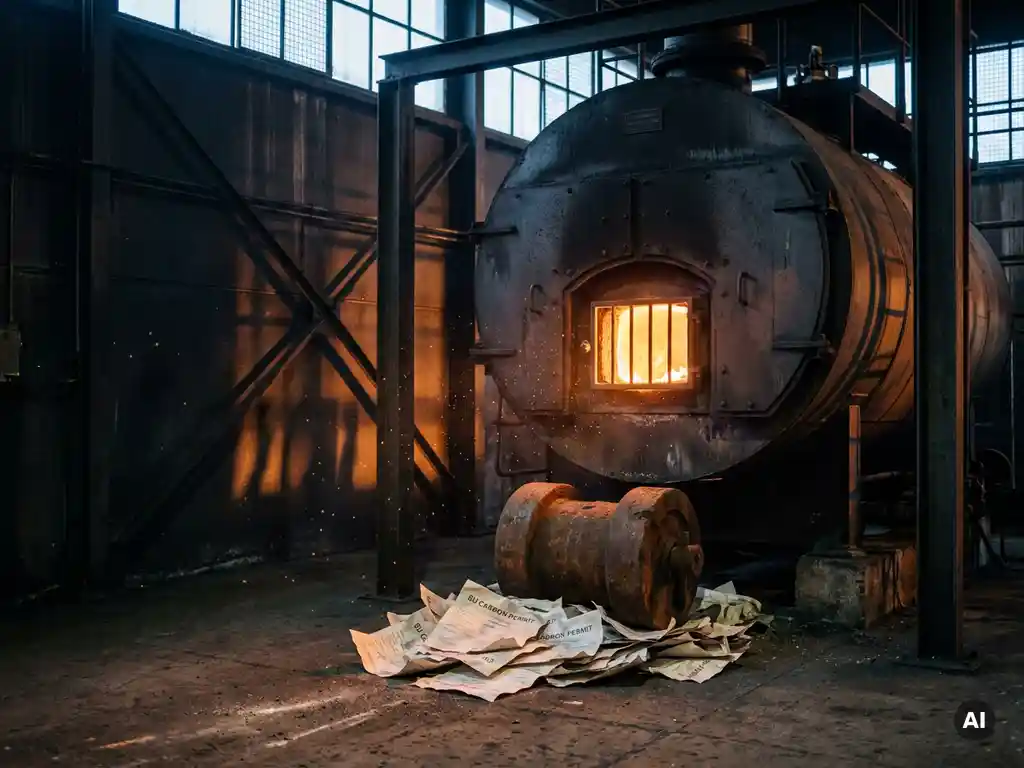
The EU Emissions Trading System creates direct financial pressure on industrial heat producers by putting a price on every tonne of CO₂ they emit. When carbon allowance prices rise, burning fossil fuels to generate heat becomes progressively more expensive, turning what was once an operational cost into a growing balance-sheet liability. The sections below unpack exactly how that pressure builds, where it hits hardest, and what options are available to reduce it.
How much does the EU ETS actually cost industrial heat producers?
The EU ETS charges industrial emitters for every tonne of CO₂ they release by requiring them to hold and surrender emission allowances (EUAs). When carbon prices are elevated, the cost of covering the emissions from a gas-fired boiler running continuously can add up to millions of euros per year for a mid-sized industrial site, making the ETS one of the most significant regulatory cost drivers for energy-intensive manufacturers today.
To put this in practical terms: a facility burning natural gas to generate process heat produces roughly 200 kg of CO₂ per megawatt-hour of thermal energy. At a carbon price of €60 per tonne, a level that has been reached and exceeded in recent years, that translates to around €12 of additional carbon cost per MWh of heat produced, on top of the fuel cost itself. At higher allowance prices, that figure climbs further. For a plant consuming several hundred gigawatt-hours of heat per year, the cumulative ETS exposure becomes a substantial line item that sustainability managers and CFOs cannot ignore.
The key point is that ETS costs are not static. They move with the carbon market, and the structural design of the system is intended to push prices upward over time as the total number of available allowances decreases. This means the financial pressure on fossil-fuel-fired heat generation is not a one-off, it compounds year after year.
Why is industrial heat particularly exposed to carbon pricing?
Industrial heat is especially vulnerable to carbon pricing because it is almost entirely dependent on fossil fuels, generates large volumes of CO₂, and has historically had fewer low-cost decarbonization alternatives than electricity generation. Unlike power producers, who have been able to shift rapidly toward renewables, industrial heat users often need high-temperature, continuous, and reliable heat that wind turbines and solar panels cannot directly provide.
Two-thirds of total industrial energy consumption goes toward heat generation, and approximately 80% of that heat is still produced by burning fossil fuels, primarily natural gas. This structural dependency means that every euro added to the carbon price is felt acutely across the industrial heat sector. Sectors such as Food and Beverage, Specialty Chemicals, and Pulp and Paper are particularly exposed because their processes require sustained high-temperature heat that is difficult to electrify at scale.
There is also a concentration effect: because heat generation is a core, continuous process rather than a peripheral activity, even modest increases in carbon costs per MWh accumulate quickly across a full year of operation. Unlike a company that uses electricity for lighting or office equipment, an industrial heat user cannot simply reduce consumption without directly affecting production output.
What happens to free allowances under the EU ETS over time?
Free allowances under the EU ETS are being systematically reduced and will be phased out entirely for most industrial sectors by 2034. This phase-out is a deliberate policy mechanism: by shrinking the number of allowances distributed at no cost, the EU forces industrial operators to either purchase more allowances on the open market or reduce their emissions. Either way, the financial pressure intensifies with each passing year.
Under the current ETS reform framework, the linear reduction factor, the annual rate at which the total cap on allowances decreases, was increased, meaning fewer allowances enter the system each year. For industrial heat producers who have historically relied on free allocations to offset a significant portion of their carbon costs, this trajectory has a clear implication: the subsidy effect of free allowances is shrinking, and the unhedged cost of emitting CO₂ is growing.
Companies that have built their energy cost models around free allocation need to stress-test those models against a future where purchased allowances represent the full cost of their emissions. The earlier that planning happens, the more options a company retains, including the time needed to evaluate and invest in clean heat solutions before the cost of inaction becomes prohibitive.
How does the EU ETS interact with CBAM for industrial companies?
The Carbon Border Adjustment Mechanism (CBAM) and the EU ETS work together to close a loophole that previously allowed carbon-intensive imports to undercut EU producers who were paying for their emissions. CBAM requires importers of certain goods to pay a carbon price equivalent to what an EU producer would pay under the ETS, effectively extending the carbon cost to the border. For industrial companies inside the EU, this interaction has two sides: protection from unfair competition, and an accelerating incentive to decarbonize.
On the protective side, CBAM reduces the competitive disadvantage that EU manufacturers face when they bear ETS costs while foreign competitors do not. This matters particularly for energy-intensive sectors where heat generation is a major input cost. On the pressure side, CBAM’s introduction is directly linked to the phase-out of free ETS allowances, the EU is removing the free allocation precisely because CBAM provides an alternative form of protection. As free allowances disappear, the full ETS cost lands on the balance sheet.
For sustainability managers, the practical takeaway is that CBAM does not reduce the urgency of decarbonizing industrial heat, it changes the competitive framing. Companies that decarbonize their heat generation can market their products as lower-carbon, which increasingly matters to customers operating their own supply chain emissions targets. The EU’s broader Clean Industrial Deal, which introduces low-carbon requirements for public procurement and sets conditions for investment in strategic sectors, reinforces this direction further.
What decarbonization options reduce ETS exposure for industrial heat?
Several pathways exist to reduce ETS exposure from industrial heat generation, each with different cost profiles, infrastructure requirements, and suitability depending on the process temperature needed. The main options are full electrification, hydrogen combustion, biomass, and emerging carbon-free fuel technologies. No single solution fits every context, but the choice has significant implications for both capital expenditure and long-term operating costs.
- Electrification: Viable for lower-temperature processes, but constrained by grid congestion, high connection costs, and volatile energy prices. For many industrial sites, the electricity infrastructure simply is not in place, and waiting for it introduces operational risk.
- Green hydrogen: Capable of high-temperature heat, but currently expensive to produce, transport, and store. Infrastructure limitations make it impractical for many sites in the near term.
- Biomass: A more established option, but subject to sustainability certification requirements, fuel supply volatility, and increasing regulatory scrutiny around land use and emissions accounting.
- Iron Fuel Technology: A circular, carbon-free alternative that burns iron powder to produce high-temperature heat with near-zero direct CO₂ emissions. Iron fuel is grid-independent, transportable in standard containers, and integrates with existing boiler infrastructure, addressing the key barriers that make electrification and hydrogen difficult for many industrial operators.
The right choice depends on process temperature requirements, site infrastructure, fuel supply security, and the timeline for decarbonization. What is clear is that continuing to rely entirely on fossil fuels means absorbing an increasing carbon cost with no end in sight.
When does the business case for clean heat technology break even under ETS pressure?
The break-even point for clean heat technology under ETS pressure depends on three variables: the upfront capital cost of the clean technology, the carbon price trajectory, and the cost of the alternative fuel being replaced. As carbon prices rise and free allowances shrink, the payback period for investments in decarbonized heat shortens, making the business case stronger the longer a company waits to act, but also more expensive to implement under time pressure.
Consider the structure of the calculation. A clean heat investment has a higher upfront capital cost (CAPEX) than simply continuing to run an existing fossil fuel boiler. But it eliminates or dramatically reduces the ongoing carbon cost (OPEX) that the ETS imposes. As the carbon price increases, the annual savings from avoiding those allowance purchases grow, which accelerates the payback on the initial investment.
There is also a strategic dimension to timing. Industrial capital investments typically have long planning and procurement cycles. A company that begins evaluating clean heat technology today is better positioned to commission a system before the phase-out of free allowances reaches its steepest point. Companies that delay risk being forced into rapid, reactive investment decisions under cost pressure, often at higher prices and with fewer options.
It is also worth noting that funding mechanisms exist to support the transition. The EU Innovation Fund, which has already backed RIFT’s own technology development, is being strengthened as part of the Clean Industrial Deal, with plans for an industrial decarbonisation bank aiming for significant funding to support exactly these kinds of investments. Sustainability managers building the internal business case for clean heat should factor in available grant and subsidy mechanisms alongside the avoided carbon cost.
How Iron Fuel Technology helps reduce ETS exposure
We developed Iron Fuel Technology specifically to address the decarbonization challenge that sustainability managers in energy-intensive industries face every day. For companies where full electrification is blocked by grid congestion, and where hydrogen remains too expensive or too infrastructure-dependent, our Iron Fuel Boiler offers a practical, high-efficiency alternative that directly reduces Scope 1 emissions, and therefore ETS exposure.
Here is what that means in concrete terms:
- Near-zero direct CO₂ emissions: Our Iron Fuel Boiler achieves up to 95% energy efficiency, with only 10 kg of CO₂ per MWhth, stemming solely from a pilot safety flame. This dramatically reduces the volume of allowances a facility needs to surrender under the ETS.
- Grid independence: Iron fuel is transported in standard containers and stored on-site, making it independent of electricity grid infrastructure. This eliminates the security-of-supply risk that comes with electrification in congested grid areas.
- Drop-in compatibility: Our boiler system is designed to integrate with existing industrial setups, reducing the disruption and complexity of transitioning away from fossil fuel heat.
- Circular fuel cycle: Iron powder burns cleanly, leaving only iron oxide, which is regenerated using hydrogen, completing a fully closed-loop process with zero CO₂ from the fuel itself.
- Long-term fuel supply: We provide a long-term fuel supply agreement alongside boiler delivery, giving companies the cost predictability and operational reliability they need to plan with confidence.
If you are building the business case for decarbonizing your industrial heat and want to understand how Iron Fuel Technology fits your specific situation, get in touch with our team to start the conversation.
Frequently Asked Questions
How do I know if my facility is above the EU ETS reporting threshold and actually obligated to participate?
The EU ETS applies to installations above a defined capacity threshold — for combustion installations, this is generally 20 MW of rated thermal input. If your site operates boilers, furnaces, or other combustion equipment above this threshold, you are very likely already covered and required to monitor, report, and surrender allowances annually. The best starting point is to review your site’s existing greenhouse gas monitoring plan or consult your national competent authority, as obligations and sector-specific rules can vary.
What are the most common mistakes industrial companies make when managing their ETS compliance costs?
One of the most common mistakes is treating ETS compliance as a purely administrative task rather than a strategic financial exposure. Companies often underestimate how quickly rising carbon prices and shrinking free allocations compound into material balance-sheet costs. Another frequent error is failing to stress-test energy cost models against future allowance price scenarios, leaving businesses unprepared when prices spike. Starting scenario planning early — ideally with input from both finance and sustainability teams — is the most effective way to avoid reactive, costly decisions down the line.
Can industrial companies buy and bank ETS allowances now to hedge against future price increases?
Yes, EU ETS allowances can be banked indefinitely, meaning companies can purchase allowances today and hold them for use in future compliance years. This is a legitimate and widely used hedging strategy, particularly when companies anticipate that carbon prices will rise or that their free allocation will decrease. However, banking allowances ties up capital and does not reduce underlying emissions, so it is best used as a short-term risk management tool alongside — not instead of — a longer-term decarbonization investment plan.
How does switching to a clean heat technology like Iron Fuel actually affect our ETS compliance reporting in practice?
Switching to a near-zero-emission heat source like an Iron Fuel Boiler directly reduces the volume of CO₂ your facility must report and cover with allowances each compliance year. Since the Iron Fuel Boiler emits only around 10 kg of CO₂ per MWhth — compared to roughly 200 kg for natural gas — the number of EUAs you need to surrender drops dramatically, translating into immediate and recurring cost savings. The transition also reduces your exposure to future allowance price volatility, which improves long-term energy cost predictability for financial planning.
Are there EU funding mechanisms we can combine with a clean heat investment to improve the business case?
Yes, several EU-level funding instruments are specifically designed to support industrial decarbonization investments. The EU Innovation Fund is one of the most relevant, funding large- and small-scale projects that reduce emissions in ETS-covered sectors, and it has already backed Iron Fuel Technology’s development. The upcoming industrial decarbonisation bank announced under the Clean Industrial Deal is expected to expand available capital further. When building your internal business case, it is worth engaging early with these mechanisms, as application timelines can be long and grant funding can significantly improve project economics.
What if our process requires very high temperatures — does that limit our decarbonization options under the ETS?
High-temperature process heat is indeed one of the harder decarbonization challenges, and it is a key reason why electrification alone is not a universal solution — heat pumps, for example, are generally limited to temperatures below 200°C. However, technologies like Iron Fuel combustion and green hydrogen are specifically capable of delivering the high-temperature heat that sectors such as Specialty Chemicals and Pulp and Paper require. The practical question is which of these is viable for your site today given infrastructure, cost, and supply chain constraints — and that assessment is worth beginning now, before ETS pressure forces a rushed decision.
How should sustainability managers make the internal business case for clean heat investment to their CFO?
The most compelling internal business case frames clean heat investment not as a sustainability expense but as a risk mitigation and cost-avoidance strategy. Present the current and projected annual ETS cost under a business-as-usual scenario — using conservative, base, and high carbon price assumptions — and compare that against the annualised CAPEX and OPEX of a clean heat alternative. Factor in the shrinking free allowance trajectory, available grant funding, and the strategic value of lower-carbon products for customers with their own supply chain emissions targets. Framing the conversation around payback period, carbon cost avoidance, and competitive positioning tends to resonate more strongly with finance leadership than emissions reduction targets alone.
Related Articles
- How do you build a business case for decarbonizing industrial heat in 2026?
- How does renewable energy affect the environment?
- What is energy independence and how do renewables enable it?
- How much of America's energy is clean?
- What are the 7 types of renewable energy?
This content was generated with the help of AI and it may contain mistakes