

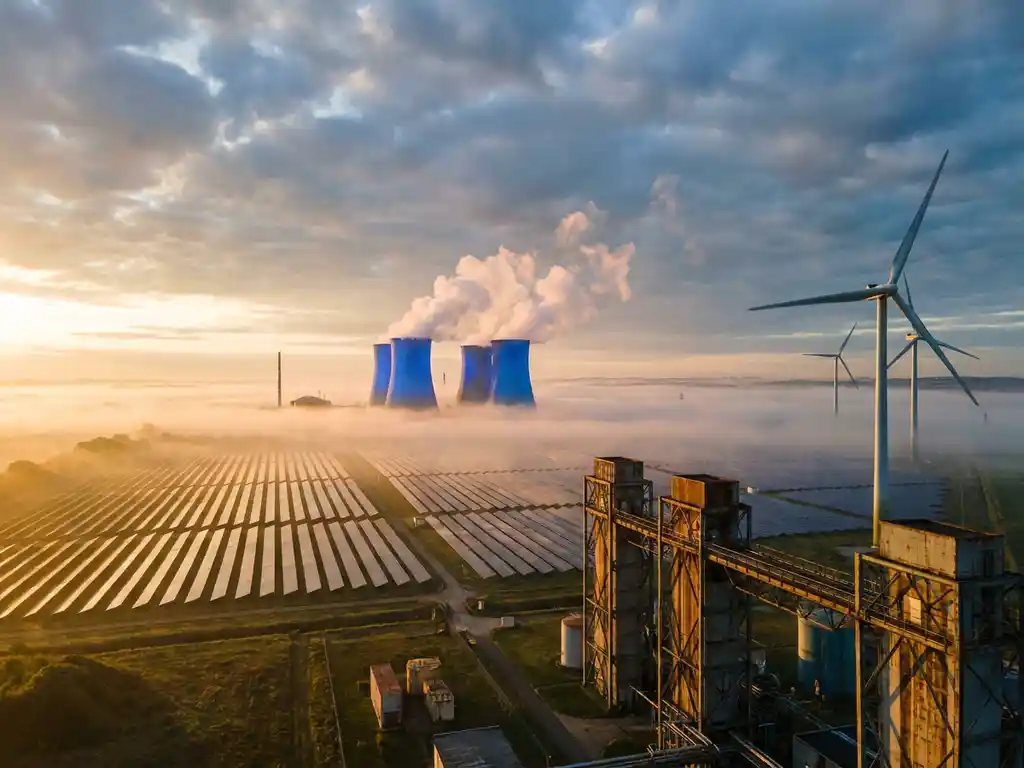
Nuclear energy and renewable energy are both low-carbon electricity sources, but they work in fundamentally different ways. Nuclear power splits atoms to generate heat, which drives turbines. Renewables such as solar, wind, and hydro convert natural energy flows directly into electricity. The key differences lie in their emissions profiles, reliability, costs, land use, and—critically for industry—their ability to decarbonize heat, not just electricity.
Treating nuclear and renewables as interchangeable is slowing down your decarbonization plan
Many sustainability managers group nuclear and renewable energy together under the “clean energy” umbrella and move on. That shortcut creates real problems when you are building a decarbonization roadmap. Nuclear provides reliable baseload power but can take decades and billions to build. Renewables are faster to deploy but intermittent. Neither automatically solves your industrial heat challenge, which is where the majority of industrial emissions actually come from. The fix is to stop treating the energy type as the decision and start asking what each source can actually deliver for your specific processes.
Focusing only on electricity is leaving your biggest emissions source untouched
Two-thirds of all industrial energy consumption goes toward heat generation, and roughly 80% of that heat still comes from fossil fuels. If your decarbonization strategy is built around switching to clean electricity, you are addressing the smaller part of the problem. The harder, larger challenge is high-temperature process heat—and neither nuclear nor conventional renewable electricity solves that directly for most industrial operators. Before comparing energy types, it is worth asking whether the solution you are evaluating can actually reach your boilers and furnaces.
How does nuclear energy generate power compared to renewables?
Nuclear energy generates power through fission: uranium atoms are split inside a reactor, releasing heat that boils water into steam, which spins a turbine to produce electricity. Renewable energy sources convert naturally occurring energy flows—sunlight, wind, moving water—into electricity, usually without combustion or steam generation. The core difference is that nuclear relies on a controlled chain reaction, while renewables tap into ambient natural forces.
Because nuclear plants run continuously regardless of weather or time of day, they provide what grid operators call baseload power. A nuclear plant operates at high capacity factors, often above 90%, meaning it generates close to its rated output around the clock. Solar panels generate power only when the sun shines. Wind turbines spin only when the wind blows. This intermittency is the central operational challenge for renewables at scale.
Renewables compensate through diversity and storage. Combining solar, wind, and hydro across a wide geography smooths out variability at individual sites. Battery storage and pumped hydro add further flexibility. But the intermittency gap has not been fully closed, which is why grid operators still rely on dispatchable power sources—including nuclear—to maintain stability.
Which is cleaner: nuclear energy or renewable energy?
Both nuclear and renewable energy produce very low lifecycle carbon emissions compared to fossil fuels. On a grams of CO₂ equivalent per kilowatt-hour basis, nuclear, wind, and solar all perform similarly well—far below coal or natural gas. The differences between them are small relative to the gap between either and fossil fuels. Neither is definitively “cleaner” across every metric.
Where they differ is in the type of environmental concern. Nuclear produces radioactive waste that requires long-term storage—a challenge without a fully resolved solution in most countries. Renewables have land-use implications, particularly solar farms and wind installations, and manufacturing solar panels involves energy-intensive processes with their own emissions footprint.
Nuclear also carries the reputational weight of accident risk, even though modern reactor designs have made major incidents extremely rare. Renewables avoid that concern but introduce supply-chain dependencies on critical minerals such as lithium, cobalt, and rare earths—materials with their own extraction and geopolitical complications.
What are the main advantages and disadvantages of each energy type?
Nuclear and renewable energy each have distinct strengths and weaknesses. Nuclear offers reliable, high-density, low-carbon power but is expensive and slow to build. Renewables are faster to deploy and increasingly cost-competitive but face intermittency and storage challenges. Neither is a universal solution.
Here is a side-by-side breakdown:
- Nuclear advantages: Consistent baseload output, high energy density, small land footprint per unit of energy, very low operational emissions
- Nuclear disadvantages: High upfront capital costs, long construction timelines (often 10 to 20 years), radioactive waste management, public opposition in many regions
- Renewable advantages: Rapidly falling costs, modular and scalable deployment, no fuel costs, no radioactive waste, broad public acceptance
- Renewable disadvantages: Intermittent generation, storage requirements, land intensity for large-scale deployment, grid integration complexity
For industrial operators, both energy types share a critical limitation: they primarily generate electricity. Most industrial processes require heat—often at temperatures that electric systems struggle to reach cost-effectively, and that neither nuclear nor conventional renewables can supply directly without significant infrastructure investment.
Can nuclear or renewable energy decarbonize industrial heat?
Nuclear and renewable energy can contribute to industrial heat decarbonization, but neither does so simply or directly. Electrification of heat is theoretically possible using electric boilers or heat pumps, but high-temperature processes—above 400°C—are difficult and expensive to electrify. Nuclear-derived heat has been proposed but requires co-location with reactors, which is impractical for most industrial sites.
The challenge is not just about the energy source—it is about the form the energy takes and how it reaches the process. Steam, hot air, and high-temperature heat at industrial scale require either combustion or very high-power electrical systems. For temperatures above 1,000°C, which are common in ceramics, chemicals, and metals processing, current electrification options are limited and often prohibitively expensive.
Hydrogen combustion is one pathway that can reach these temperatures, but hydrogen infrastructure is still developing, and costs remain high in most markets. This is precisely why alternative combustion fuels that can slot into existing boiler infrastructure are attracting serious attention. Iron Fuel Technology is one example: iron powder burns at up to 2,000°C with zero direct CO₂ emissions, producing only iron oxide as a byproduct—which can then be regenerated back into fuel using hydrogen.
What is the best clean energy option for industrial companies today?
There is no single best clean energy option for industrial companies—the right choice depends on your process temperatures, existing infrastructure, energy costs, and decarbonization timeline. That said, the most practical near-term path for industrial heat decarbonization is usually a combination of approaches rather than a single technology replacing everything at once.
For electricity-based needs, renewable energy is increasingly the cost-effective choice. For baseload power in energy-intensive industries, nuclear remains relevant where it is already available. But for process heat—the dominant energy use in most industrial facilities—neither nuclear nor renewables offer a direct, infrastructure-compatible solution today.
The most promising near-term options for industrial heat decarbonization share a few characteristics:
- Compatibility with existing infrastructure: Solutions that integrate with current boiler systems reduce capital expenditure and deployment time significantly.
- High-temperature capability: The fuel or system must reach the temperatures your processes actually require, not just what is convenient to generate.
- Reliable fuel supply: Industrial operations cannot tolerate intermittency—a dependable, storable fuel is a practical requirement.
- Clear emissions reduction: The solution must deliver measurable Scope 1 reductions to satisfy regulatory requirements and internal targets.
For many industrial operators in sectors such as food and beverage, specialty chemicals, and pulp and paper, the answer is a technology that can replace or complement fossil-fuel boilers without requiring a complete infrastructure overhaul. That is where clean combustion alternatives such as iron fuel become relevant—filling a gap that electrification and hydrogen are not yet able to fill at scale.
How RIFT helps with industrial heat decarbonization
We developed Iron Fuel Technology specifically for the industrial heat challenge that nuclear and renewables cannot easily solve. Our Iron Fuel Boiler burns iron powder to generate heat at up to 2,000°C with zero direct CO₂ emissions and ultra-low NOₓ, and it is designed to work alongside your existing boiler infrastructure, not replace it entirely.
- Up to 95% energy efficiency, outperforming many fossil-fuel systems
- Zero direct CO₂ emissions from iron fuel combustion
- Drop-in compatible with existing industrial boiler setups
- Long-term fuel supply agreements for operational reliability
- Already demonstrated at megawatt scale at Technology Readiness Level 7 in the Netherlands
If you are evaluating clean energy options for your industrial heat processes and want to understand whether iron fuel fits your operations, get in touch with our team, and we will walk you through the specifics.
Related Articles
- Which country is closest to net zero?
- What does the Department of Energy do?
- What role does renewable energy play in fighting climate change?
- How does renewable energy create jobs?
- What are the 7 types of renewable energy?
This content was generated with the help of AI and it may contain mistakes