

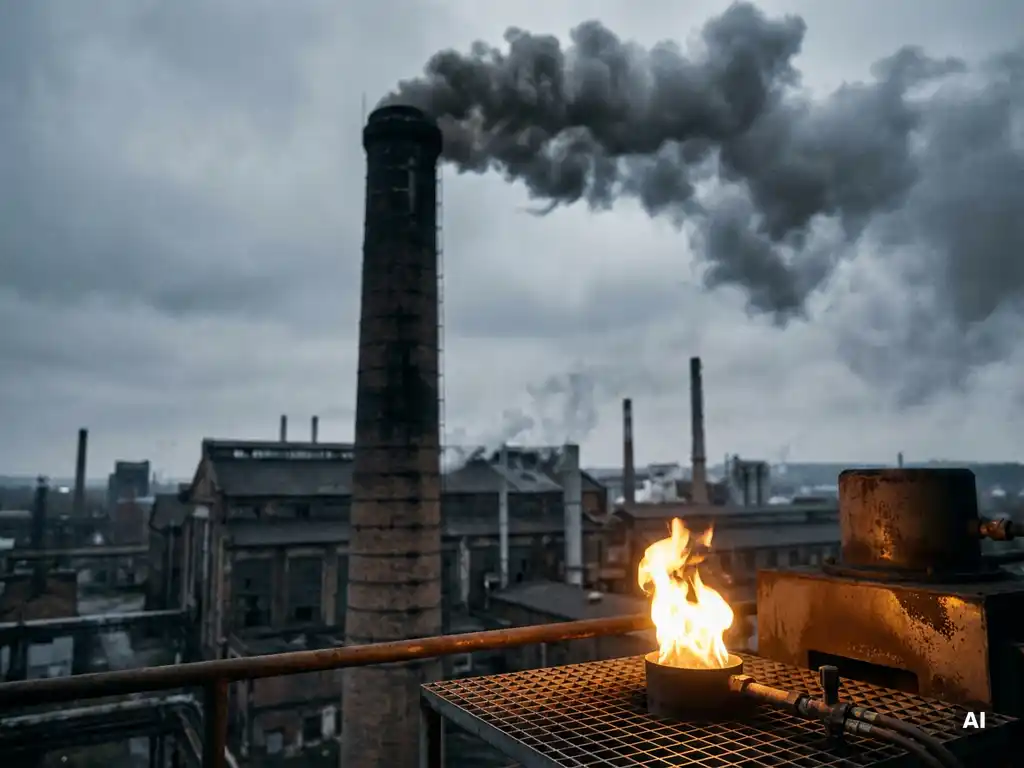
The EU Emissions Trading System (EU ETS) is a carbon pricing mechanism that requires industrial companies operating in Europe to hold allowances for every tonne of CO₂ they emit. If you emit more than your allowances cover, you pay. If you reduce emissions, you can sell surplus allowances. For manufacturers running fossil-fuel-fired processes, this creates a direct and growing financial pressure to decarbonize. The sections below walk through how the system works, who it covers, and what your options are as a manufacturer navigating its requirements.
How does the EU Emissions Trading System actually work?
The EU ETS works on a “cap and trade” principle. The EU sets a total cap on the amount of greenhouse gases that covered industries can emit each year. Companies receive or purchase allowances, each one permitting the emission of one tonne of CO₂ equivalent. At the end of each compliance year, every covered company must surrender enough allowances to match its actual emissions. The cap decreases over time, making allowances progressively scarcer and more valuable.
Companies that reduce their emissions below their allowance level can sell or bank their surplus. Companies that exceed their allowances must buy more on the carbon market. This creates a direct financial incentive to cut emissions: the lower your carbon output, the lower your compliance cost, or the more you can earn by selling unused allowances.
The price of allowances fluctuates based on supply and demand across the market. When energy prices spike or industrial output rises, demand for allowances increases and prices follow. This connection between volatile energy prices and carbon costs means manufacturers face a compound exposure: paying more for fossil fuels and more for the emissions those fuels generate at the same time.
Which industries and facilities are covered by the EU ETS?
The EU ETS covers large industrial facilities and power generators across the EU that exceed specific emissions thresholds. Since its expansion under the Fit for 55 package, coverage has broadened significantly. The system currently applies to sectors including power generation, steel, cement, glass, ceramics, paper and pulp, chemicals, and aviation within the European Economic Area.
For manufacturers specifically, the threshold that triggers inclusion is typically a thermal rated input of more than 20 megawatts. This captures a wide range of industrial boilers, furnaces, and combustion installations. Facilities in the food and beverage, specialty chemicals, and pulp and paper sectors, industries where high-temperature heat is central to production, fall squarely within scope.
It is also worth noting that the EU ETS has been extended beyond its original industrial perimeter. A separate ETS II system now covers emissions from buildings and road transport, and the revenues generated from this extension are earmarked in part for social climate measures. For industrial manufacturers, however, the original ETS remains the primary compliance framework, and its requirements are tightening year on year.
How does a rising carbon price affect manufacturing costs?
A rising carbon price directly increases the cost of burning fossil fuels in any ETS-covered facility. Every tonne of CO₂ emitted from a gas boiler, oil burner, or coal-fired furnace requires a corresponding allowance. As the EU tightens the cap and free allocations are phased out, the market price per allowance rises, and that cost feeds straight into a manufacturer’s energy bill and production economics.
The practical effect compounds across several cost lines:
- Direct compliance costs: Purchasing allowances to cover actual emissions becomes an increasingly significant operational expense as the carbon price rises.
- Indirect energy cost exposure: Electricity prices already embed carbon costs from power generators, adding a second layer of exposure for facilities that use both heat and electricity.
- Capital planning pressure: The longer a facility delays decarbonization investment, the more it spends on allowances in the interim, shifting the CAPEX versus OPEX calculation toward earlier action.
- Competitiveness risk: Competitors who decarbonize earlier face lower compliance costs, creating a structural cost advantage over time.
For sustainability managers, this means the EU ETS is no longer a distant regulatory concern, it is a live input into energy procurement decisions, capital budgets, and long-term operational planning.
What happens if a company exceeds its emissions allowances?
If a company emits more CO₂ than it holds allowances for, it faces an automatic financial penalty and must still surrender the missing allowances in the following year. The penalty under the EU ETS is currently set at €100 per tonne of excess emissions, indexed to inflation. This is in addition to, not instead of, the obligation to surrender the shortfall, so the cost of non-compliance is both punitive and cumulative.
Beyond the immediate financial hit, exceeding allowances creates reputational and regulatory risk. Persistent non-compliance can attract scrutiny from national enforcement authorities, complicate access to green financing, and undermine a company’s credibility with customers and investors who are increasingly scrutinizing supply chain emissions.
For manufacturers running fossil-fuel-intensive heat processes, the risk of exceeding allowances grows as the cap tightens. Proactive monitoring, robust energy management systems, and early investment in lower-carbon heat sources are the most reliable ways to stay on the right side of compliance.
How are free allowances being phased out under ETS reforms?
Free allowances, the allocations that historically shielded energy-intensive industries from the full cost of carbon, are being progressively reduced under the EU ETS reform agreed as part of the Fit for 55 package. The phase-out is structured to accelerate through the late 2020s and into the 2030s, with full auctioning replacing free allocation for most sectors over time.
The pace of phase-out is linked to the introduction of the Carbon Border Adjustment Mechanism (CBAM), which imposes a carbon price on imports of certain goods from countries without equivalent carbon pricing. As CBAM takes effect, the justification for free allowances as a competitiveness shield weakens, and the European Commission has used this transition to accelerate their removal.
For manufacturers in sectors like steel, chemicals, and paper, this means the financial buffer they have relied on is shrinking on a known and published timeline. The implication is straightforward: the effective carbon cost per unit of production will rise even if the allowance market price stays flat, simply because fewer allowances are being handed out for free. Planning decarbonization investment around this trajectory, rather than waiting for the pressure to peak, is increasingly the prudent approach.
What decarbonisation options are available to ETS-covered manufacturers?
ETS-covered manufacturers have several pathways to reduce their carbon exposure, ranging from incremental efficiency improvements to full fuel switching. The right combination depends on the temperature requirements of the process, available infrastructure, capital budgets, and timeline. The main options include:
- Energy efficiency improvements: Reducing energy consumption through better insulation, heat recovery, and process optimization lowers the volume of fuel burned and therefore the number of allowances needed. The revised EU Energy Efficiency Directive now requires energy audits for all companies above a certain consumption threshold, regardless of size, making this a regulatory baseline as much as a decarbonization strategy.
- Electrification: Switching heat generation to electric systems, heat pumps, electric boilers, or resistance heating, can eliminate direct combustion emissions. However, electrification is constrained by grid congestion in many industrial regions, high connection costs, and the challenge of achieving the high process temperatures that many industries require. Security of supply is also a concern where grid reliability is uncertain.
- Hydrogen: Green hydrogen can replace natural gas in combustion processes. The replacement of natural gas with hydrogen is technically feasible in many boiler configurations, but hydrogen infrastructure remains underdeveloped in most industrial areas, and the delivered cost of green hydrogen is still significantly higher than fossil alternatives in most markets.
- Carbon capture: Retrofitting facilities with carbon capture and storage (CCS) technology can reduce net emissions from existing fossil fuel processes. The capital intensity and operational complexity of CCS make it a realistic option mainly for very large facilities with long operational lifespans.
- Alternative fuels and heat carriers: Emerging clean energy carriers, including iron fuel, offer a path to decarbonization of industrial heat without requiring grid upgrades or hydrogen infrastructure. These solutions are particularly relevant for processes requiring high-temperature heat where electrification is impractical.
No single option is right for every facility. Many manufacturers will pursue a combination, phasing investments over time as technology matures and carbon costs rise. The key is to start with a clear picture of your current emissions profile, process heat requirements, and the timeline over which your free allowances will disappear. You can explore industrial heat decarbonization solutions suited to different operational contexts to see how different technologies compare against your specific constraints.
How Iron Fuel Technology helps manufacturers manage EU ETS pressure
For manufacturers facing rising carbon costs under the EU ETS, we at RIFT offer a practical alternative to fossil-fuel-fired heat that avoids the infrastructure barriers of electrification and hydrogen. Our Iron Fuel Boiler is designed to integrate with existing industrial setups and deliver high-temperature heat with zero direct CO₂ emissions, addressing Scope 1 emissions directly, which is where ETS compliance pressure lands hardest.
Here is what makes Iron Fuel Technology relevant specifically in the context of EU ETS compliance:
- Zero direct CO₂ during combustion: The only CO₂ output from our boiler system stems from a pilot safety flame, resulting in just 10 kg of CO₂ per MWhth, a fraction of what any fossil fuel alternative produces. This dramatically reduces the allowances a facility needs to surrender each year.
- No grid dependency: Unlike electrification, Iron Fuel Technology operates independently of the electricity grid, avoiding grid congestion issues and maintaining security of supply.
- Up to 95% energy efficiency: Our Iron Fuel Boiler achieves up to 95% energy efficiency, outperforming many traditional fossil fuel systems and reducing overall energy input requirements.
- Drop-in compatibility: The boiler is designed to complement existing infrastructure, meaning manufacturers do not need to overhaul their entire heat generation setup to start reducing ETS exposure.
- Long-term fuel supply certainty: We offer long-term iron fuel supply agreements, giving manufacturers predictable fuel costs, a meaningful advantage against the volatility of fossil fuel and carbon allowance markets.
Our technology is demonstrated at TRL7 (megawatt-industrial scale), and we have already signed the first commercial contract worldwide for industrial Iron Fuel use, with Kingspan Unidek. If you are evaluating how to reduce your facility’s carbon exposure under the EU ETS, we would be glad to discuss whether Iron Fuel Technology is a fit for your process. Get in touch with our team to start the conversation.
Frequently Asked Questions
How do I calculate how many EU ETS allowances my facility actually needs each year?
Start by establishing your facility’s annual CO₂ emissions through a verified monitoring plan aligned with the EU ETS Monitoring and Reporting Regulation (MRR). This involves tracking fuel consumption by type, applying published emission factors, and accounting for any process emissions beyond combustion. Most national competent authorities provide templates and guidance, and many manufacturers work with an accredited verifier to ensure their monitoring methodology is compliant before the first surrender deadline.
What is the difference between auctioned allowances and free allocations, and how do I know which applies to my facility?
Free allocations are allowances granted at no cost to eligible industrial facilities based on benchmarks set by the European Commission, historically used to protect energy-intensive industries from carbon leakage. Auctioned allowances must be purchased on the carbon market. Whether your facility qualifies for free allocations depends on your sector, its carbon leakage status, and the applicable benchmark for your production process. Your national competent authority administers the allocation process, and the published National Implementation Measures (NIMs) for your country will specify what your facility is entitled to for each trading period.
What are the most common compliance mistakes manufacturers make under the EU ETS, and how can I avoid them?
The most frequent pitfalls include using incorrect or outdated emission factors in monitoring plans, failing to update the plan when processes change, and leaving allowance procurement too late in the compliance year when market prices may be elevated. A second common mistake is underestimating the pace at which free allocations are being reduced, leading to budget surprises as the gap between allocated and required allowances widens. Building a rolling 12-month forward view of your emissions position and allowance balance, and reviewing your monitoring plan annually, are the most reliable ways to stay ahead of these issues.
How should I factor EU ETS carbon costs into my capital investment decisions for new or upgraded heat equipment?
The key is to model carbon costs not at today’s allowance price but across a forward price range that reflects the tightening cap and phase-out of free allocations through the 2030s. For any heat equipment with a 10–20 year operational lifespan, locking in a fossil fuel combustion process today means absorbing rising compliance costs for the full asset life. A robust business case should compare the total cost of ownership — capital, fuel, and allowance costs combined — for fossil fuel options against lower-carbon alternatives, using a carbon price sensitivity analysis that includes scenarios well above current spot prices.
Can a manufacturer bank surplus allowances for future use, or do unused allowances expire?
Yes, banking of surplus allowances is permitted under the EU ETS and is a legitimate compliance strategy. Allowances do not expire at the end of a compliance year; they can be held and used in future years, which incentivises early emissions reductions. However, there are rules governing the transition between trading phases, and the Market Stability Reserve (MSR) mechanism can absorb excess allowances from the market under certain conditions, which affects the long-term value of banked allowances. Manufacturers with a genuine surplus should factor MSR dynamics into any decision to bank rather than sell.
How does the Carbon Border Adjustment Mechanism (CBAM) affect manufacturers who export goods outside the EU?
CBAM primarily targets importers bringing goods into the EU from countries without equivalent carbon pricing, not EU-based exporters. However, the mechanism is directly linked to the phase-out of free allocations for EU manufacturers: as CBAM reduces the competitiveness argument for protecting domestic producers with free allowances, those allocations are being removed on an accelerating schedule. For EU manufacturers who compete globally, the more relevant concern is that their non-EU competitors selling into other markets will not face the same carbon cost burden, which reinforces the strategic case for investing in genuinely lower-cost, lower-carbon production processes rather than simply managing compliance costs.
Where can I get independent support to assess my facility's EU ETS compliance position and decarbonization options?
National competent authorities in each EU member state are the primary regulatory point of contact and publish guidance specific to their jurisdiction. For technical and strategic support, accredited MRV (Monitoring, Reporting and Verification) consultants can audit your current compliance setup, while energy and decarbonization consultancies can model your options across fuel switching, efficiency, and alternative heat technologies. Industry associations in sectors such as steel, chemicals, and paper also publish sector-specific guidance on navigating ETS reforms, and the European Commission’s own ETS guidance documents are regularly updated to reflect the latest regulatory changes under the Fit for 55 package.
Related Articles
- How can Dutch manufacturers use VEKI to fund decarbonization projects?
- Is clean energy really clean?
- Why is it important for companies to go green?
- Can renewable energy reduce dependence on energy imports?
- What is renewable energy?
This content was generated with the help of AI and it may contain mistakes