

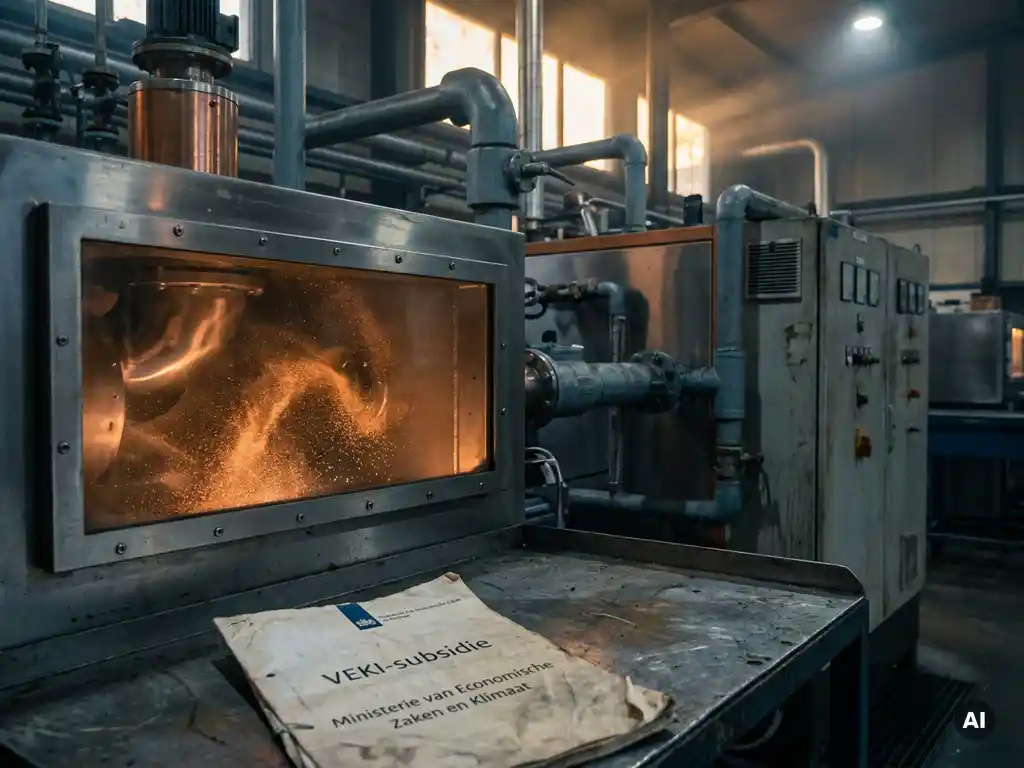
Dutch manufacturers can use the VEKI subsidy, officially known as the Versnelde Klimaatinvesteringen Industrie (VEKI) scheme, administered by RVO, to co-fund investments that reduce CO₂ emissions in industrial production processes in the Netherlands. The scheme targets companies whose decarbonization projects have a payback period of more than five years without public support, making it especially relevant for capital-intensive clean heat transitions. Below, we answer the most common questions sustainability managers ask about VEKI, from eligible costs to the application process.
What does VEKI actually cover for industrial heat projects?
VEKI covers both investment costs and operational costs related to measures that deliver an absolute reduction in CO₂ or equivalent greenhouse gas emissions from Dutch industrial processes by 2030. The subsidy applies to production installations located in the Netherlands, and the project must demonstrably cut emissions compared to the current fossil fuel baseline. Projects fall into two categories: Category A, which focuses on direct emission savings through large-scale process efficiency, electrification, or hydrogen, and Category B, which targets the replacement of primary fossil carbon in the product chain.
For sustainability managers working on industrial heat decarbonization, this means that switching away from natural gas-fired boilers, one of the most carbon-intensive aspects of manufacturing, sits squarely within VEKI’s scope. The scheme recognizes CO₂-equivalent emissions too, including methane, nitrous oxide, HFCs, PFCs, and SF6, so the eligible impact is broader than direct CO₂ alone.
Importantly, VEKI does not cover every type of clean energy project. The following are explicitly excluded:
- Applications with a bid above €300 per tonne of CO₂ avoided
- New infrastructure construction projects
- Combined heat and power (CHP) energy production
- Hydrogen production through electrolysis
- Electricity generation from hydrogen
- Recycling projects that result in a lower quality output than conventional methods
- Technologies already listed on the mandatory technology list (MJA/MEE)
How much funding can Dutch manufacturers claim through VEKI?
The amount of VEKI funding a manufacturer can claim depends on the difference between the cost price of the decarbonized production method and the market price of the resulting output. There is no fixed percentage grant rate, instead, the subsidy is calculated using mandatory RVO calculation models that quantify both the CO₂ reduction achieved and the financial support required to make the project viable. The minimum financial support threshold is €30 million per application.
This minimum threshold is a significant filter. It means VEKI is designed for large-scale industrial transformations, not incremental efficiency upgrades. For manufacturers planning a meaningful shift away from fossil-fueled heat, such as replacing multiple gas-fired boilers or restructuring an entire steam generation system, the scale requirement is more likely to be met.
The subsidy covers both investment and operational costs, which is a meaningful advantage when evaluating the CAPEX versus OPEX balance of a decarbonization project. Many clean heat technologies carry high upfront capital costs but lower long-term running costs; VEKI’s dual coverage helps bridge that gap. The calculation methodology is fixed and must be applied consistently, so engaging a subsidy advisor early in the process is strongly recommended to ensure your financial model aligns with RVO’s requirements.
Which decarbonization technologies qualify for VEKI support?
VEKI supports technologies that deliver direct CO₂ savings in industrial production processes, with eligible themes including large-scale process efficiency improvements, electrification, and hydrogen. Technologies that replace primary fossil carbon in the production chain also qualify under Category B. The key eligibility test is not the technology itself, but whether it produces a measurable, absolute reduction in greenhouse gas emissions in the Netherlands by 2030.
This means that innovative clean heat solutions, including those that address the limitations of electrification and hydrogen in energy-intensive industries, can qualify, provided they meet the emissions reduction and financial criteria. For sectors like Food and Beverage, Specialty Chemicals, and Pulp and Paper, where clean heat solutions need to deliver reliable high-temperature output without full grid dependency, VEKI’s technology-neutral framing is an advantage.
Technologies that are already mandated under existing agreements (such as the MJA or MEE long-term energy efficiency agreements) are not eligible, VEKI is intended to accelerate investments that go beyond business-as-usual. Grid congestion is also a relevant factor here: technologies that do not rely on additional electricity grid capacity may have a practical advantage in the current Dutch infrastructure landscape, where grid access is increasingly constrained.
How do you apply for a VEKI subsidy in the Netherlands?
Applying for VEKI involves several preparation steps before you can submit through RVO’s Mijn RVO portal. The process is structured and document-intensive, so starting early is essential. Here is the sequence to follow:
- Complete basic engineering: Your project’s basic engineering phase must be finished before you apply. This forms the foundation for all emission reduction and subsidy calculations.
- Run the mandatory calculation models: RVO requires you to use the NIKI CO₂ emission reduction model and the NIKI subsidy calculation model (found in annexes 4.13.2 and 4.13.3 of the scheme). These are non-negotiable, you cannot substitute your own methodology.
- Prepare your documentation: You will need a project plan, a climate plan, and an auditor’s statement. You must also provide a declaration confirming your company is not “in financial difficulty” under EU state aid rules.
- Arrange eHerkenning access: Logging in to Mijn RVO requires eHerkenning at level 3 or higher with RVO services authorization. If you do not have this yet, request it in advance, it can take several days to process.
- Submit during the open application window: VEKI opens in rounds. A new round is expected in autumn 2026. Monitor the RVO website or sign up for email notifications. A project idea assessment (projectideetoets) can already be requested ahead of the formal opening.
- Start the project within one year of approval: Once a positive decision is issued, you must begin the project within 12 months and commission the installation within four years, followed by a 10-year operational period.
Engaging a certified subsidy advisor (intermediair) is permitted and often advisable for large, complex applications. Advisors can be authorized to submit on your behalf through Mijn RVO.
Can VEKI funding be combined with other Dutch or EU grants?
Yes, VEKI funding can in principle be combined with other public funding instruments, but the total public support across all schemes must remain within the applicable EU state aid limits for your project category. In practice, many Dutch industrial decarbonization projects are structured to layer multiple funding sources, for example, combining VEKI with EU Innovation Fund support or regional development funds, provided the combined subsidy does not exceed the maximum allowable aid intensity and the costs being covered do not overlap.
The EU Emissions Trading System (EU ETS) is a related but separate mechanism. ETS carbon costs can strengthen the business case for decarbonization investments by making fossil fuel operations more expensive over time, but ETS allowances are not a direct funding source for capital investment. They do, however, influence the financial modelling that underpins a VEKI application, particularly when demonstrating the gap between decarbonized and conventional production costs.
Security of supply considerations also play a role in how manufacturers frame their funding strategy. Technologies that reduce dependence on volatile natural gas prices and address grid congestion risks can present a stronger overall investment case when combining VEKI with other instruments focused on energy resilience and independence.
How Iron Fuel Technology can support your VEKI application
If you are a Dutch manufacturer evaluating VEKI as a funding route for your heat decarbonization project, Iron Fuel Technology may be the solution that makes your application viable. Our Iron Fuel Boiler is designed specifically for industrial heat users who need a practical, high-efficiency alternative to natural gas, one that works independently of the electricity grid and integrates with existing boiler infrastructure.
Here is why Iron Fuel Technology is worth considering alongside a VEKI application:
- Zero direct CO₂ during combustion — the boiler produces up to 95% energy efficiency with just 10 kg of CO₂ per MWhth, stemming only from a pilot safety flame
- No grid dependency — iron fuel is stored and transported as a solid powder, making it independent of electricity grid capacity constraints
- Drop-in compatible — the Iron Fuel Boiler is designed to complement existing fossil fuel boiler systems, reducing the complexity and cost of transition
- Circular and secure supply — iron fuel regenerates from iron oxide using hydrogen, creating a closed loop with predictable, long-term fuel supply agreements
- Demonstrated at TRL 7 — our technology has been validated at megawatt-industrial scale in the Netherlands, providing the engineering foundation a VEKI application requires
We work with sustainability managers in Food and Beverage, Specialty Chemicals, and Pulp and Paper to build the technical and financial case for clean heat transitions. Want to explore whether an Iron Fuel Boiler project could qualify for VEKI support? Get in touch with our team and we will help you assess the fit.
Frequently Asked Questions
What is the difference between VEKI Category A and Category B, and how do I know which one applies to my project?
Category A targets direct emission savings through measures like large-scale process efficiency improvements, electrification, or switching to hydrogen in your production process — for example, replacing gas-fired boilers with a zero-emission heat source. Category B applies when you are replacing primary fossil carbon within the product chain itself, such as using bio-based or circular feedstocks instead of fossil-derived raw materials. If your project is focused on industrial heat decarbonization, Category A is almost certainly your starting point. When in doubt, a project idea assessment (projectideetoets) submitted to RVO before the formal application window opens can help you confirm the right category.
Our project is below the €30 million minimum threshold — are there alternative Dutch subsidies we should look at instead?
Yes. If your decarbonization investment falls below VEKI’s €30 million minimum support threshold, the SDE++ (Stimulering Duurzame Energieproductie en Klimaattransitie) scheme is the most relevant alternative for industrial heat producers, as it supports a broader range of project sizes. The DEI+ (Demonstratie Energie- en Klimaatinnovatie) scheme is also worth exploring if your technology is at an earlier commercial stage and you need funding for a demonstration or pilot project. For smaller manufacturers, the MIA/Vamil scheme offers fiscal incentives for environmentally friendly investments that may not meet VEKI’s scale requirements.
How long does the VEKI application and approval process typically take, and when should we start preparing?
The VEKI process is structured around formal application rounds, with the next round expected in autumn 2026, meaning preparation should begin well in advance — ideally 12 to 18 months before the opening date. Basic engineering must be completed, RVO’s mandatory NIKI calculation models must be run, and all supporting documentation (project plan, climate plan, auditor’s statement) must be ready before submission. The review and decision period by RVO can add further months after submission. Starting early also gives you time to request a project idea assessment, secure eHerkenning access, and engage a certified subsidy advisor without rushing critical steps.
What are the most common reasons VEKI applications are rejected or scored poorly?
The most frequent pitfalls include using non-standard financial models instead of RVO’s mandatory NIKI calculation tools, submitting before basic engineering is complete (which undermines the credibility of your emission reduction claims), and failing to demonstrate that the project would not proceed without public support — the so-called incentive effect. Applications also struggle when the bid price exceeds €300 per tonne of CO₂ avoided, or when the technology is already covered under mandatory MJA or MEE agreements. Engaging a certified subsidy advisor (intermediair) early significantly reduces the risk of these errors, particularly for first-time applicants.
Does grid congestion in the Netherlands affect our VEKI eligibility or the strength of our application?
Grid congestion does not directly affect VEKI eligibility, but it has a practical impact on which technologies are viable and how strong your application looks in context. Projects that rely heavily on new grid connections or large increases in electricity demand may face delays or feasibility risks that weaken the investment case presented to RVO. Technologies that operate independently of the electricity grid — such as iron fuel combustion or other fuel-based clean heat solutions — can sidestep this constraint entirely, which both simplifies project planning and strengthens the overall bankability argument in your VEKI submission.
Can a foreign-owned manufacturer with production facilities in the Netherlands apply for VEKI?
Yes. VEKI eligibility is based on the location of the production installation, not the nationality or ownership structure of the company. As long as the industrial facility is located in the Netherlands and the project delivers a measurable reduction in greenhouse gas emissions from Dutch industrial processes by 2030, foreign-owned manufacturers are eligible to apply. However, the applicant entity must comply with EU state aid rules, including the requirement to confirm that the company is not ‘in financial difficulty’ as defined under EU regulations, and must be able to access eHerkenning at the required level for submission through Mijn RVO.
After VEKI approval, what ongoing obligations does our company have during the 10-year operational period?
Once your installation is commissioned, VEKI requires you to operate it for a minimum of 10 years and to report on actual CO₂ reductions delivered during this period, typically through periodic progress reports submitted to RVO. If the installation underperforms against the committed emission reduction figures, or if it is decommissioned before the end of the operational period without RVO approval, a clawback of subsidy funds is possible. This makes robust operational planning and monitoring infrastructure an important part of your project design from the outset — not just something to address after funding is secured.
Related Articles
- How do you calculate the total cost of decarbonizing industrial heat?
- Will EU ETS carbon prices keep rising and what does that mean for industry?
- What is green hydrogen and how is it produced?
- How does renewable energy reduce carbon emissions?
- What is the difference between onshore and offshore wind energy?
This content was generated with the help of AI and it may contain mistakes