

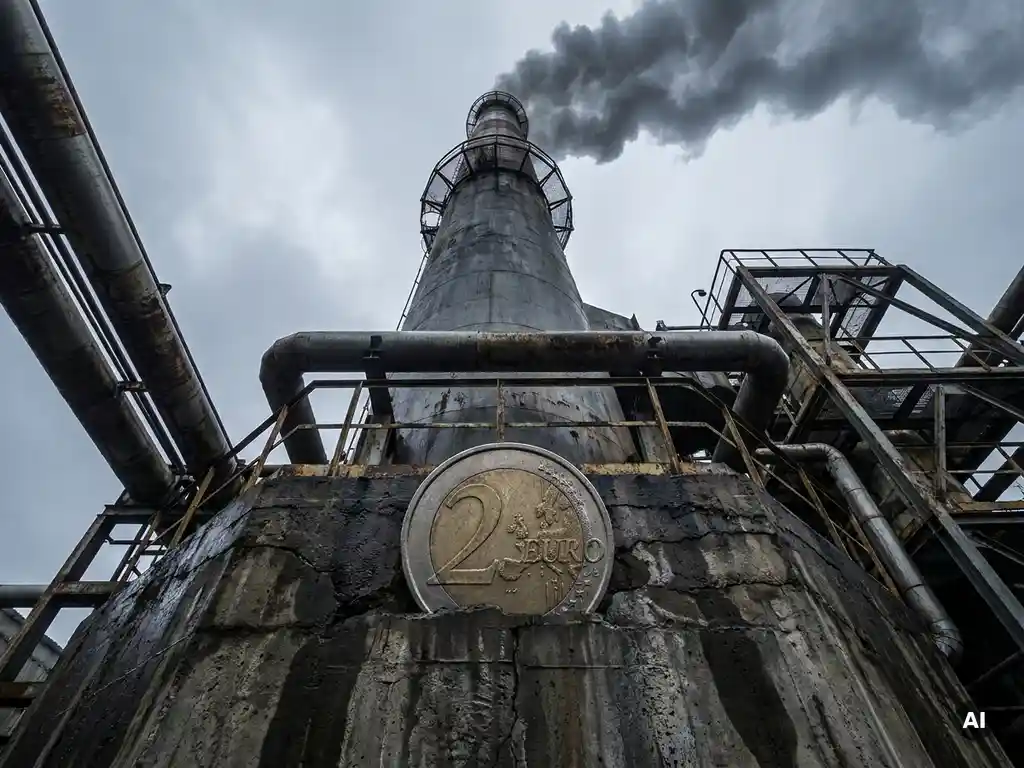
In 2026, EU ETS carbon costs for industrial heat sit roughly in the range of €60 to €80 per tonne of CO₂, depending on market conditions at the time of purchase. For energy-intensive industries that still rely on fossil fuels to generate heat, that translates into a meaningful and growing line item on the energy bill, one that is not going away. The sections below break down how the price is calculated, what it means in practice for different sectors, and what your options are for reducing exposure.
How is the EU ETS carbon price calculated in 2026?
The EU ETS carbon price is set by supply and demand on the European carbon market, where industrial emitters buy and trade emission allowances (EUAs). Each allowance covers one tonne of CO₂. The total number of allowances in circulation is capped by the EU and reduced each year, which structurally tightens supply over time and creates upward price pressure.
Several factors influence where the price lands at any given moment:
- The annual linear reduction factor: Under the revised EU ETS, the cap on total allowances decreases by 4.3% per year from 2024 to 2027, then by 4.4% from 2028 onwards. Fewer allowances mean higher prices, all else being equal.
- Energy market conditions: When gas prices spike, power generators burn more coal and buy more allowances, pushing the carbon price up. When renewable generation is high, demand for allowances falls.
- Free allocation rules: Industrial facilities receive some allowances for free, based on benchmark performance. Companies that emit more than their free allocation must buy the difference. The number of free allowances is gradually declining.
- Market speculation and macro sentiment: Like any traded commodity, EUA prices respond to broader economic signals, energy policy announcements, and investor positioning.
For industrial heat specifically, the relevant benchmark is the heat benchmark under the ETS, currently set at around 62.3 tonnes of CO₂ per terajoule of heat produced from natural gas. Facilities that exceed this benchmark face the highest exposure.
What is the expected EU ETS carbon price range for 2026?
In 2026, most analyst forecasts and market signals point to an EU ETS carbon price range of approximately €60 to €80 per tonne of CO₂. Prices dipped from their 2023 highs above €100 due to weaker industrial demand and high renewable output, but structural tightening of the cap is expected to push prices upward again over the medium term.
It is important to be clear about what drives uncertainty in this range. Volatile energy prices remain a major variable: a cold winter, a gas supply disruption, or a shift in coal use by power generators can move the EUA price by €10 or more within weeks. Regulatory signals also matter: announcements from the European Commission about the Clean Industrial Deal or changes to free allocation rules can shift market expectations quickly.
For sustainability managers building a multi-year business case, the more useful framing is not the exact 2026 price, but the direction of travel. The structural design of the EU ETS, a shrinking cap, declining free allocations, and expanding scope, means that carbon costs for fossil-fuel-based industrial heat are expected to increase over time, not decrease. Planning around a floor of €60 and a plausible ceiling above €100 is a reasonable approach for scenario modelling.
How much does EU ETS carbon cost add to industrial heat bills?
At a carbon price of €70 per tonne of CO₂, burning natural gas to generate heat adds roughly €14 to €15 per megawatt-hour of thermal energy (MWhth) in carbon costs alone. That is on top of the fuel cost itself, which has also been volatile in recent years. For a mid-sized industrial facility consuming 50,000 MWhth of heat per year, that amounts to approximately €700,000 to €750,000 annually in ETS costs, before accounting for any shortfall in free allocations.
The actual additional cost depends on three factors:
- Your free allocation position: If your facility receives free allowances that cover most of your emissions, your net ETS cost is lower. But free allocations are declining, and many facilities in food, chemicals, and paper are already running short.
- Your fuel mix: Natural gas produces roughly 0.2 tonnes of CO₂ per MWhth. Coal is significantly higher. The higher your emission intensity, the more allowances you need per unit of heat produced.
- Your hedging strategy: Companies that buy allowances forward at lower prices are partially shielded from short-term spikes. Those purchasing on the spot market absorb full price volatility.
The bottom line is that EU ETS carbon costs are already material for most industrial heat users, and they are set to grow. Decarbonization of industrial heat is no longer just an environmental priority, it is an increasingly urgent financial one.
Which industrial sectors are most exposed to ETS carbon costs?
The sectors most exposed to EU ETS carbon costs for heat are those that require large volumes of high-temperature thermal energy and have limited access to free allowances relative to their actual emissions. Food and beverage, specialty chemicals, and pulp and paper consistently rank among the most affected.
Food and beverage facilities typically use steam at temperatures between 100°C and 200°C for cooking, sterilisation, and drying. These processes are hard to electrify at scale and consume substantial volumes of fossil fuel. ETS exposure is high and rising as free allocations tighten.
Specialty chemicals often require process heat above 300°C, making electrification technically challenging and hydrogen infrastructure dependent. Carbon costs are compounded by the complexity of switching fuels without disrupting sensitive production processes.
Pulp and paper is one of the largest industrial heat consumers in Europe. Many facilities already have combined heat and power systems running on biomass or gas, but those running predominantly on gas face significant ETS exposure, particularly as biomass sustainability rules tighten.
What these sectors share is a structural dependency on reliable, high-temperature heat that cannot easily or quickly be replaced by electrification. That is precisely why the question of decarbonization of industrial heat is so urgent for sustainability managers in these industries.
What happens to ETS carbon costs if the price rises above €100?
If the EU ETS carbon price rises above €100 per tonne of CO₂, which several analysts consider plausible by the late 2020s, the financial impact on fossil-fuel-based heat generation becomes severe. At €100 per tonne, burning natural gas adds approximately €20 per MWhth in carbon costs alone. For a facility using 100,000 MWhth of heat per year, that is €2 million in annual ETS costs, entirely separate from fuel costs.
There is a market stability mechanism built into the EU ETS called the Market Stability Reserve (MSR), which can withdraw allowances from the market when supply is too high. This mechanism is designed to prevent price crashes, not price ceilings. There is no hard cap on how high the EUA price can go.
A sustained price above €100 would have several consequences for industrial heat users:
- The cost gap between fossil fuels and clean alternatives narrows significantly, improving the business case for technologies like Iron Fuel Technology, green hydrogen, and electrification.
- Companies with high residual emissions and limited free allocations face direct profitability pressure, which can affect investment decisions and competitiveness.
- The Carbon Border Adjustment Mechanism (CBAM), which is being phased in from 2026, begins to affect imported goods from regions without equivalent carbon pricing, adding a further competitive dimension for European producers.
For sustainability managers, the scenario of €100+ ETS prices is not a tail risk to be dismissed. It is a planning scenario that should inform investment decisions being made today.
How can industrial companies reduce their EU ETS exposure for heat?
Industrial companies can reduce their EU ETS exposure for heat by lowering the carbon intensity of their heat generation, either by switching fuel sources, improving energy efficiency, or a combination of both. The most effective strategies address the root cause: fossil fuel combustion that generates CO₂ and therefore requires allowances.
The main options available in 2026 include:
- Fuel switching to low-carbon alternatives: Replacing natural gas with a carbon-free energy carrier eliminates direct CO₂ emissions and removes the need to purchase allowances for heat generation. This is the most direct route to ETS cost reduction.
- Energy efficiency improvements: Reducing the total amount of heat consumed lowers the volume of fuel burned and therefore the number of allowances required. The EU Energy Efficiency Directive sets escalating energy savings obligations, 1.5% per year in 2026 and 2027, rising to 1.9% from 2028, which adds regulatory momentum to efficiency investments.
- Allowance hedging: Buying EUAs forward at current prices can lock in costs and reduce exposure to future price spikes. This is a financial strategy, not an emissions strategy, but it provides budget certainty.
- Engaging with the Clean Industrial Deal: The European Commission’s Clean Industrial Deal includes support mechanisms for industrial decarbonisation, including the Innovation Fund and a proposed industrial decarbonisation bank targeting €100 billion in funding. These instruments can reduce the CAPEX versus OPEX burden of switching to clean heat technologies.
- Reviewing free allocation eligibility: Facilities that have made efficiency improvements may be able to optimise their benchmark position and retain more free allowances. This requires close engagement with national competent authorities.
The most durable strategy combines fuel switching with efficiency improvements. Hedging and free allocation optimisation provide short-term relief, but they do not reduce actual emissions, and as the ETS cap tightens, the cost of inaction compounds.
How Iron Fuel Technology helps reduce EU ETS exposure
We developed Iron Fuel Technology precisely to address the challenge that sustainability managers in energy-intensive industries face: how do you decarbonize high-temperature industrial heat without waiting for electrification infrastructure or hydrogen networks that may not arrive in time?
Our Iron Fuel Boiler burns iron powder, not fossil fuels, to produce high-temperature heat with zero direct CO₂ emissions and what we claim to be the lowest NOx emissions of any fuel. Because there is no carbon in the combustion process, switching to iron fuel eliminates the Scope 1 emissions that drive ETS allowance purchases for heat. The only CO₂ output at the boiler comes from a pilot safety flame, amounting to just 10 kg of CO₂ per MWhth, a fraction of what natural gas produces.
Here is what makes our solution relevant to the ETS cost challenge specifically:
- Zero direct CO₂ from combustion: No fossil fuel burned means no allowances needed for heat generation, a direct reduction in ETS liability.
- Up to 95% energy efficiency: High efficiency means less fuel consumed per unit of heat produced, reducing both fuel cost and residual emissions.
- Drop-in compatible: Our Iron Fuel Boiler is designed to complement existing industrial boiler infrastructure, so you do not need to replace your entire heat system to start reducing ETS exposure.
- Independent of grid congestion: Unlike electrification, iron fuel does not require grid connection upgrades, a real barrier for many industrial sites today.
- Long-term fuel supply security: Iron fuel is delivered under a long-term supply agreement, providing cost predictability in an environment of volatile energy prices.
We have already signed the first commercial contract worldwide for industrial Iron Fuel Technology with Kingspan Unidek, and we are backed by €113.8 million in funding to scale from pilot to commercial deployment. If you are evaluating how to reduce your EU ETS exposure for industrial heat, we would be glad to talk through what this could look like for your facility. Get in touch with our team to start the conversation.
Frequently Asked Questions
How do I calculate my facility's actual net EU ETS cost after accounting for free allocations?
Start by comparing your facility’s verified annual emissions against the free allowances allocated by your national competent authority. The difference — your ‘allocation shortfall’ — is the volume of EUAs you need to purchase on the market. Multiply that shortfall by the prevailing EUA price (e.g., €70/tonne) to get your net annual ETS cost. If you are unsure of your benchmark position, your national registry and the EU Transaction Log (EUTL) are the authoritative sources, and engaging an ETS compliance consultant can help you identify optimisation opportunities before the next allocation period.
What is the difference between Scope 1 and Scope 2 emissions in the context of EU ETS, and which one does the ETS actually charge you for?
The EU ETS primarily targets Scope 1 emissions — direct CO₂ released from combustion at your own facility, such as burning natural gas in an industrial boiler. Scope 2 emissions (indirect emissions from purchased electricity) are regulated at the power generator level, not at yours, though you may still face indirect cost pass-through via higher electricity prices. This distinction matters strategically: switching from gas-fired heat to electric heat shifts your ETS liability away from you but does not eliminate the carbon cost entirely, whereas switching to a zero-carbon fuel like iron fuel eliminates the direct Scope 1 liability at source.
How does the Carbon Border Adjustment Mechanism (CBAM) interact with EU ETS costs, and should it factor into my planning?
CBAM, being phased in from 2026, places a carbon price on certain imported goods — including steel, cement, aluminium, fertilisers, and hydrogen — from countries without equivalent carbon pricing. For European industrial producers, this levels the playing field against lower-cost imports that previously benefited from avoiding EU ETS costs. If your sector or your customers’ sectors are covered by CBAM, it reinforces the case for decarbonising now: your ETS-compliant, lower-carbon production becomes a competitive advantage as CBAM tightens, rather than a cost burden relative to imports.
What are the most common mistakes companies make when trying to manage their EU ETS exposure?
The three most common mistakes are: (1) over-relying on free allocation assumptions without stress-testing what happens as allocations decline year-on-year; (2) treating allowance hedging as a decarbonisation strategy — buying EUAs forward locks in a price but does nothing to reduce actual emissions or long-term liability; and (3) delaying investment decisions while waiting for technology certainty, which means paying rising carbon costs for longer while competitors who moved earlier gain cost advantages. The ETS is structurally designed to make inaction increasingly expensive, so the timing of a fuel-switching or efficiency investment is as financially significant as the investment itself.
How long does it typically take to implement a fuel-switching project for industrial heat, and what should I do now to prepare?
Fuel-switching projects for industrial heat typically take two to four years from initial feasibility assessment to full operational deployment, depending on technology readiness, permitting requirements, and site-specific integration complexity. Given that EU ETS costs are expected to rise over that same horizon, the time to start is now. Practical first steps include commissioning an energy and emissions audit to quantify your current ETS exposure, mapping the heat temperature profiles your processes require (since this determines which technologies are viable), and engaging with technology providers and funding bodies like the EU Innovation Fund early to understand what support is available for your specific situation.
Are there EU funding mechanisms available specifically to help cover the capital cost of switching to clean industrial heat?
Yes. The EU Innovation Fund is one of the largest dedicated funding mechanisms for low-carbon industrial technology deployment in Europe, financed directly by revenues from EU ETS allowance auctions. The European Commission’s Clean Industrial Deal also proposes an industrial decarbonisation bank targeting €100 billion in support. At the national level, many member states offer co-financing through state aid schemes approved under the EU’s Temporary Crisis and Transition Framework. The key is to engage early: application windows are competitive, and projects that have already completed feasibility studies and secured site agreements are better positioned to succeed.
Can a partial fuel switch — replacing only a portion of my fossil fuel heat — still deliver meaningful EU ETS savings?
Absolutely, and for many facilities a phased or partial switch is the most practical starting point. If you replace 30% of your fossil-fuel heat demand with a zero-carbon alternative, you reduce your allowance purchase requirement by roughly the same proportion, delivering immediate and recurring ETS cost savings while you build operational confidence with the new technology. A partial switch also allows you to retain existing boiler infrastructure as backup, which matters for production continuity. The key is to design the partial switch as a stepping stone within a longer-term decarbonisation roadmap, rather than a permanent end state, so that each investment phase builds toward full ETS liability elimination.
Related Articles
- How do industrial companies evaluate CAPEX versus OPEX for clean heat?
- What clean heat options exist for food and beverage manufacturers?
- Which country is closest to net zero?
- What is Scope 1 emissions reduction and why is it a priority for manufacturers?
- How long do solar panels last?
This content was generated with the help of AI and it may contain mistakes