

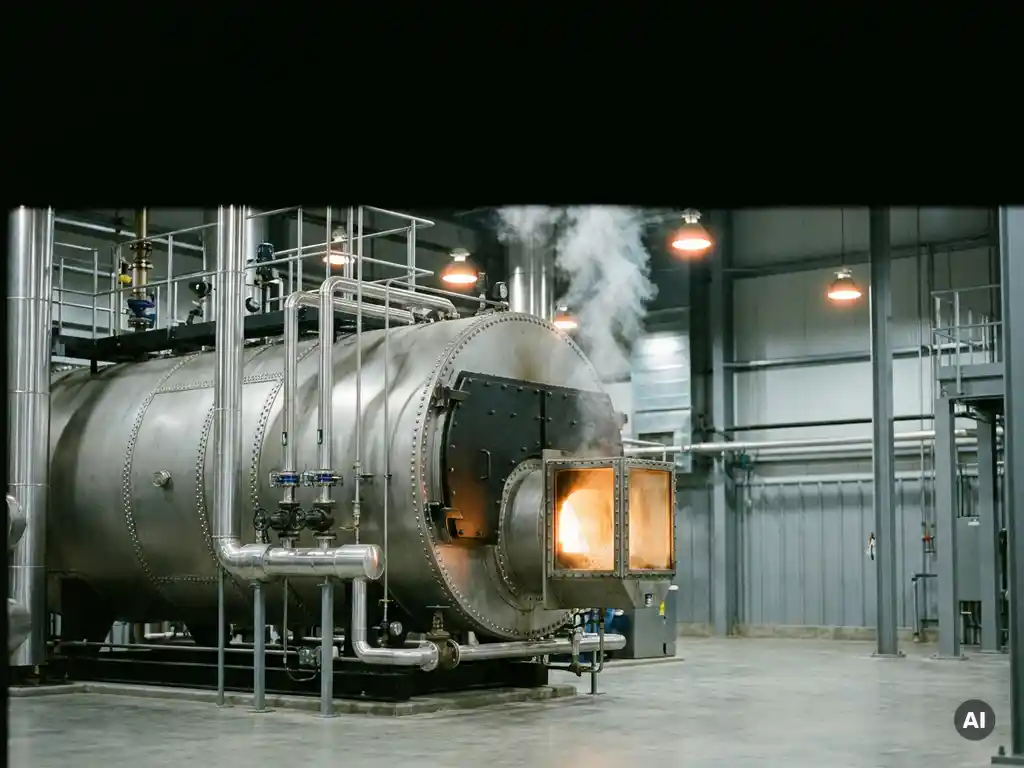
Scope 1 emissions reduction means cutting the greenhouse gases your company releases directly from its own operations, primarily from burning fossil fuels to generate heat, power machinery, or run industrial processes. For manufacturers, this is the most urgent emissions category to address because it sits entirely within their operational control. The sections below unpack the key questions sustainability managers are asking about Scope 1 in 2026.
How do Scope 1 emissions differ from Scope 2 and Scope 3?
Scope 1 emissions are the direct greenhouse gas emissions produced by sources your company owns or controls, think combustion in your own boilers, furnaces, or kilns. Scope 2 covers indirect emissions from purchased electricity or heat. Scope 3 captures everything else upstream and downstream in your value chain, from raw material extraction to product end-of-life.
The distinction matters enormously for manufacturers. Scope 1 emissions are the ones you are directly responsible for and can directly act on. If your facility runs gas-fired boilers to generate process heat, every tonne of CO₂ those boilers emit is a Scope 1 emission. There is no intermediary: it is your fuel, your combustion, your carbon.
Scope 2 and Scope 3 reductions often rely on purchasing decisions, switching to a green electricity tariff, choosing lower-carbon suppliers. Scope 1 reduction, by contrast, requires changing how you actually generate energy on-site. That makes it harder, but it also means the climate impact is real and verifiable rather than dependent on certificates or supply chain claims.
Why are Scope 1 emissions so hard to reduce in manufacturing?
Scope 1 emissions are difficult to reduce in manufacturing because industrial heat, the single biggest driver of direct emissions, demands temperatures and reliability that most clean alternatives struggle to deliver at scale. Electrification and hydrogen are frequently cited as solutions, but both face serious barriers in practice.
Industry accounts for a significant share of total global energy consumption, and roughly two-thirds of that energy goes toward heat generation. The vast majority of that heat is still produced by burning fossil fuels. The reasons manufacturers have not switched faster come down to a few persistent obstacles:
- Grid congestion and infrastructure limits: Many industrial sites cannot access sufficient grid capacity to electrify high-temperature processes, and grid congestion is worsening in many European regions in 2026.
- Volatile energy prices: Unpredictable electricity costs make the business case for electrification fragile, especially for energy-intensive sectors.
- High upfront CAPEX: Replacing fossil fuel infrastructure with clean alternatives typically requires substantial capital investment with long payback periods.
- Process compatibility: Many industrial processes require very high temperatures or specific heat profiles that current clean technologies cannot easily replicate without significant process redesign.
- Security of supply: Manufacturers cannot afford process downtime. Any replacement technology must be as reliable as the fossil fuel systems it replaces.
This combination of technical, financial, and infrastructure barriers means that even companies with genuine ambitions to decarbonize industrial heat often find themselves stuck. The gap between climate commitments and operational reality is widest precisely where Scope 1 emissions are highest.
What regulations are pushing manufacturers to cut Scope 1 emissions?
The most significant regulatory driver for Scope 1 emissions reduction in manufacturing is the EU Emissions Trading System (EU ETS), which puts a direct carbon price on industrial emissions. As the carbon price rises and the number of free allowances decreases, the financial cost of maintaining fossil fuel-based processes grows year on year.
Beyond the EU ETS, manufacturers face a broadening regulatory landscape. The revised EU Energy Efficiency Directive now extends mandatory energy audit obligations to all companies above certain energy consumption thresholds, including SMEs, and requires large industrial energy consumers to implement energy management systems. This means more manufacturers are formally required to identify and act on inefficiencies, including those tied to fossil fuel combustion.
In the Netherlands, subsidy instruments like VEKI (Versnelde Klimaatinvestering Industrie) are specifically designed to support industrial companies investing in measures that reduce CO₂ emissions, helping to offset the higher upfront costs of cleaner technologies. These frameworks reinforce the financial case for acting on Scope 1 now rather than waiting.
Board-level net-zero commitments and customer expectations are adding further pressure from inside and outside the organisation. Sustainability reporting frameworks increasingly require companies to disclose Scope 1 figures with precision, making it harder to defer action without reputational consequences.
What technologies are available for Scope 1 emissions reduction in industry?
Manufacturers have several technology pathways available to reduce Scope 1 emissions, each with different trade-offs in terms of cost, infrastructure requirements, and suitability for high-temperature heat. The right choice depends on your process temperatures, site infrastructure, and investment horizon.
The main options currently available include:
- Electrification: Electric boilers and heat pumps can replace gas-fired systems for lower-temperature processes. However, grid congestion, high electricity costs, and capacity limits make this impractical for many energy-intensive sites.
- Green hydrogen: Hydrogen can theoretically replace natural gas in industrial burners. The challenge is cost, availability, and the need for new infrastructure: hydrogen pipelines and on-site storage remain limited in most regions.
- Biomass and biogas: Bioenergy can reduce net CO₂ emissions from combustion, but sustainability concerns, feedstock availability, and land-use implications limit its scalability.
- Carbon capture and storage (CCS): CCS can be applied to existing fossil fuel processes to capture emissions at the point of release. It is capital-intensive and does not eliminate the underlying fossil fuel dependency.
- Iron Fuel Technology: A newer pathway that uses iron powder as a circular, carbon-free energy carrier. Iron fuel burns to produce high-temperature heat with zero direct CO₂ emissions, and the resulting iron oxide is regenerated using hydrogen, completing a closed loop. It is designed to integrate with existing boiler infrastructure, which reduces the replacement barrier significantly.
No single technology is right for every manufacturer. The most pragmatic approach in 2026 is to evaluate options against your specific process requirements, grid access, and decarbonization of industrial heat targets rather than defaulting to the most familiar solution.
How do manufacturers measure and report Scope 1 emissions accurately?
Manufacturers measure Scope 1 emissions by calculating the greenhouse gases released directly from their own combustion sources, using fuel consumption data combined with established emission factors. The most widely used methodology is the GHG Protocol Corporate Standard, which defines how to identify emission sources, collect activity data, and convert it into CO₂ equivalent figures.
In practice, accurate measurement involves three steps:
- Identify all direct emission sources: This includes boilers, furnaces, kilns, process heaters, on-site vehicles, and any other combustion equipment your company owns or controls.
- Collect activity data: Gather fuel consumption records, typically in volume or energy units, for each source over the reporting period.
- Apply appropriate emission factors: Multiply consumption by the relevant CO₂ equivalent factor for each fuel type. For companies switching to newer fuels or technologies, it is important to use methodology-aligned factors. For example, the full Iron Fuel Technology chain delivers a CO₂ equivalent reduction of 0.55 tCO₂eq per tonne of iron fuel produced, calculated using EU definitions for low-carbon hydrogen and the EU Innovation Fund GHG methodology including transport, a figure that is relevant for carbon accounting and regulatory reporting, but only valid under those specific conditions.
Accurate reporting also requires consistency year on year. If you change your methodology, update your base year recalculation accordingly. Many manufacturers are now subject to third-party verification requirements, particularly those within the EU ETS or those disclosing under frameworks such as CDP or CSRD. Getting the measurement right from the start avoids costly corrections later.
When should a manufacturer prioritise Scope 1 over other emission scopes?
A manufacturer should prioritise Scope 1 emissions when direct combustion from on-site processes represents the largest share of its total carbon footprint. For companies in energy-intensive sectors, Food and Beverage, Specialty Chemicals, Pulp and Paper, Scope 1 from industrial heat generation is typically the dominant source of emissions, which means it is also where the greatest reduction potential lies.
There are three clear signals that Scope 1 should come first:
- Your Scope 1 footprint dwarfs Scope 2 and 3: If the bulk of your emissions come from your own boilers and furnaces, addressing purchased electricity or supply chain emissions first will yield relatively small results.
- You are exposed to rising carbon costs: Companies within the EU ETS face a direct financial penalty for every tonne of Scope 1 CO₂. The higher the carbon price rises, the more urgent it becomes to reduce combustion emissions at source.
- Your customers and stakeholders are scrutinising your direct emissions: Scope 1 figures are the most credible and verifiable part of a corporate climate disclosure. Reducing them signals genuine operational change rather than purchased offsets.
That said, the scopes are not entirely separate decisions. Replacing a natural gas boiler with a clean heat technology simultaneously reduces Scope 1 and can improve your overall emissions profile. The key is to sequence investments so that the highest-impact, highest-leverage actions come first, and for most manufacturers, that means starting with the fossil fuels burning inside their own facilities.
How we help manufacturers reduce Scope 1 emissions with Iron Fuel Technology
At RIFT, we develop and deliver industrial Iron Fuel Boilers, purpose-built systems that replace fossil fuel-fired heat generation with a fully circular, carbon-free alternative. Our technology is designed specifically for the Scope 1 challenge: it addresses high-temperature industrial heat directly, without requiring a complete overhaul of existing infrastructure or dependence on grid capacity.
Here is what makes our approach relevant for manufacturers tackling Scope 1:
- Zero direct CO₂ emissions during combustion – the only CO₂ output stems from a pilot safety flame, resulting in just 10 kg CO₂ per MWhth of thermal energy produced.
- Up to 95% energy efficiency – outperforming many conventional fossil fuel systems.
- Grid-independent operation – iron fuel is stored and transported in standard containers, making it a reliable heat source regardless of local grid congestion or electricity price volatility.
- Drop-in compatibility – the Iron Fuel Boiler is designed to complement existing boiler setups, reducing the CAPEX barrier and integration complexity.
- Long-term fuel supply security – we provide both the boiler system and a long-term iron fuel supply agreement, giving manufacturers the reliability they need to commit.
We are already working with industrial partners in Food and Beverage, Specialty Chemicals, and Pulp and Paper, sectors where electrification and hydrogen remain constrained. To find out whether Iron Fuel Technology fits your decarbonization roadmap, get in touch with our team and we will walk through the options together.
Frequently Asked Questions
How long does it typically take for a manufacturer to see a measurable reduction in Scope 1 emissions after implementing a new technology?
The timeline varies significantly depending on the technology chosen and the scale of implementation. Retrofitting an existing boiler setup with a compatible solution like an Iron Fuel Boiler can deliver measurable Scope 1 reductions within months of commissioning, while more complex overhauls such as full electrification or hydrogen infrastructure can take several years from planning to operation. The fastest wins typically come from improving combustion efficiency or switching to a drop-in compatible clean fuel before committing to full process redesign.
What are the most common mistakes manufacturers make when trying to reduce Scope 1 emissions?
One of the most frequent mistakes is defaulting to electrification without first assessing local grid capacity and electricity cost stability — two factors that can make the business case collapse quickly for energy-intensive sites. Another common error is focusing on Scope 2 or Scope 3 initiatives first simply because they appear easier, while the largest and most financially exposed emissions sit in Scope 1. Manufacturers also often underestimate the importance of establishing accurate baseline measurements before starting reduction programmes, which makes it difficult to verify progress or satisfy third-party reporting requirements later.
Can smaller or mid-sized manufacturers realistically afford to tackle Scope 1 emissions, or is this only viable for large industrial players?
Scope 1 reduction is increasingly accessible to SMEs, particularly as subsidy instruments such as the Dutch VEKI scheme and EU-level innovation funding are explicitly designed to offset the high upfront capital costs of cleaner industrial technologies. The revised EU Energy Efficiency Directive also now extends energy audit obligations to smaller companies, which means SMEs are being formally guided toward identifying and acting on these inefficiencies. The key for smaller manufacturers is to prioritise high-impact, modular solutions that do not require a complete infrastructure overhaul and to explore available grant funding before ruling out investment on cost grounds alone.
How do I know which Scope 1 reduction technology is the right fit for my specific industrial process?
The most important starting point is mapping your process heat requirements — specifically the temperatures needed, the reliability demands, and the hours of operation — against the capabilities and constraints of each available technology. Electrification and heat pumps are well-suited to lower-temperature processes below roughly 150–200°C, while high-temperature applications above 400°C currently have fewer proven clean alternatives, making options like Iron Fuel Technology or green hydrogen more relevant. A structured feasibility assessment that includes your grid access, energy costs, and decarbonisation timeline will give you a much clearer picture than evaluating technologies in the abstract.
Will reducing Scope 1 emissions negatively impact production output or operational reliability?
It does not have to, and operational continuity is rightly one of the first concerns manufacturers raise. The risk of disruption is highest when a technology requires significant process redesign or dependence on infrastructure — like grid capacity or hydrogen pipelines — that is not yet stable. Solutions designed for drop-in compatibility with existing boiler infrastructure are specifically engineered to minimise this risk, allowing manufacturers to transition without interrupting production. Any credible technology vendor should be able to provide data on system uptime, redundancy options, and transition planning to give you confidence before committing.
How should Scope 1 emissions reduction fit into a broader corporate net-zero or decarbonisation roadmap?
Scope 1 reduction should generally be sequenced early in a decarbonisation roadmap, particularly for manufacturers where direct combustion dominates the emissions profile, because it delivers the most verifiable and financially material impact. A practical approach is to treat Scope 1 as the foundation — reducing direct emissions first — and then layer in Scope 2 improvements such as switching to renewable electricity, followed by Scope 3 supply chain initiatives. This sequencing also aligns well with regulatory exposure: EU ETS carbon costs apply directly to Scope 1 emissions, so reducing them first has an immediate effect on operating costs as well as on climate performance.
What should I look for when choosing a technology partner to help reduce our Scope 1 emissions?
Beyond the technical specifications of the solution itself, look for a partner who can demonstrate real industrial deployments at comparable scale and process conditions — not just pilot projects. Transparency around emissions accounting methodology matters too: a credible partner should be able to provide independently verified CO₂ reduction figures aligned with recognised frameworks such as the GHG Protocol or EU Innovation Fund methodology. Finally, consider whether the partner offers long-term supply or service agreements, since the reliability of your heat supply is non-negotiable in manufacturing and a technology that cannot guarantee continuity of fuel or support creates operational risk that outweighs its environmental benefit.
Related Articles
- What is a circular energy carrier and how does it work in industry?
- How do industrial companies reduce Scope 1 emissions from heat generation?
- What industries can switch to carbon-free heat generation now?
- What is the difference between solar and wind energy?
- Can renewable energy reduce dependence on energy imports?
This content was generated with the help of AI and it may contain mistakes