

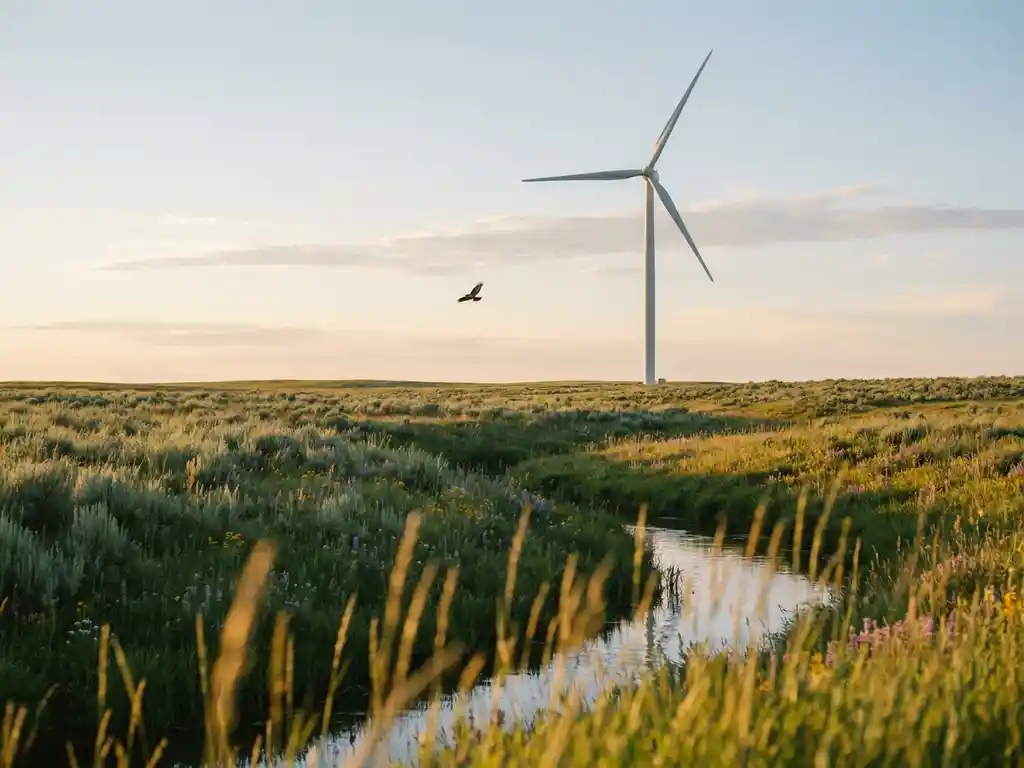
Renewable energy projects can affect local ecosystems in both positive and negative ways, depending on the technology, scale, and location. Solar farms, wind installations, and hydropower projects all have different ecological footprints. While they eliminate the ongoing pollution caused by fossil fuel combustion, large-scale deployments can disrupt habitats, alter land use, and affect wildlife. The net impact depends heavily on how projects are designed, sited, and managed over time.
Ignoring ecosystem impact early is costing renewable projects their social licence
When environmental assessments are treated as a compliance checkbox rather than a genuine planning tool, projects face community opposition, permitting delays, and sometimes outright cancellation. Wind farms built on migration corridors, solar installations that fragment critical habitats, and run-of-river hydro schemes that block fish passage have all faced serious setbacks because ecosystem risks were not addressed at the design stage. The fix is straightforward in principle: bring ecologists into the room before engineers finalize site selection, not after. Early ecological screening saves money, builds trust with local communities, and protects the project timeline.
Treating all renewable energy as automatically “green” is holding back smarter decision-making
Renewable energy is cleaner than fossil fuels in terms of operational emissions, but that does not mean it is ecologically neutral. A large hydropower dam can devastate river biodiversity. A poorly sited solar park can displace productive farmland or scrubland that supports pollinators. When sustainability managers assume that switching to renewables automatically solves environmental impacts, they miss real risks that can damage both ecosystems and corporate reputation. A more productive framing is to ask: which clean energy pathway delivers the lowest total ecological footprint in our specific context? That question leads to better technology choices and better outcomes.
What does ‘impact on local ecosystems’ actually mean for energy projects?
Ecosystem impact refers to the changes an energy project causes to the living and non-living environment around it. This includes effects on soil, water, air quality, plant communities, and animal populations. For energy projects, the key categories are habitat loss or fragmentation, disruption to wildlife movement, changes to water flow or quality, and noise or light pollution that affects local species.
These impacts can be direct, such as clearing land to install infrastructure, or indirect, such as increased road traffic during construction disturbing nesting birds. They can also be temporary, fading once construction ends, or permanent, as with a dam that permanently alters a river’s flow regime.
For sustainability managers evaluating clean energy options, understanding ecosystem impact means looking beyond the operational phase. Construction, fuel supply chains, and end-of-life decommissioning all carry ecological consequences that belong in a complete assessment.
How does renewable energy affect biodiversity compared to fossil fuels?
Renewable energy generally causes less long-term biodiversity harm than fossil fuels, but it is not impact-free. Fossil fuel extraction and combustion cause persistent air and water pollution, habitat destruction through mining and drilling, and climate change itself, which is the single largest driver of biodiversity loss globally. Renewable energy avoids most of these ongoing harms but introduces site-specific ecological pressures during construction and operation.
Wind turbines, for example, pose collision risks for birds and bats, particularly in areas with high migratory activity. Solar installations can reduce ground-level vegetation and affect insect populations, though well-designed projects that incorporate native planting beneath panels can actually support pollinators. Hydropower remains the most ecologically disruptive renewable technology when large reservoirs are involved, affecting fish migration, sediment transport, and downstream water temperature.
The honest comparison is this: fossil fuels cause diffuse, cumulative, and global ecological damage. Renewable energy causes more localized impacts that are often avoidable or mitigable with good planning. That distinction matters when building the case for a clean energy transition.
What are the biggest environmental risks of large-scale renewable energy deployment?
The biggest environmental risks of large-scale renewable energy deployment are land use change, habitat fragmentation, and the ecological footprint of manufacturing and supply chains. At scale, these risks become significant even when individual projects appear modest in isolation.
Land use is the most pressing concern. Meeting industrial and national energy demands through solar or wind requires substantial land areas. When these projects are sited on ecologically sensitive land, the consequences for biodiversity can be severe. Habitat fragmentation, where continuous natural areas are broken up by infrastructure, reduces species’ ability to move, find mates, and adapt to changing conditions.
Supply chain impacts are less visible but equally real. Manufacturing solar panels requires mining for silicon, silver, and rare earth elements. Wind turbines rely on steel, concrete, and composite materials. Each of these supply chains carries its own environmental footprint, including mining-related habitat destruction and water use.
A third risk is the pace of deployment itself. When projects are built faster than ecological assessments can properly evaluate, cumulative impacts across a region can go unnoticed until damage is already done.
How can industrial companies reduce ecosystem impact when switching to clean energy?
Industrial companies can reduce ecosystem impact by prioritizing clean energy technologies that use existing infrastructure, require minimal new land, and have low operational ecological footprints. The most effective approach combines careful technology selection with thorough site assessment and supply chain scrutiny.
Here are practical steps that sustainability managers can take:
- Prioritize brownfield and built-environment deployment — Installing solar on rooftops, car parks, or already disturbed industrial land avoids the land use conflicts that drive the largest ecological risks.
- Conduct early ecological screening — Commission habitat and species surveys before finalizing technology or site choices, not as a regulatory afterthought.
- Evaluate the full life-cycle footprint — Include manufacturing, transport, and end-of-life impacts in your assessment, not just operational emissions.
- Choose technologies compatible with existing infrastructure — Technologies that integrate with current boiler systems or industrial setups reduce the need for large new construction footprints.
- Engage local stakeholders — Early dialogue with communities, conservation groups, and local authorities identifies potential conflicts before they become costly disputes.
Which clean energy technologies have the smallest ecological footprint?
Clean energy technologies with the smallest ecological footprints are generally those that require the least new land, integrate with existing infrastructure, and avoid ongoing resource extraction or water use. Geothermal, rooftop solar, and solid-state energy carriers tend to score well on these criteria compared to large-scale wind, hydropower, or bioenergy.
Solid-state energy carriers are a particularly interesting category from an ecological perspective. Technologies that use a physical material as an energy carrier, rather than requiring vast land areas or continuous water flows, can deliver industrial heat with a very contained physical footprint. The energy is stored in the material itself, transported using standard logistics infrastructure, and combusted within existing or adapted industrial systems.
Bioenergy deserves a specific note of caution. While it is often classified as renewable, large-scale bioenergy can drive land use change, deforestation, and biodiversity loss when feedstocks are sourced unsustainably. Its ecological footprint depends almost entirely on how and where biomass is produced.
For industrial heat applications specifically, technologies that avoid the combustion of organic materials, produce no carbon emissions during operation, and do not require new land-intensive infrastructure represent the most ecologically conservative choice. You can explore how different industrial heat solutions compare by looking at clean heat solutions for industrial applications.
What should sustainability managers consider when evaluating ecosystem impact?
Sustainability managers should evaluate ecosystem impact across four dimensions: land use, operational emissions, supply chain footprint, and end-of-life considerations. Focusing only on operational carbon emissions gives an incomplete picture and can lead to choices that trade one environmental problem for another.
Land use assessment should ask how much new land the technology requires, what the current ecological value of that land is, and whether deployment can be concentrated on already disturbed sites. A technology that requires less land per unit of energy output will almost always carry lower ecosystem risk.
Supply chain scrutiny matters more than many managers realize. The materials required to manufacture clean energy infrastructure, from lithium for batteries to rare earths for wind turbine magnets, all come from somewhere. Understanding where those materials originate and under what environmental standards they are extracted is part of a complete ecosystem impact assessment.
Operational considerations include noise, light, water use, and any ongoing interactions with local wildlife. End-of-life planning, including whether materials can be recovered and reused, affects both the long-term ecological footprint and the circular economy credentials of the technology. Iron Fuel Technology’s circular design is one example of how end-of-life material recovery can be built into a clean energy system from the outset.
How Iron Fuel Technology helps with ecosystem-conscious industrial decarbonization
We developed Iron Fuel Technology specifically to address the challenge of decarbonizing industrial heat without creating the large ecological footprints associated with other clean energy approaches. Here is how our technology compares on the dimensions that matter most for ecosystem impact:
- Minimal land use — Iron fuel is stored and transported using standard logistics infrastructure. No new land-intensive installations are needed at the point of use.
- Zero direct CO2 emissions during combustion — The only CO2 output from our Iron Fuel Boiler comes from a small pilot safety flame, resulting in just 10 kg of CO2 per MWh of thermal energy produced.
- Ultra-low NOx emissions — Our boiler achieves the lowest NOx emissions of any combustion fuel, reducing air quality impacts on surrounding ecosystems.
- Circular material cycle — Iron oxide, the only combustion by-product, is collected and regenerated back into iron fuel using hydrogen. No waste stream and no ongoing resource extraction at scale.
- Integration with existing infrastructure — Our Iron Fuel Boiler is designed to work alongside existing boiler systems, reducing the construction footprint and disruption associated with switching to clean heat.
If you are building the business case for a clean energy transition and want to understand how iron fuel fits your specific industrial context, get in touch with our team to start the conversation.
Related Articles
- How do you build a business case for decarbonizing industrial heat in 2026?
- What is green energy and how is it different from renewable energy?
- How does renewable energy affect the environment?
- What is energy poverty and can renewables help solve it?
- How does renewable energy impact electricity prices?
This content was generated with the help of AI and it may contain mistakes