

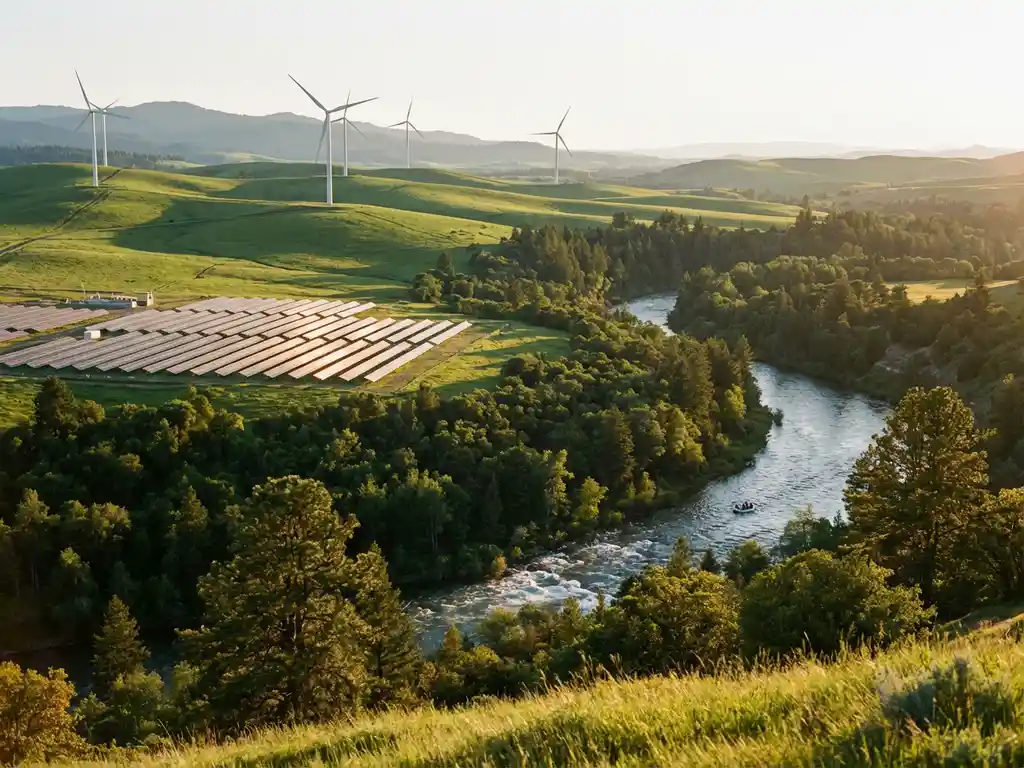
Renewable resources are at the heart of the global energy transition—and understanding what they are, how they work, and where they fall short is essential for anyone involved in industrial sustainability. Whether you’re exploring clean energy options for your operations or simply want a clearer picture of the landscape, this guide covers the most important questions in plain, practical terms.
From solar panels to iron fuel, the world of renewable energy is broader and more varied than most people realize. Some resources are well established; others are emerging as serious contenders for the hardest-to-decarbonize sectors. Let’s work through the key questions one by one.
What are renewable resources and why do they matter?
Renewable resources are natural resources that replenish themselves over time through natural processes, making them available for ongoing use without permanent depletion. Unlike fossil fuels, which take millions of years to form and are consumed far faster than they regenerate, renewable resources are continuously restored by natural cycles—sunlight, wind, water, biological growth, and heat from the Earth itself.
They matter because the global energy system is built on fuels that are finite and polluting. Burning fossil fuels releases carbon dioxide that has been locked underground for millennia, driving climate change at a pace that natural systems cannot absorb. Renewable resources offer a way to meet energy demand without adding to that carbon burden.
For industrial companies in particular, the shift to renewable energy is no longer optional. Regulatory frameworks like the EU Emissions Trading System, board-level net-zero commitments, and growing customer expectations are all pushing operations to reduce emissions—and renewable resources are the foundation of every credible decarbonization strategy.
What are the 20 most common examples of renewable resources?
The 20 most common examples of renewable resources span energy, materials, and biological systems. They range from the familiar—sunlight and wind—to emerging options such as iron fuel. Here is a structured overview across key categories.
Energy-based renewable resources
- Solar energy — captured via photovoltaic panels or concentrated solar systems
- Wind energy — converted to electricity through onshore and offshore turbines
- Hydropower — generated by flowing or falling water through turbines
- Geothermal energy — heat drawn from the Earth’s interior for power and heating
- Tidal and wave energy — harvested from ocean movements
- Biomass energy — organic material burned or converted to fuel
- Biogas — methane produced from the decomposition of organic waste
- Green hydrogen — produced through electrolysis powered by renewable electricity
- Iron fuel — iron powder used as a circular, carbon-free energy carrier for industrial heat
- Ambient air heat — low-grade thermal energy captured by heat pumps
Biological and material renewable resources
- Timber and wood — sustainably managed forests regenerate over decades
- Agricultural crops — annual growing cycles make food and fiber crops renewable
- Fresh water — replenished through the hydrological cycle
- Soil — with proper management, topsoil regenerates through biological activity
- Fish and seafood — renewable when harvested within sustainable limits
- Animal products — sustainably raised livestock and their outputs
- Algae — fast-growing biomass with applications in fuel, food, and materials
- Natural rubber — harvested from rubber trees that continue producing for decades
- Cotton and natural fibers — grown and harvested seasonally
- Peat — technically renewable, but it regenerates so slowly that it is often treated as finite
This list reflects the full breadth of what “renewable” means. In energy discussions, the focus tends to narrow to the first category—but understanding the wider picture helps clarify why some resources are genuinely sustainable and others require careful management to remain so.
What’s the difference between renewable and non-renewable resources?
The core difference is replenishment rate. Renewable resources regenerate on human timescales—within years, decades, or through continuous natural cycles. Non-renewable resources, such as coal, oil, and natural gas, took hundreds of millions of years to form and cannot be meaningfully replenished once consumed.
This distinction has direct consequences for emissions and long-term availability. When fossil fuels combust, they release carbon that has been stored underground since long before human civilization existed. That carbon adds to the atmosphere’s total load. Renewable energy sources, by contrast, either release no carbon at all or participate in cycles in which carbon is absorbed and re-released in balance.
A practical comparison
Non-renewable resources also tend to be geographically concentrated, creating supply chain vulnerabilities and geopolitical dependencies. Renewable resources, while not evenly distributed, are generally more widely available and do not carry the same risk of permanent exhaustion.
For industrial operators, the practical implication is straightforward: building an energy strategy around non-renewable fuels means accepting long-term price volatility, tightening carbon regulations, and stranded-asset risk. Renewable alternatives offer a way to reduce exposure to all three.
Which renewable resources are used for industrial heat?
Industrial heat is one of the most challenging sectors to decarbonize, and only a subset of renewable resources are technically and commercially viable for it. The main options currently in use or under active development are biomass, green hydrogen, electrification via heat pumps or electric boilers, and emerging solid-state energy carriers like iron fuel.
Each comes with trade-offs. Biomass is widely deployed but raises questions about land use and emissions accounting. Green hydrogen can deliver high-temperature heat but requires significant infrastructure investment and presents challenges around storage and transport. Electric boilers work well at lower temperatures but struggle with the very high heat demands of industries like specialty chemicals or pulp and paper.
Why industrial heat is a special challenge
Two-thirds of industrial energy consumption goes toward heat generation, and around 80% of that heat is still produced using fossil fuels. Many processes require temperatures well above what heat pumps can efficiently deliver, and the infrastructure for hydrogen is not yet in place at the scale needed.
This is why the search for practical, high-temperature renewable heat solutions remains urgent. You can explore how industrial renewable heat solutions are being developed to address exactly this gap—combining high efficiency with drop-in compatibility for existing boiler infrastructure.
How do circular energy carriers like iron fuel work as renewable resources?
Circular energy carriers like iron fuel function as renewable resources by operating in a closed loop: the fuel is used, its combustion byproduct is collected, and that byproduct is then regenerated back into usable fuel using renewable energy inputs. Nothing is permanently consumed, and no carbon enters the cycle at any stage.
Iron fuel specifically uses fine iron powder as its energy carrier. When iron powder combusts with ambient air inside an industrial boiler, it produces a flame of up to 2,000°C—delivering the high-temperature heat that many industrial processes require. The only byproduct is iron oxide, commonly known as rust. That iron oxide is then collected, transported to a production facility, and converted back into iron powder using low-carbon hydrogen. The cycle then begins again.
Why this qualifies as a renewable approach
The iron itself is not consumed in the way that fossil fuels are. It acts more like a rechargeable battery—carrying energy in solid form, releasing it as heat, and then being recharged for reuse. The renewable input that powers the whole cycle is hydrogen, which in turn is produced using renewable electricity.
This circular model also addresses one of the practical barriers to renewable energy adoption in industry: storage and transport. Iron powder is a stable, solid material that can be stored safely and shipped in standard containers, without the pressurization requirements of hydrogen or the intermittency challenges of direct electrification. To understand the full cycle in more detail, the Iron Fuel Technology overview explains each stage of the process.
What are the biggest challenges in switching to renewable resources?
The biggest challenges in switching to renewable resources are cost, infrastructure, intermittency, and technical compatibility with existing systems. These barriers vary significantly depending on the sector, the specific renewable resource, and the scale of the transition required.
For energy-intensive industries, the challenges are particularly acute. Here is a structured view of the most common obstacles:
- Upfront capital cost — new equipment, retrofitting, and supply chain development require significant investment before any savings materialize
- Infrastructure gaps — hydrogen pipelines, grid capacity, and storage facilities are not yet available at the scale many industries need
- Technology readiness — some renewable solutions are still maturing and have not yet been proven at full industrial scale
- Intermittency — solar and wind are weather-dependent, creating reliability challenges for processes that require continuous heat
- Price competitiveness — the cost differential between fossil fuels and cleaner alternatives remains a genuine barrier for many operators
- Regulatory uncertainty — while policy is generally moving in the right direction, the pace and detail of regulation can be difficult to plan around
The good news is that these challenges are not uniform across all renewable options. Some technologies are specifically designed to minimize disruption—working alongside existing infrastructure rather than replacing it entirely, and offering pricing that is competitive with fossil fuels from day one. The transition does not have to mean a complete overhaul; for many industrial operators, the most practical path forward involves gradually layering in new solutions.
If you’re currently weighing up options for your site, the short questionnaire below can help clarify which approach might fit your situation best.
How RIFT helps with switching to renewable industrial heat
We develop and deliver the Iron Fuel Boiler—a clean heat system designed specifically for industrial operators who need high-temperature, carbon-free heat without abandoning their existing infrastructure. Our technology fits directly into the renewable energy landscape described in this article, addressing the specific gaps that solar, wind, and hydrogen cannot yet fill for industrial heat.
Here is what working with us looks like in practice:
- Drop-in compatibility — our Iron Fuel Boiler integrates with existing boiler setups, so you avoid costly full replacements
- Zero direct CO₂ emissions — iron fuel combustion produces no carbon dioxide, with ultra-low NOₓ emissions as well
- Up to 95% energy efficiency — outperforming many conventional fossil fuel systems
- Long-term fuel supply agreements — we provide iron fuel on contract, giving you supply security and cost predictability
- Cost-competitive pricing — designed to align with fossil fuel pricing so the business case is clear from the start
We are already working with industrial partners in food and beverage, specialty chemicals, and pulp and paper, and we have signed the world’s first commercial contract for industrial Iron Fuel Technology. If you are a sustainability manager looking for a practical, proven path to decarbonizing your heat generation, we would be glad to talk through what is possible for your site. Get in touch with our team to start the conversation.
Related Articles
- What is the most efficient form of renewable energy?
- What is the environmental impact of large-scale solar farms?
- Can renewable energy reduce dependence on energy imports?
- How do I switch to renewable energy at home?
- Why is renewable energy important?
This content was generated with the help of AI and it may contain mistakes