

The world is under growing pressure to move away from fossil fuels, and industrial energy is one of the hardest parts of that transition to crack. While solar panels and electric vehicles dominate the headlines, the factories, food plants, and paper mills that keep modern economies running still depend almost entirely on burning gas, coal, and oil to generate the heat they need. Finding credible, scalable alternatives to fossil fuels in these settings is one of the defining challenges of the clean energy era.
This article answers the most common questions sustainability managers and energy professionals are asking right now—from why fossil fuels are so difficult to dislodge to which renewable energy technologies are realistically positioned to replace them before 2050.
Why do fossil fuels still dominate industrial energy?
Fossil fuels still dominate industrial energy because they are energy-dense, cheap, widely available, and capable of delivering the very high temperatures that industrial processes require. Decades of infrastructure investment have made them the default choice, and no single alternative yet matches their combination of cost, reliability, and thermal output across all settings.
The challenge is not simply one of technology. Industrial heat demand is enormous, accounting for roughly two-thirds of all industrial energy consumption. A large share of that heat is required at temperatures above 400°C, which rules out many lower-temperature renewable options entirely. Gas and coal deliver this reliably, day and night, regardless of weather.
There is also the economic reality. Fossil fuel infrastructure has been paid off over decades, making the marginal cost of continuing to use it very low. Switching to a cleaner alternative often means writing off existing assets, investing in new equipment, and accepting a period of operational uncertainty. For businesses operating on tight margins, that is a significant barrier even when the environmental case is clear.
Regulatory pressure is beginning to shift the calculation. Carbon pricing mechanisms like the EU Emissions Trading System are making fossil fuels progressively more expensive, while clean energy subsidies are making alternatives more attractive. But the transition is uneven, and for many industrial operators, the economics of switching still do not stack up without additional support.
What are the main alternatives to fossil fuels for industry?
The main alternatives to fossil fuels for industrial heat are electrification, hydrogen combustion, biomass, and emerging technologies like iron fuel. Each has a distinct profile of strengths and limitations, and no single solution works equally well across all industries or temperature ranges.
Here is a brief overview of the leading options:
- Electrification: Electric boilers and heat pumps work well at lower temperatures and are increasingly cost-effective where grid infrastructure is strong. At very high temperatures, they become technically complex and expensive.
- Green hydrogen: Hydrogen can generate very high-temperature heat with no direct carbon emissions. However, it requires significant infrastructure investment, is difficult to store and transport, and remains costly at scale.
- Biomass: Burning organic material can replace fossil fuels in some boiler systems, but sustainability concerns, land-use competition, and supply-chain complexity limit its appeal as a long-term universal solution.
- Iron fuel: A newer entrant, iron fuel burns as a solid powder to produce high-temperature heat with zero direct CO₂ emissions. The iron oxide by-product can be regenerated using hydrogen and reused, making it a circular energy carrier.
The right choice depends heavily on the specific industry, the temperatures required, local infrastructure, and the cost of capital. In practice, most industrial decarbonisation roadmaps will involve a combination of these technologies rather than a single winner.
What’s the difference between hydrogen, electrification, and iron fuel for industrial heat?
The key difference lies in how each technology delivers heat, what infrastructure it requires, and how practical it is to deploy at scale. Hydrogen produces heat through combustion or fuel cells but is difficult to store and transport. Electrification converts electrical energy directly into heat but struggles at very high temperatures. Iron fuel is a solid energy carrier that burns cleanly and can be transported using existing logistics infrastructure.
Hydrogen for industrial heat
Hydrogen combustion produces no direct CO₂ emissions and can reach the high temperatures that industrial processes demand. The challenge is the supply chain. Hydrogen is a gas, which means it requires pressurised tanks, dedicated pipelines, or cryogenic storage. Building that infrastructure from scratch is expensive and slow, particularly for facilities located away from major industrial clusters.
Electrification for industrial heat
Electric heating technologies, including resistance heaters, electrode boilers, and heat pumps, are mature and readily available. They work well for processes requiring heat up to around 200 to 300°C. Above that threshold, efficiency drops and costs rise sharply. Electrification also places significant demand on the grid, which can be a limiting factor in regions where grid capacity is constrained.
Iron fuel for industrial heat
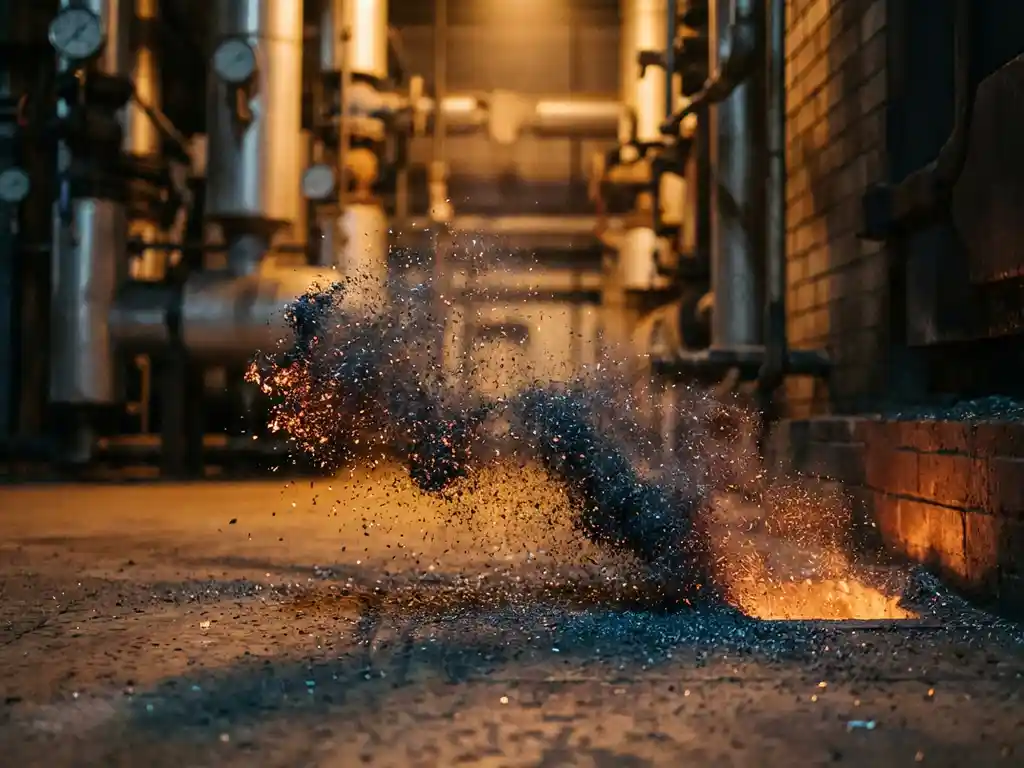
Iron fuel occupies a different position. As a solid powder, it can be stored in standard containers and transported using conventional freight systems, without the need for specialised pipelines or cryogenic equipment. When burned, it produces a flame of up to 2,000°C, making it suitable for the highest-temperature industrial applications. The combustion by-product is iron oxide, which can be collected and regenerated back into iron fuel using hydrogen, completing a closed loop with no carbon emissions at the point of combustion.
For a detailed technical comparison of how these approaches stack up in practice, the Iron Fuel Technology solutions overview provides a clear breakdown of where each technology fits.
How does iron fuel technology work as a fossil fuel replacement?
Iron fuel technology replaces fossil fuels by using fine iron powder as a combustible, carbon-free energy carrier. When burned inside an industrial boiler, iron powder reacts with oxygen in the air to generate intense heat, producing only iron oxide as a by-product. That iron oxide is then collected, transported to a production facility, and converted back into iron fuel using low-carbon hydrogen, completing a fully circular cycle.
The process works in four stages:
- Storage and transport: Iron powder is stored as a safe, solid-state fuel and transported to industrial sites using standard logistics. No specialist pipelines or pressurised containers are required.
- Combustion: Inside the Iron Fuel Boiler, the iron powder burns with ambient air, generating a flame of up to 2,000°C. This heat produces steam, hot water, or hot air for industrial processes, with zero direct CO₂ emissions and ultra-low NOₓ emissions.
- Collection: The iron oxide by-product is collected from the boiler chamber, safely stored, and returned to a production facility.
- Regeneration: At the production facility, iron oxide is converted back into iron fuel using low-carbon hydrogen, ready to be used again.
What makes this particularly practical for industrial operators is that the Iron Fuel Boiler is designed to integrate with existing boiler infrastructure. It does not require a complete overhaul of a facility, which significantly reduces disruption and capital cost. The system achieves an energy efficiency of up to 95%, and the total CO₂ output from the boiler system amounts to just 10 kg per megawatt-hour of thermal energy, attributable solely to a small pilot safety flame rather than the iron fuel combustion itself.
You can explore the full mechanics of the technology on the Iron Fuel Technology page, which covers the science behind the circular fuel cycle in more detail.
Which industries can replace fossil fuels the fastest?
Industries that operate at moderate process temperatures, have standardised boiler setups, and face strong regulatory or commercial pressure to decarbonise are best positioned to replace fossil fuels quickly. Food and beverage, specialty chemicals, and pulp and paper are among the sectors where the transition is most achievable in the near term.
These sectors share several characteristics that make them suitable early movers. Their heat demand is relatively consistent, which makes long-term fuel supply agreements viable. Many of their processes operate in the 100 to 500°C range, which is within reach of multiple clean heat technologies. And they face growing scrutiny from customers, investors, and regulators who want to see measurable progress on Scope 1 emissions.
Heavy industries such as cement, steel, and glass face a harder path. Their processes require extremely high temperatures, often above 1,000°C, and their facilities are large, capital-intensive, and difficult to retrofit. The transition in these sectors will take longer and will likely require a combination of breakthrough technologies and significant policy support.
The speed of transition also depends on geography. Industrial clusters with access to clean electricity grids, hydrogen infrastructure, or established renewable fuel supply chains will move faster than those in regions where that infrastructure is still being built.
What will realistically replace fossil fuels by 2050?
By 2050, fossil fuels in industrial heat will most likely be replaced by a mix of technologies rather than a single solution. Electrification will cover lower-temperature processes where grid access allows. Hydrogen will play a role in high-temperature sectors with the infrastructure to support it. And circular solid-fuel technologies like iron fuel are positioned to serve the middle ground, where neither electrification nor hydrogen is yet practical or cost-competitive.
The 2050 timeline is not arbitrary. It aligns with international climate commitments and regulatory frameworks that are progressively tightening the cost of carbon-intensive production. For industrial operators, this means the transition is not a distant consideration but an active planning challenge that is already shaping investment decisions today.
What is becoming clearer is that the technologies needed to replace fossil fuels in industry already exist or are in advanced stages of development. The question is no longer whether the transition will happen, but how quickly individual companies and sectors can move. Pilot programmes, first commercial contracts, and large-scale funding rounds are all signals that the market is beginning to move in earnest.
Iron fuel, for example, has already been demonstrated at megawatt industrial scale at Technology Readiness Level 7, and the first commercial contract for its industrial deployment has been signed. These are not theoretical milestones. They represent real progress toward a post-fossil-fuel industrial energy system that is both technically credible and commercially viable.
How RIFT helps replace fossil fuels in industrial heat
We develop and deliver industrial Iron Fuel Boilers that give energy-intensive manufacturers a practical, drop-in alternative to fossil fuel-fired heat. Our technology is built for industries where electrification and hydrogen are not yet viable, and where decarbonisation cannot wait for infrastructure that does not yet exist.
Here is what working with us looks like in practice:
- Zero direct CO₂ emissions from combustion, with ultra-low NOₓ output that meets stringent environmental standards
- Up to 95% energy efficiency, matching or outperforming the fossil fuel systems our boilers replace
- Plug-and-play integration with existing boiler infrastructure, minimising disruption and capital expenditure
- Long-term fuel supply agreements that give your operations the reliability and cost predictability you need to plan ahead
- A fully circular fuel cycle, with iron oxide collected after combustion and regenerated back into iron fuel using low-carbon hydrogen
We are already working with industrial partners across food and beverage, specialty chemicals, and pulp and paper, and our first commercial contract has been signed and is moving toward deployment. If you are ready to explore what Iron Fuel Technology could mean for your decarbonisation roadmap, get in touch with our team and we will walk you through the options.
Related Articles
- What is net zero and how does renewable energy help achieve it?
- What are the main types of renewable energy?
- What is a heat pump and how does it use renewable energy?
- Can homes run entirely on renewable energy?
- How does renewable energy work?
This content was generated with the help of AI and it may contain mistakes