

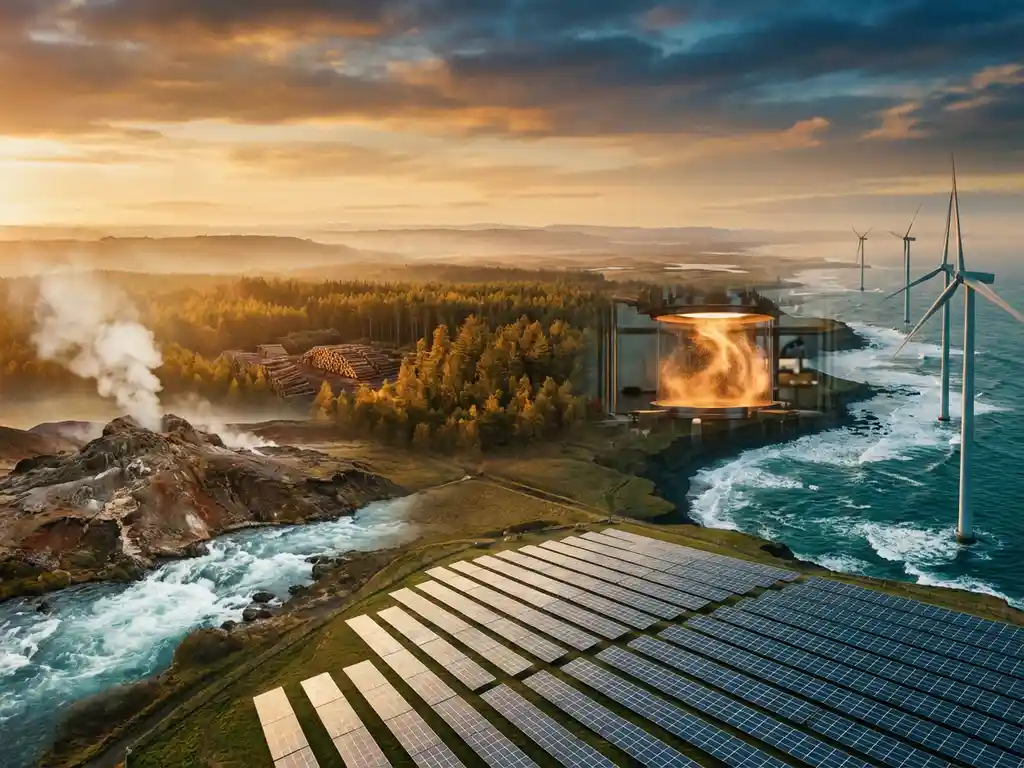
Renewable resources are reshaping how industries think about energy—and for good reason. As climate targets tighten and fossil fuel costs remain volatile, more sustainability managers are asking a fundamental question: Which renewable resources actually work for industrial operations, and how do you choose between them?
This guide walks through the nine most important renewable resources, explains how they generate energy, and takes an honest look at which ones are best suited to the high-temperature heat demands that industries like food and beverage, specialty chemicals, and pulp and paper rely on every day.
What are renewable resources and why do they matter?
Renewable resources are natural energy sources that replenish themselves over time, either continuously or within a human-relevant timeframe. Unlike fossil fuels, which took millions of years to form and release carbon when burned, renewable resources can be harvested repeatedly without depleting the source or adding net carbon dioxide to the atmosphere. They matter because the global energy system urgently needs to shift away from carbon-intensive fuels to limit climate change.
For industrial companies, the stakes are particularly high. Industry accounts for roughly 37% of total global energy consumption, and most of that energy is used for heat. When sustainability managers talk about decarbonizing operations, they are largely talking about finding renewable alternatives to the gas and oil that currently fire their boilers, kilns, and furnaces.
Renewable resources also matter from a regulatory and financial perspective. Frameworks like the EU Emissions Trading System are making carbon-intensive operations increasingly costly, while investors and customers are raising expectations around net-zero commitments. Transitioning to renewable energy sources is no longer just an environmental choice—it is becoming a commercial necessity.
What are the 9 most important renewable resources?
The nine most widely recognized renewable resources are solar energy, wind energy, hydropower, geothermal energy, biomass, tidal and wave energy, hydrogen, ocean thermal energy, and iron fuel. Each offers a distinct mechanism for generating usable energy, and each comes with its own set of strengths and limitations depending on the application.
- Solar energy: Captured through photovoltaic panels or concentrated solar systems, solar converts sunlight into electricity or heat.
- Wind energy: Wind turbines convert kinetic energy from moving air into electricity, most effectively at scale in open or offshore environments.
- Hydropower: Moving water drives turbines to generate electricity, making it one of the oldest and most reliable renewable sources.
- Geothermal energy: Heat from within the Earth is used to generate electricity or provide direct heating, particularly in volcanically active regions.
- Biomass: Organic material such as wood, agricultural residues, or dedicated energy crops is burned or converted to produce heat and electricity.
- Tidal and wave energy: The movement of ocean tides and waves is harnessed to generate electricity, still largely in early commercial stages.
- Hydrogen: When produced using renewable electricity, hydrogen is a clean energy carrier that can be burned or used in fuel cells.
- Ocean thermal energy: Temperature differences between surface and deep ocean water are used to drive a thermodynamic cycle and generate electricity.
- Iron fuel: Fine iron powder acts as a circular, solid-state energy carrier—it burns without any direct CO₂ emissions, and the resulting iron oxide is regenerated back into iron fuel using hydrogen, completing a fully closed loop.
Each of these resources plays a role in the broader energy transition, but their suitability varies significantly depending on geography, infrastructure, and the specific energy demand of the application.
How do renewable resources generate energy?
Renewable resources generate energy by converting naturally occurring forces, such as sunlight, wind, heat, or chemical reactions, into usable forms of energy like electricity, heat, or mechanical power. The conversion mechanism differs by resource, but the common thread is that no finite fuel is consumed and no net carbon is released in the process.
Conversion through physical forces
Solar panels use the photovoltaic effect to convert photons from sunlight into electrical current. Wind turbines capture the kinetic energy of moving air through rotating blades connected to a generator. Hydropower and tidal systems work similarly, using the movement of water to spin turbines. These technologies are well established and widely deployed at utility scale.
Conversion through heat and chemistry
Geothermal and biomass systems generate energy through heat—either extracted from the Earth or released through the combustion of organic material. Hydrogen and iron fuel operate through chemical reactions: hydrogen releases energy when it reacts with oxygen in a fuel cell or combustion chamber, while iron powder releases heat when it oxidizes during combustion. The key advantage of chemical energy carriers like hydrogen and iron fuel is that they can be stored and transported, making them far more flexible than intermittent sources like solar or wind.
Understanding how each resource converts energy is essential when evaluating which one fits a specific industrial process. High-temperature heat applications, for example, cannot always be served by electricity alone—they need a combustible fuel or a very high-temperature heat source.
Which renewable resources are best for industrial heat?
For industrial heat applications, the most viable renewable resources are biomass, hydrogen, and iron fuel. Solar thermal can contribute at lower temperatures, but most industrial processes require heat well above 200°C, which limits the options considerably. The best choice depends on the required temperature, available infrastructure, and the need for a continuous, reliable supply.
Biomass
Biomass is currently one of the most widely used renewable heat sources in industry. It can reach high temperatures and integrates relatively well with existing combustion equipment. However, biomass comes with sustainability concerns around land use, supply chain emissions, and air quality, and it does produce CO₂ at the point of combustion, even if that carbon is considered biogenic.
Hydrogen
Green hydrogen is a promising option for industrial heat, capable of reaching very high flame temperatures. The challenge is infrastructure. Hydrogen requires dedicated pipelines or on-site storage, and the cost of green hydrogen remains high in most markets. For companies without access to a hydrogen network, it can be difficult to deploy at scale in the near term.
Iron fuel
Iron fuel is emerging as a compelling alternative for industries that need high-temperature heat without the infrastructure constraints of hydrogen. It burns to produce a flame of up to 2,000°C, generates zero direct CO₂, and can be stored and transported in standard containers—much like coal or other solid fuels. You can read more about how this technology works on the Iron Fuel Technology page.
What is iron fuel and how does it work as a renewable resource?
Iron fuel is a circular, solid-state energy carrier made from fine iron powder. It works as a renewable resource because it operates in a fully closed loop: iron powder burns with ambient air to release high-temperature heat with zero direct CO₂ emissions, producing only iron oxide as a byproduct. That iron oxide is then regenerated back into iron fuel using low-carbon hydrogen, completing the cycle and making the material ready for reuse.
The process has four distinct stages. First, iron powder is stored and transported to an industrial site, much like any solid fuel. Second, it combusts inside a boiler, generating heat for steam, hot water, or hot air. Third, the resulting iron oxide is collected and transported to a production facility. Fourth, the iron oxide is converted back into iron fuel using hydrogen, closing the loop entirely.
What makes iron fuel particularly relevant for industrial operators is its practicality. It does not require a new pipeline network or major infrastructure investment. It integrates with existing boiler setups and delivers the high temperatures that many industrial processes demand. The Iron Fuel Boiler system achieves an energy efficiency of up to 95%, and total CO₂ output from the system is just 10 kg per megawatt-hour of thermal energy, attributable only to a small pilot safety flame rather than the combustion of iron itself.
From a lifecycle perspective, the full Iron Fuel Technology chain delivers a CO₂ reduction of 0.55 tonnes of CO₂ equivalent per tonne of iron fuel produced, calculated using EU Innovation Fund greenhouse gas methodology and assuming low-carbon hydrogen as feedstock. This makes it a credible option for carbon accounting and regulatory reporting.
How do you choose the right renewable resource for your industry?
Choosing the right renewable resource for your industry comes down to four key factors: the temperature your processes require, the infrastructure available at your site, the reliability and continuity of supply you need, and the total cost of switching. There is no single best answer, but a structured evaluation of these criteria will point you toward the most viable option.
Start by mapping your heat demand. Processes that require temperatures above 500°C immediately narrow the field, ruling out most solar thermal options and some geothermal applications. If your operations run continuously and cannot tolerate supply interruptions, intermittent sources like solar and wind are unlikely to meet your needs without significant investment in storage.
Next, consider your existing infrastructure. Companies with access to a hydrogen pipeline network may find green hydrogen a natural fit. Those without that access may find iron fuel more practical, since it can be transported in standard containers and integrated with existing boiler systems without major site modifications. For sectors like food and beverage, specialty chemicals, and pulp and paper, where boilers are central to operations, a drop-in-compatible solution significantly reduces transition risk.
Finally, factor in the total cost of ownership, not just the upfront investment. Some renewable technologies carry high capital costs but lower operating costs over time. Others, like iron fuel, are designed to be cost-competitive with fossil fuels from the outset, which matters when you are building the business case internally. Explore the full range of industrial clean heat solutions to understand what a transition could look like for your specific setup.
- Map your process heat requirements by temperature and continuity.
- Assess your existing infrastructure and what modifications are feasible.
- Evaluate supply reliability and fuel logistics for each option.
- Calculate total cost of ownership, including capital, operating, and transition costs.
- Check regulatory eligibility—some technologies qualify for EU Innovation Fund support or ETS benefits.
How We Help with Decarbonizing Industrial Heat
We develop and deliver industrial Iron Fuel Boilers—clean energy systems designed to replace fossil fuel-fired heat generation with a fully circular, carbon-free alternative. Our technology is built for industries that need high-temperature heat today, not after a decade of infrastructure investment.
- Zero direct CO₂ emissions and ultra-low NOₓ from combustion
- Up to 95% energy efficiency, outperforming most traditional fossil fuel boilers
- Plug-and-play integration with existing boiler setups—no major disruption to operations
- Long-term fuel supply agreements that guarantee reliable, cost-competitive iron fuel delivery
- Already deployed at commercial scale, with our first contract signed with Kingspan Unidek
- Backed by €113.8 million in funding, including an EU Innovation Fund grant
If you are evaluating renewable heat options for your facility and want to understand whether iron fuel is the right fit, we would love to talk. Get in touch with our team and let us help you build the case for cleaner industrial heat.
Related Articles
- How often does the EIA release reports?
- What is the difference between nuclear energy and renewable energy?
- What is the environmental impact of large-scale solar farms?
- What is the difference between renewable and non-renewable energy?
- Why are renewable energy companies struggling?
This content was generated with the help of AI and it may contain mistakes