

Choosing the most promising renewable energy source is not a simple question—and for industrial companies, it is one of the most consequential decisions on the path to decarbonization. While solar panels and wind turbines dominate the public conversation around clean energy, the reality for factories, food processors, and chemical plants is far more complex. High-temperature heat demands, infrastructure constraints, and operational continuity all shape which renewable energy sources are genuinely viable.
This article breaks down the key questions sustainability managers and energy decision-makers are asking right now, from the basics of what qualifies as a renewable energy source to the emerging technologies that are quietly reshaping the industrial heat sector.
What counts as a renewable energy source?
A renewable energy source is any energy source that is naturally replenished on a human timescale and does not deplete finite reserves. The most widely recognized examples are solar, wind, hydropower, geothermal, and biomass. What they share is a fundamentally different relationship with the planet compared to fossil fuels: they draw on ongoing natural processes rather than extracting stored carbon built up over millions of years.
The definition, however, is broader than many people realize. Emerging energy carriers like green hydrogen and iron fuel are also considered renewable when they are produced using renewable electricity or low-carbon hydrogen. These are not primary energy sources in the traditional sense, but they function as clean energy carriers that store and transport renewable energy in a usable form. This distinction matters enormously for industries that cannot simply plug into a solar panel and call it a day.
It is also worth noting that “renewable” and “zero-carbon” are not always synonymous. Biomass, for example, is technically renewable but produces CO₂ when burned. The most promising renewable energy sources for industry are those that combine renewability with near-zero lifecycle emissions.
Why is industrial heat so hard to decarbonize?
Industrial heat is difficult to decarbonize because most renewable energy technologies were not designed for it. The majority of clean energy innovation has focused on electricity generation, while heat—which accounts for roughly two-thirds of total industrial energy consumption—has received far less attention. Most of that heat is still produced by burning fossil fuels, and replacing it with clean alternatives is technically and economically challenging.
The temperature problem
Many industrial processes require heat at temperatures well above 200°C, and some demand temperatures exceeding 1,000°C. Electric heat pumps, which work well for low-temperature applications, lose efficiency and viability at these higher ranges. Green hydrogen can theoretically reach high temperatures, but the infrastructure required to store and transport it safely at scale remains limited and costly in most regions.
The infrastructure problem
Factories and processing plants have existing boiler infrastructure built around natural gas or coal. Replacing that infrastructure entirely involves significant capital expenditure, operational downtime, and technical risk. For many companies, a complete overhaul is not financially or operationally realistic in the near term. This is why drop-in compatibility—the ability to integrate a clean heat solution with existing equipment—is such a valued characteristic in industrial decarbonization.
Regulatory pressure from frameworks like the EU Emissions Trading System is accelerating the urgency, but the practical barriers remain real. The most promising renewable energy sources for industrial heat are those that address both the temperature challenge and the infrastructure challenge simultaneously.
Which renewable energy sources work for high-temperature industrial heat?
Only a handful of renewable energy sources can reliably deliver the high-temperature heat that energy-intensive industries require. These include green hydrogen, biomass, concentrated solar thermal, and emerging solid fuel carriers like iron fuel. Each has distinct strengths and limitations depending on the application, location, and existing infrastructure.
- Green hydrogen can produce very high flame temperatures and is carbon-free at the point of combustion, but it requires specialized storage and pressurized transport infrastructure and carries safety considerations that add cost and complexity.
- Biomass is widely available and can reach moderate to high temperatures, but it produces CO₂ during combustion and raises sustainability questions around land use and supply chain emissions.
- Concentrated solar thermal can generate process heat in sun-rich regions, but it is geographically limited and cannot provide heat on demand around the clock without substantial storage systems.
- Iron fuel burns at flame temperatures of up to 2,000°C, produces zero direct CO₂ emissions, and can be stored and transported using standard logistics infrastructure—making it particularly well suited to industrial boiler applications.
For most industrial operators in temperate climates, the practical shortlist comes down to hydrogen and iron fuel for high-temperature, high-demand applications. The key differentiator is often logistics, cost, and compatibility with existing equipment rather than the technology itself.
What is iron fuel, and how does it work as an energy carrier?
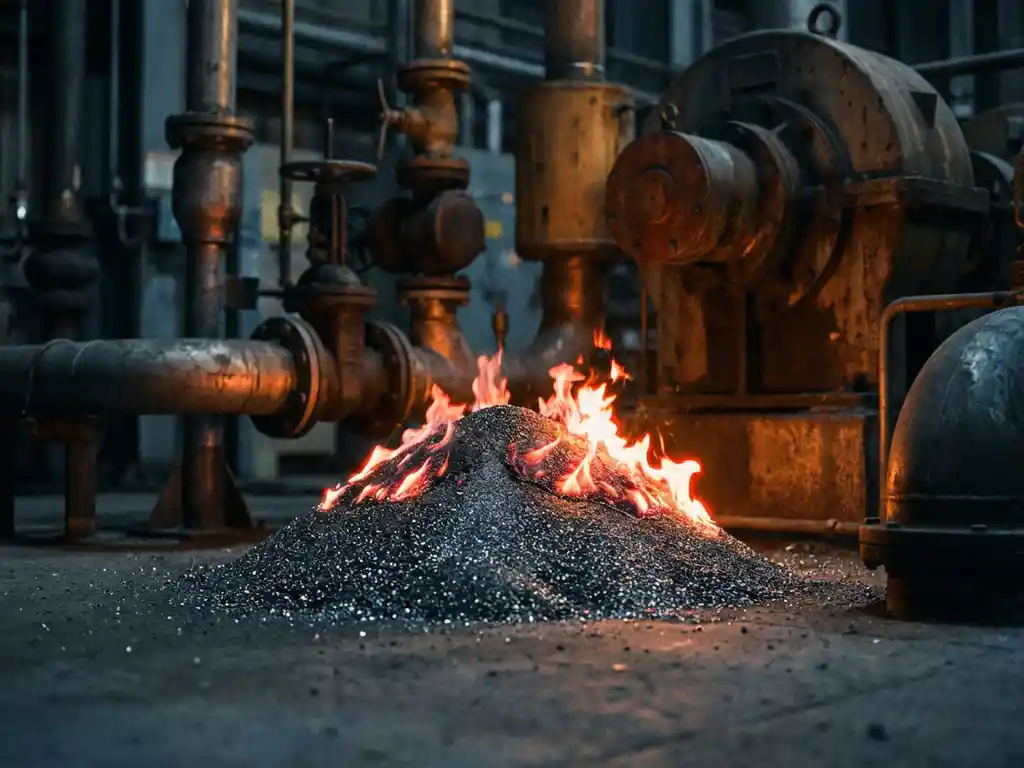
Iron fuel is a clean energy carrier made from fine iron powder that releases high-temperature heat when burned, producing zero direct CO₂ emissions. After combustion, the only byproduct is iron oxide—essentially rust—which can be collected and regenerated back into iron fuel using low-carbon hydrogen. This makes the entire cycle circular and reusable, functioning much like a rechargeable battery for industrial heat.
The process works in four stages. First, iron powder is stored and transported to industrial sites using standard, safe logistics—no pressurized tanks or specialist handling required. Second, the iron fuel combusts inside a boiler with ambient air, generating a flame of up to 2,000°C that produces steam, hot water, or hot air for industrial processes. Third, the iron oxide byproduct is collected from the boiler and transported to a production facility. Fourth, the iron oxide is converted back into iron fuel using hydrogen, completing the closed loop.
You can explore the full mechanics of this cycle on our Iron Fuel Technology page.
What makes iron fuel particularly compelling as a renewable energy source is its energy density and storability. Unlike electricity, it does not require immediate use. Unlike hydrogen, it does not require pressurization or cryogenic storage. It can sit in a warehouse and be deployed when needed, giving industrial operators the kind of operational flexibility that other clean energy carriers struggle to match.
How do the most promising renewable energy sources compare?
When comparing the most promising renewable energy sources for industrial applications, the key criteria are temperature capability, carbon emissions, infrastructure requirements, storability, and cost competitiveness. No single source wins on every dimension, but the comparison reveals clear patterns that should inform decision-making.
Here is how the leading options stack up across those criteria:
- Green hydrogen scores well on temperature capability and zero-carbon combustion, but faces significant hurdles in storage, transport infrastructure, and cost at scale in most markets today.
- Electrification is ideal for low-to-medium-temperature processes and is increasingly cost-competitive where renewable electricity is abundant, but it struggles to serve high-temperature industrial heat demands efficiently.
- Biomass offers fuel flexibility and high availability, but its carbon credentials depend heavily on sourcing, and it does not achieve zero-emission combustion.
- Iron fuel delivers high-temperature heat with near-zero carbon emissions at the point of combustion, integrates with existing boiler infrastructure, and benefits from straightforward logistics—though it is an emerging technology still in its commercial scale-up phase.
For sustainability managers evaluating options, the honest answer is that the best renewable energy source depends on the specific process, site, and sector. However, for industries where electrification is not viable and hydrogen infrastructure is not yet available, iron fuel represents a genuinely promising and practical alternative.
What should companies consider when choosing a renewable energy source?
Companies choosing a renewable energy source for industrial heat should evaluate five core factors: process temperature requirements, infrastructure compatibility, total cost of ownership, supply chain reliability, and carbon accounting accuracy. Getting these right from the start avoids costly pivots later and helps build a credible business case for internal stakeholders and regulators alike.
Start with your heat demand profile
Not all processes need the same type of heat. A food processing plant requiring steam at 150°C has very different options available compared to a ceramics manufacturer needing temperatures above 1,000°C. Understanding your heat demand profile—temperature ranges, load patterns, and seasonal variation—is the essential first step before evaluating any renewable energy source.
Assess infrastructure compatibility honestly
The most technically impressive clean energy solution is only useful if it can be integrated into your existing operations without prohibitive disruption. Ask whether the technology requires new pipelines, grid upgrades, or specialized safety systems. A solution that works with your current boiler setup and logistics infrastructure will almost always have a shorter path to deployment and a lower total cost of transition.
Look beyond the purchase price
Upfront capital costs matter, but the total cost of ownership over a 10- to 20-year horizon is a more accurate measure of financial viability. This includes fuel supply costs, maintenance, regulatory compliance costs, and the value of avoided carbon pricing under schemes like the EU ETS. A renewable energy source that appears more expensive today may become significantly more competitive as carbon prices rise and fossil fuel costs remain volatile.
Our industrial clean heat solutions are designed with cost competitiveness in mind, with iron fuel pricing aligned with fossil fuel benchmarks to make the transition financially viable for industrial operators.
How RIFT helps companies decarbonize industrial heat
We develop and deliver industrial Iron Fuel Boilers that replace fossil fuel-fired heat with a fully circular, carbon-free alternative—without requiring companies to rebuild their operations from scratch. Our approach is built around practical compatibility and long-term reliability.
- Drop-in integration: Our Iron Fuel Boiler is designed to complement existing boiler infrastructure, minimizing operational disruption during the transition.
- High-temperature performance: Iron fuel combusts at up to 2,000°C, making it suitable for the most demanding industrial heat applications.
- Near-zero emissions: Zero direct CO₂ emissions during combustion and ultra-low NOₓ emissions, with a full-chain CO₂ reduction of 0.55 tonnes of CO₂ equivalent per tonne of iron fuel when using low-carbon hydrogen.
- Up to 95% energy efficiency: Outperforming many traditional fossil fuel systems on both emissions and energy utilization.
- Long-term fuel supply: We offer fuel supply agreements that give operators the certainty they need to plan and invest with confidence.
We have already signed the world’s first commercial contract for the industrial use of Iron Fuel Technology, with Kingspan Unidek, and we are backed by €113.8 million in funding to scale from pilot to commercial deployment. If you are evaluating your options for decarbonizing industrial heat, we would love to talk. Get in touch with our team to explore what iron fuel could mean for your operations.
Related Articles
- What are examples of clean energy?
- Is nuclear energy considered renewable?
- How does biomass energy work?
- What industries are most affected by the shift to renewable energy?
- What are the 7 types of renewable energy?
This content was generated with the help of AI and it may contain mistakes