

Renewable energy is reliable enough for everyday industrial use—but reliability looks different depending on the energy source and application. For electricity-based renewables like wind and solar, output varies with weather conditions. For industrial heat, newer energy carriers like iron fuel offer consistent, on-demand performance that matches the dependability of conventional fossil-fuel systems. The real question is not whether renewable energy is reliable, but which form fits your specific process.
Intermittency in renewable electricity is holding back industrial heat decarbonization
When people question renewable energy reliability, they are usually thinking about solar panels going dark at night or wind turbines standing still on calm days. That intermittency is a genuine operational problem for energy-intensive industries that run continuous, high-temperature processes. If your boiler needs to hit 1,800°C to keep a production line moving, a gap in supply is not an inconvenience—it is a production stoppage with real financial consequences. The solution is not to abandon renewable energy, but to separate the question of renewable electricity from renewable heat. Energy carriers that store energy in a stable physical form—and release it on demand—eliminate the intermittency problem entirely.
Treating all renewable energy as the same is slowing down your transition
Sustainability managers often inherit a simplified view of renewable energy: solar, wind, and maybe hydrogen. That framing causes real problems when you are trying to decarbonize a cement kiln, a food-processing line, or a paper mill. Electrification may be too costly or constrained by infrastructure. Green hydrogen may not yet be available at the scale or price point your operation needs. Treating these as the only options means many companies stall on their Scope 1 targets while waiting for a solution that fits. A broader view of what counts as renewable heat—including solid-state energy carriers like iron fuel—opens up practical routes that work within existing boiler infrastructure without requiring a complete overhaul.
What does ‘reliable’ actually mean for industrial energy?
Reliability for industrial energy means consistent availability, predictable output, and supply security—independent of weather, grid conditions, or geopolitical disruption. A reliable energy source delivers the right temperature, at the right volume, when the production process demands it, without unplanned interruptions that affect output quality or cost.
For industrial operators, reliability is not an abstract concept. It is tied directly to production continuity. A boiler that cannot maintain consistent temperature affects product quality. A fuel supply that is uncertain creates planning risk. This is why industrial companies have historically stuck with fossil fuels—not because they are clean, but because they are predictable.
The good news is that reliability is increasingly achievable with renewable alternatives. The key is matching the right technology to the right application. For high-temperature heat, energy carriers that can be stored and transported as a stable physical material offer the same operational certainty as fossil fuels, without the carbon emissions.
Why is renewable energy seen as unreliable for industry?
Renewable energy is seen as unreliable for industry primarily because the most visible forms—solar and wind—are weather-dependent and cannot be controlled on demand. Industrial processes run on fixed schedules and require precise temperatures, which creates a mismatch with variable generation profiles.
This perception is accurate for grid-connected renewables without storage. A solar array produces electricity when the sun shines. A wind farm produces electricity when the wind blows. For a factory running a 24-hour production cycle, that variability creates real operational risk unless substantial battery storage or grid backup is available—both of which add cost and complexity.
However, this reliability concern does not apply equally to all forms of renewable energy. Energy carriers that store energy in a stable physical state—such as solid fuels or chemical carriers—decouple energy generation from energy use. They can be produced when renewable electricity is abundant and consumed when the process demands it. That distinction is important for industries evaluating their options.
What types of renewable energy are used in industrial heat?
The main renewable energy types used in industrial heat are electric heating powered by renewable electricity, green hydrogen combustion, biomass and bioenergy, and emerging solid-state energy carriers like iron fuel. Each suits different temperature ranges, infrastructure conditions, and investment profiles.
Here is a brief overview of the main options:
- Electric heating: Works well for low-to-medium temperature processes but becomes expensive and infrastructure-intensive at high temperatures. Grid capacity and industrial electricity tariffs are often limiting factors.
- Green hydrogen: Can reach high combustion temperatures and produces no direct CO₂. However, supply chains are still developing, and costs remain elevated in most markets.
- Biomass and bioenergy: A mature option with established supply chains, but sustainability credentials vary depending on feedstock sourcing, and it still produces CO₂ at the point of combustion.
- Iron fuel: A solid-state energy carrier that burns at up to 2,000°C with zero direct CO₂ emissions. It is stored and transported like conventional solid fuel, and the combustion byproduct—iron oxide—is regenerated back into iron fuel using hydrogen, completing a closed cycle.
The right choice depends on the process temperature required, existing infrastructure, fuel supply logistics, and total cost of ownership. Many industrial sites will end up using a combination of these technologies rather than a single solution.
How does iron fuel technology work as an energy carrier?
Iron fuel technology uses fine iron powder as a solid-state energy carrier. When burned, it generates high-temperature heat with zero direct CO₂ emissions. The only combustion byproduct is iron oxide, which is collected and regenerated back into iron fuel using hydrogen—creating a fully circular, carbon-free energy cycle.
The process follows four stages:
- Storage and transport: Iron powder is stored and transported to industrial boiler locations. As a solid material, it is stable, safe, and straightforward to handle using existing logistics infrastructure.
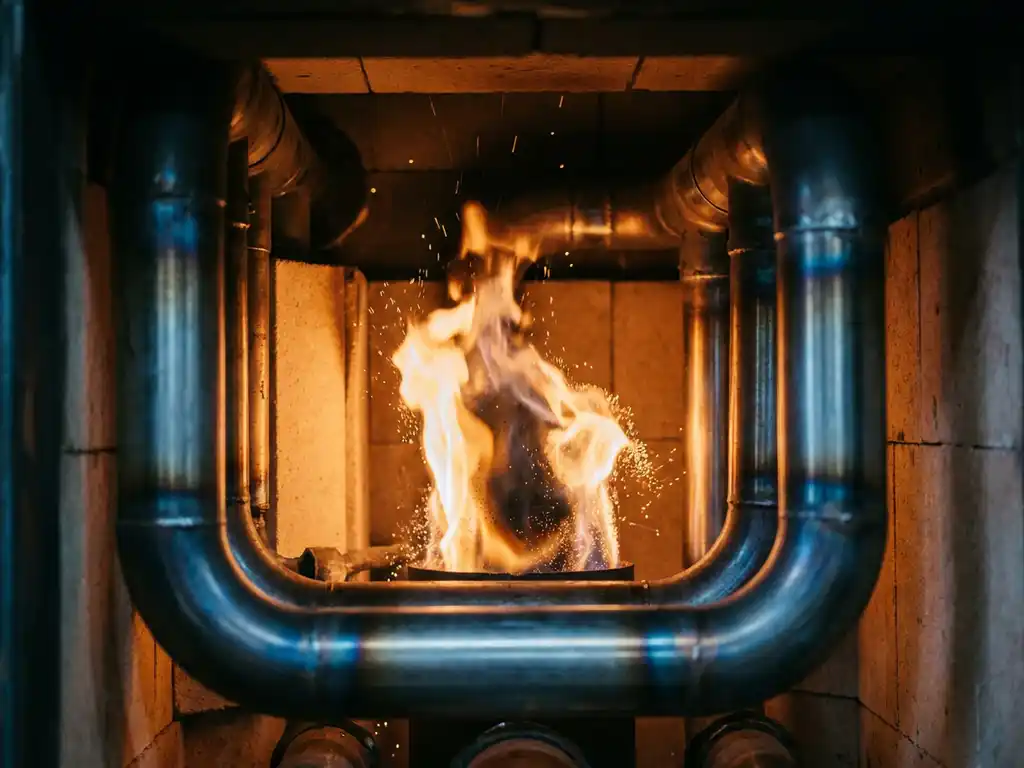
- Combustion: The iron fuel burns inside an industrial boiler, generating a flame of up to 2,000°C. This heat produces steam, hot water, or hot air for industrial processes. The only direct emissions are ultra-low NOₓ, and the only byproduct is iron oxide.
- Collection: The iron oxide is collected from the boiler chamber, stored, and transported to a production facility for regeneration.
- Regeneration: The iron oxide is converted back into iron fuel using low-carbon hydrogen, completing the cycle and making the material ready for reuse.
The Iron Fuel Boiler achieves an energy efficiency of up to 95% and requires only 43 kWh of auxiliary electricity per MWh of thermal energy produced. Total CO₂ output from the system is just 10 kg per MWhth—attributable solely to a pilot safety flame, not to the combustion of iron fuel itself. You can read more about how the full technology works on our Iron Fuel Technology page.
Which renewable heat solution is right for industrial processes?
The right renewable heat solution depends on your process temperature, existing boiler infrastructure, available fuel supply, and capital budget. There is no universal answer, but a structured comparison of your operational requirements against each technology’s strengths will point you toward the best fit.
For processes requiring temperatures above 500°C—common in food processing, specialty chemicals, and pulp and paper—electric heating often falls short without significant infrastructure upgrades. Green hydrogen can reach the necessary temperatures but depends on local supply availability. Iron fuel is designed specifically for this high-temperature range and integrates with existing boiler systems, reducing the capital disruption of switching.
Cost is another practical filter. Iron fuel is priced at around 140 euros per tonne and is designed to be cost-competitive with fossil fuels, which matters when sustainability managers are building an internal business case. A solution that requires a large upfront premium over current energy costs faces a harder approval process, regardless of its environmental credentials.
Fuel supply security also deserves attention. Long-term fuel supply agreements—like those we offer alongside our Iron Fuel Boiler—reduce the planning risk that comes with newer energy technologies. Knowing that supply is contracted and consistent removes one of the main objections to switching away from fossil fuels. Explore our industrial heat solutions to see how different options compare for your sector.
How can industrial companies start transitioning to renewable heat?
Industrial companies can start transitioning to renewable heat by auditing their current heat demand, identifying which processes are candidates for decarbonization, and evaluating renewable heat technologies against those specific requirements. The transition does not need to be all-or-nothing—a phased approach that complements existing infrastructure is often the most practical starting point.
A structured starting approach typically looks like this:
- Map your heat demand by temperature range and volume across all processes.
- Identify which processes are the highest priority based on emissions impact and operational flexibility.
- Evaluate available technologies against those processes—factoring in temperature requirements, infrastructure compatibility, and total cost.
- Assess fuel supply options and whether long-term supply agreements are available to reduce transition risk.
- Build the internal business case with a clear emissions-reduction projection and payback timeline.
One practical advantage of drop-in solutions—technologies designed to work alongside existing boiler infrastructure rather than replace it entirely—is that they reduce the initial capital commitment and operational disruption. This makes it easier to demonstrate results on a smaller scale before committing to a full transition.
Regulatory context also matters here. The EU Emissions Trading System is increasing the cost of carbon over time, which gradually improves the financial case for renewable heat. Companies that begin the transition earlier are better positioned to manage compliance costs and meet board-level net-zero commitments without rushed, expensive decisions later.
How RIFT helps industrial companies decarbonize their heat
We developed Iron Fuel Technology specifically to solve the reliability and compatibility challenges that make industrial heat decarbonization so difficult. Our solution is built around what industrial operators actually need: consistent performance, supply security, and a transition that does not require shutting down existing infrastructure.
Here is what we offer:
- Drop-in compatibility: Our Iron Fuel Boiler is designed to integrate with existing boiler systems, so you are not starting from zero.
- High-temperature output: We generate heat up to 2,000°C with zero direct CO₂ and ultra-low NOₓ emissions.
- Up to 95% energy efficiency: Our system outperforms many conventional fossil-fuel boilers on efficiency.
- Long-term fuel supply agreements: We provide contracted fuel supply so your planning is not dependent on an uncertain market.
- Cost-competitive pricing: Iron fuel is priced to align with fossil-fuel economics, making the business case easier to build internally.
If you are evaluating options for your industrial heat transition, we are happy to talk through what makes sense for your specific processes. Get in touch with our team to start the conversation.
Related Articles
- What is the payback period for solar panels?
- What is a smart grid and how does it support renewable energy?
- Can renewable energy reduce dependence on energy imports?
- How do countries transition to renewable energy?
- What are 5 renewable sources of energy?
This content was generated with the help of AI and it may contain mistakes