

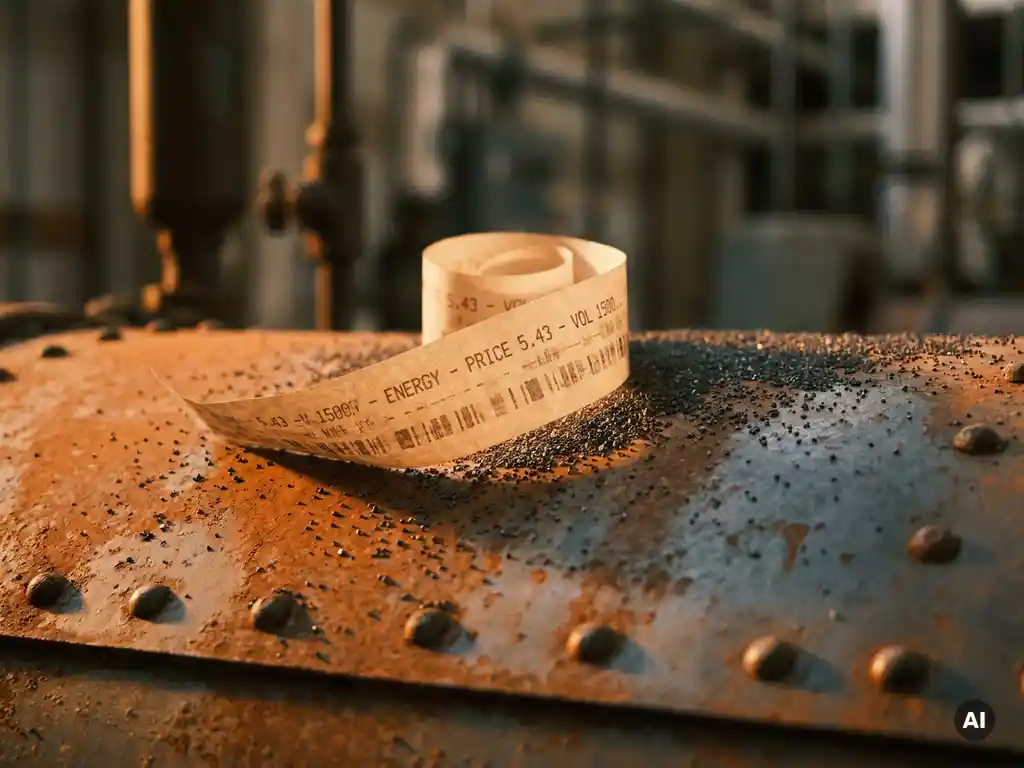
Volatile energy prices make the business case for clean heat harder to build in the short term but more compelling in the long term. When natural gas prices swing unpredictably, finance teams hesitate to commit to large capital investments, but that same unpredictability is precisely what makes price-stable, fossil-free heat alternatives strategically attractive. For sustainability managers in energy-intensive industries, understanding how to frame energy price risk is essential to building a credible internal business case for decarbonised heat. This article works through the key questions that shape that conversation.
How does fossil fuel price volatility affect industrial heat costs?
Fossil fuel price volatility directly increases the cost and unpredictability of industrial heat production. Because most industrial heat is still generated by burning natural gas or other fossil fuels, any spike in commodity prices flows straight through to energy bills, with little buffer for companies that cannot switch fuels quickly or reduce heat demand without disrupting production.
Industrial heat is not a discretionary cost. In sectors like Food and Beverage, Specialty Chemicals, and Pulp and Paper, continuous process heat is a production requirement, not an efficiency variable. When gas prices surge, as European markets experienced acutely in recent years, these companies absorb the full impact. They cannot simply pause operations or substitute a cheaper energy source overnight.
The structural problem runs deeper than price spikes. It is the unpredictability itself that causes damage. Energy-intensive manufacturers build cost models around projected fuel prices. When those projections prove wrong by a wide margin, margins erode, investment planning becomes unreliable, and competitive positioning weakens relative to producers in regions with more stable energy costs. The EU’s Clean Industrial Deal, introduced to address exactly this dynamic, identifies affordable energy as the foundation of industrial competitiveness, and explicitly targets reduced dependence on imported fossil fuels as a core policy objective.
The replacement of natural gas with domestically produced or circularly regenerated energy carriers is therefore not just an environmental argument. It is an economic resilience argument.
Why does energy price uncertainty make decarbonisation harder to justify?
Energy price uncertainty complicates decarbonisation investment decisions because it undermines the financial comparisons that business cases depend on. When the baseline cost of fossil fuel heat is unclear, calculating the payback period or net present value of a clean heat investment becomes unreliable, which gives finance teams a legitimate reason to delay approval.
Most clean heat technologies require meaningful upfront capital expenditure. Whether a company is evaluating electrification, hydrogen, or an alternative fuel system, the CAPEX versus OPEX decision hinges on assumptions about future energy prices. If natural gas is cheap today, the financial case for switching looks weaker on paper. If it is expensive, the case looks stronger. But if no one can confidently predict which direction prices will move over the next five to ten years, the investment case feels inherently speculative.
This is compounded by the EU Emissions Trading System. ETS carbon prices add a cost layer on top of fuel prices, and those prices are also subject to market fluctuation. A sustainability manager building a business case must therefore model both fuel price risk and carbon price risk simultaneously, and present that case to a board that may be sceptical of projections built on two uncertain variables.
Grid congestion adds a further layer of complexity for companies considering electrification as their decarbonisation route. In many parts of Europe, connection to the grid at the capacity needed for industrial heat electrification is either unavailable, subject to long waiting times, or prohibitively expensive. This means that even when the financial case for electrification is theoretically sound, the practical pathway is blocked, leaving sustainability managers without a clear near-term alternative to fossil fuels.
Can fixed-price clean heat alternatives reduce exposure to energy market swings?
Yes. Clean heat technologies that operate on long-term, fixed-price fuel supply agreements can provide meaningful insulation from fossil fuel market volatility. By locking in a predictable cost per unit of heat over a defined contract period, companies replace an unpredictable variable cost with a stable, plannable one, which is structurally different from how fossil fuel procurement works.
This is one of the underappreciated advantages of emerging iron fuel technology and similar circular energy carriers. Because iron fuel is regenerated from iron oxide using hydrogen in a closed loop, its price is not tied to global commodity markets in the way that natural gas prices are. The cost of iron fuel reflects the cost of production, primarily hydrogen and electricity, rather than geopolitical supply dynamics or spot market speculation.
For a sustainability manager, this distinction matters enormously when building a multi-year business case. A fixed-price fuel supply agreement transforms the financial model from a forecast exercise into a known-cost scenario. That makes board approval easier to secure, project financing more straightforward, and long-term planning more credible.
It is worth noting that security of supply is a related but distinct benefit. Iron fuel can be stored in standard containers and does not require dedicated pipeline infrastructure. This means companies are not exposed to supply interruptions caused by grid congestion, pipeline capacity constraints, or geopolitical disruptions to gas imports, all of which have proven to be real risks in recent years.
What’s the difference between short-term energy savings and long-term price stability?
Short-term energy savings are reductions in your current energy bill, typically achieved through efficiency measures or opportunistic fuel switching when prices are favourable. Long-term price stability is a structural property of your energy supply, the degree to which your future heat costs are predictable and insulated from market volatility. These are related but fundamentally different outcomes, and confusing them leads to poor investment decisions.
A company that switches to a cheaper fuel source when spot prices are low may achieve short-term savings, but it remains fully exposed to the next price cycle. Conversely, a company that invests in a fixed-price clean heat solution may not achieve the lowest possible cost in any given year, but it eliminates the risk of cost spikes disrupting its financial planning over a ten- or twenty-year horizon.
For sustainability managers, the relevant question is not just “what does this cost today?” but “what does our heat cost exposure look like across the full asset lifetime?” Consider the difference in these two planning scenarios:
- Fossil fuel baseline: Current gas price is competitive, but costs fluctuate year on year. Carbon costs under the EU ETS add further variability. Long-term cost trajectory is uncertain and likely upward as carbon pricing tightens.
- Fixed-price clean heat: Upfront investment is higher, but fuel cost per unit of heat is locked or indexed to a stable reference. No direct carbon cost exposure. Financial model is predictable over the asset lifetime.
The first scenario may look cheaper today. The second scenario is almost certainly cheaper to plan around, and potentially cheaper in absolute terms once carbon costs are fully factored in. Long-term price stability is a form of risk management, and it deserves to be valued as such in any serious business case.
How should sustainability managers factor energy price risk into the clean heat business case?
Sustainability managers should treat energy price risk as a quantifiable financial variable, not a qualitative caveat. The most effective approach is to model multiple fuel price scenarios, a conservative case, a central case, and a stress case, and show how the clean heat investment performs across all three. This reframes the conversation from “is clean heat cheap enough?” to “how much risk does fossil fuel dependency carry?”
In practice, this means building the business case around the following elements:
- Total cost of heat over the asset lifetime, not just year-one energy savings. A clean heat system with higher upfront CAPEX may deliver lower lifetime costs once fuel price risk and carbon costs are included.
- Carbon cost exposure under the EU ETS. As carbon prices evolve and the ETS tightens, the financial penalty for fossil fuel combustion increases. This should be modelled explicitly, not treated as a footnote.
- Grid congestion and infrastructure risk for electrification alternatives. If grid connection is uncertain or delayed, the apparent cost advantage of electrification may not be realisable within the planning horizon.
- Regulatory trajectory. The EU’s Clean Industrial Deal and associated frameworks are moving in a clear direction: low-carbon requirements in procurement, stronger support for industrial decarbonisation, and tightening emissions rules. Companies that act early will be better positioned than those that wait.
- Operational continuity value. A clean heat solution that integrates with existing boiler infrastructure without requiring a full production shutdown has a real economic value that belongs in the business case.
The goal is to present the board not with a single number, but with a risk-adjusted comparison. Fossil fuel heat carries a cost today and an escalating risk tomorrow. A credible clean heat alternative offers cost predictability, regulatory alignment, and operational resilience. Framed that way, the business case becomes a risk management decision as much as an energy procurement decision.
How Iron Fuel Technology helps with volatile energy prices
We developed Iron Fuel Technology precisely for the situation described throughout this article: industrial companies that need reliable, high-temperature heat, cannot afford to wait for grid infrastructure, and want to escape the cost unpredictability of fossil fuels without compromising production continuity.
Our Iron Fuel Boiler delivers clean industrial heat with the following characteristics that are directly relevant to energy price risk:
- Up to 95% energy efficiency, outperforming many traditional fossil fuel systems and reducing the volume of fuel needed per unit of heat produced.
- Zero direct CO₂ emissions during combustion (only 10 kg CO₂/MWhth, stemming solely from the pilot safety flame), which eliminates direct carbon cost exposure under the EU ETS.
- RIFT claims the lowest NOₓ emissions of any fuel, at under 5 mg/MJ, supporting compliance with tightening air quality regulations.
- Long-term fuel supply agreements at a fixed price of 140 €/tonne, replacing unpredictable fossil fuel procurement with a stable, plannable cost structure.
- No grid connection required for heat generation, making the solution fully independent of grid congestion constraints.
- Drop-in compatibility with existing boiler infrastructure, minimising disruption to operations during the transition.
Iron fuel is stored and transported in standard containers, is not subject to the geopolitical supply risks that affect gas markets, and is regenerated in a fully circular process, meaning the fuel cycle itself is not dependent on fossil inputs. For sustainability managers building the business case for decarbonised heat, this combination of price stability, carbon performance, and operational practicality is designed to make the internal conversation significantly easier.
If you are evaluating clean heat options for your facility and want to understand how Iron Fuel Technology could fit your specific situation, get in touch with our team to start the conversation.
Frequently Asked Questions
How do we model energy price risk in a way that a CFO or finance committee will find credible?
The most effective approach is to build a three-scenario model — conservative, central, and stress — using publicly available gas price forecasts from sources like the IEA, European Commission, or energy market analysts as your reference points. Present each scenario alongside the clean heat alternative’s fixed cost structure, so the board can see exactly how much financial risk the fossil fuel baseline carries under each outcome. Framing it as a risk-adjusted comparison rather than a simple cost comparison shifts the conversation from speculation to structured decision-making, which is language finance teams respond to.
What if natural gas prices drop significantly — does that undermine the business case for clean heat?
A short-term drop in gas prices reduces the immediate financial gap but does not eliminate the structural risks that make fossil fuel dependency costly: price volatility will return, EU ETS carbon costs continue to tighten, and regulatory requirements around industrial emissions are moving in one direction only. A clean heat investment is a 10–20 year asset decision, and a single favourable price window does not change the long-term cost trajectory or compliance exposure. The business case should explicitly show that even in a low-gas-price scenario, the risk-adjusted lifetime cost of clean heat remains competitive.
How do we account for EU ETS carbon costs when building the business case, given that carbon prices also fluctuate?
Model carbon costs as a separate line item using a range of ETS price projections — current spot price, analyst consensus forecasts, and a high-end stress scenario consistent with the EU’s stated policy direction. The EU ETS is designed to tighten over time as free allowances are phased out under the Carbon Border Adjustment Mechanism (CBAM) framework and sectoral caps decrease, so a flat carbon price assumption is likely to understate future exposure. Presenting the board with a sensitivity table showing how total fossil fuel heat costs change at different carbon price levels makes the regulatory risk concrete and quantifiable rather than theoretical.
What are the most common mistakes sustainability managers make when presenting clean heat business cases internally?
The most frequent mistake is framing the business case purely around year-one energy savings rather than total cost of ownership over the asset lifetime, which systematically undervalues clean heat investments with higher upfront CAPEX but lower and more stable long-term costs. A second common error is treating energy price and carbon price risk as qualitative caveats rather than modelling them explicitly as financial variables. Finally, failing to quantify the operational continuity value of a solution that integrates with existing infrastructure — avoiding a full production shutdown — often leaves a significant economic benefit out of the analysis entirely.
How long does it typically take to implement an iron fuel boiler system, and what disruption should we expect during the transition?
Iron Fuel Technology is designed for drop-in compatibility with existing boiler infrastructure, which significantly reduces both implementation time and operational disruption compared to full electrification or a greenfield heat system. Because no new grid connection is required and the system integrates with existing equipment, the transition can be planned around scheduled maintenance windows rather than requiring an unplanned production shutdown. For specific timelines relevant to your facility configuration and heat demand profile, the Iron Fuel Technology team can provide a more detailed implementation assessment.
Is iron fuel supply chain risk comparable to natural gas, or does it introduce different vulnerabilities?
Iron fuel carries a fundamentally different risk profile from natural gas. Natural gas supply is exposed to geopolitical disruption, pipeline capacity constraints, and global commodity market speculation — all of which have proven to be acute risks for European industry in recent years. Iron fuel, by contrast, is stored in standard containers, does not require dedicated pipeline infrastructure, and is regenerated through a closed circular process that is not dependent on fossil inputs or concentrated geopolitical supply routes. This does not mean iron fuel supply is risk-free, but the nature and geography of the risks are structurally different, and for many European manufacturers, meaningfully lower.
At what scale or heat demand level does an iron fuel solution typically become financially viable?
Iron fuel is best suited to energy-intensive industrial processes that require continuous, high-temperature process heat — sectors like Food and Beverage, Specialty Chemicals, and Pulp and Paper are natural fits. The financial viability threshold depends on your facility’s specific heat demand, current fuel costs, carbon cost exposure, and grid connection situation, all of which affect the comparison with alternatives. Rather than applying a generic rule of thumb, the most reliable starting point is a facility-specific assessment with the Iron Fuel Technology team, who can model the business case against your actual cost and operational parameters.
Related Articles
- What is the primary purpose of the EIA?
- How recyclable are solar panels and wind turbines?
- What is the energy transition and why does it matter?
- What industries are most affected by the shift to renewable energy?
- What countries use the most renewables?
This content was generated with the help of AI and it may contain mistakes