

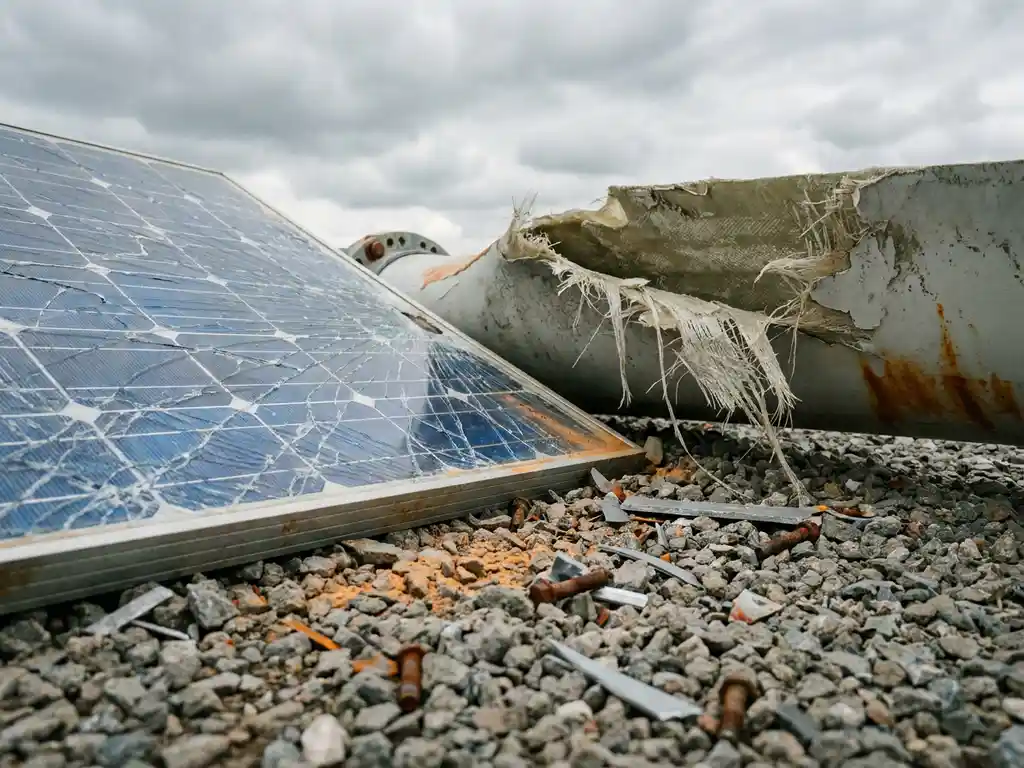
Solar panels and wind turbines are widely celebrated as clean energy solutions, and rightly so. But a question that often gets overlooked is what happens to them at the end of their working lives. The honest answer is that recyclability varies significantly between technologies, and for some components, the industry is still working out how to handle them responsibly. Understanding these limitations matters if you are making long-term decisions about your decarbonisation strategy.
End-of-life waste from renewables is building up faster than recycling infrastructure
The first generation of large-scale solar installations is approaching the end of its operational life, and wind capacity decommissioned over the next two decades will generate substantial volumes of hard-to-process material. The problem is not that renewables produce waste during operation—they do not. The problem is that the systems needed to recycle them at scale simply do not exist yet in most regions. For sustainability managers evaluating the full lifecycle of their energy choices, this gap between expected recyclability and actual recycling capacity is a real planning risk. The practical fix is to factor end-of-life management into procurement decisions now, not after assets are already installed.
Assuming renewables are waste-free is holding back honest lifecycle accounting
There is a persistent assumption that because solar and wind produce no emissions during operation, they are inherently clean across their entire lifecycle. That assumption is incomplete. Manufacturing solar panels requires energy-intensive processes and materials such as silver, indium, and tellurium. Wind turbine blades are made from composite materials that are difficult to separate and recycle. If these realities are left out of a company’s Scope 3 accounting, the sustainability picture looks cleaner than it is. The fix is straightforward: apply full lifecycle thinking to renewable energy assets with the same rigour you would apply to any other material input.
How recyclable are solar panels at end of life?
Solar panels are partially recyclable, but not fully. The aluminium frame and glass cover—which together make up the majority of a panel’s weight—can be recovered through established processes. However, the photovoltaic cells themselves contain materials such as silver, silicon, and, in some cases, cadmium or lead, which are harder and more expensive to extract. Current recycling rates for the full panel remain low in most markets.
The core challenge is economics. Recycling a solar panel costs money, and the recovered materials often do not offset that cost at current commodity prices. Most panels that reach end of life today are sent to general electronics recyclers or, in some regions, to landfill. The EU’s Waste Electrical and Electronic Equipment (WEEE) Directive requires member states to collect and recycle solar panels, but enforcement and infrastructure vary considerably across countries.
The materials that are most valuable and most difficult to recover—silver for electrical contacts and thin-film materials such as indium and telluride in some panel types—require specialised processes that are not yet widely deployed at commercial scale. As more panels reach end of life over the coming decade, the economics of recovery are expected to improve, but the infrastructure needs to be built now to meet that demand.
What happens to wind turbine blades when they’re decommissioned?
Wind turbine blades are among the most difficult components in the renewable energy sector to recycle. Most blades are made from fibreglass- or carbon fibre-reinforced composites, which are strong and lightweight but extremely hard to break down. When blades are decommissioned, the most common outcome today is landfill, incineration, or cutting them into sections for use as construction fill.
A typical onshore wind turbine blade can be anywhere from 40 to 80 metres long and weigh several tonnes. The composite materials that make blades so effective at capturing wind energy are the same properties that make them resistant to conventional recycling methods. Thermal and chemical processes can break down the resin, but recovering high-quality fibre remains technically and economically challenging.
Some European countries, including Germany, have banned the landfilling of turbine blades, which has accelerated the search for alternatives. Cement kilns have been used to co-process blade material as a fuel substitute and filler, which reduces landfill volumes but is not true recycling. Several companies are developing mechanical shredding and pyrolysis approaches, but none has yet reached the scale needed to handle the volume of blades that will be decommissioned over the next 20 years.
Why is recycling solar panels so difficult?
Recycling solar panels is difficult primarily because of their layered construction. A panel bonds together glass, encapsulant material, photovoltaic cells, and a backsheet using adhesives and laminates designed to last 25 to 30 years. Separating these layers without damaging the recoverable materials requires heat, chemicals, or mechanical force—each of which adds cost and complexity.
The economics create a further barrier. The most abundant material in a panel by weight is glass, which has a low market value per tonne. Recovering it requires significant processing effort for a modest return. The valuable materials—silver, silicon, and rare elements in thin-film panels—exist in small quantities and require specialised extraction to recover in a usable form.
There is also a design problem. Solar panels were not originally designed with end-of-life disassembly in mind. The adhesives and encapsulants that protect panels from decades of weather exposure are precisely the features that make them hard to take apart later. Newer panel designs are beginning to address this, with some manufacturers exploring more recyclable encapsulants and modular designs, but the vast majority of panels currently in operation were not built with recycling in mind.
What new technologies exist for recycling renewable energy components?
Several technologies are emerging to improve the recyclability of solar panels and wind turbine blades. The most promising approaches include chemical recycling for composites, pyrolysis for blade material, and dedicated thermal processing lines for solar panels that recover high-purity silicon and silver.
For solar panels, the key developments include:
- Thermal delamination: Controlled heating to separate the encapsulant from the glass and cells, enabling cleaner material recovery
- Hydrometallurgical processes: Using chemical solutions to dissolve and recover silver and other metals from photovoltaic cells with higher purity than mechanical methods
- Electrostatic separation: A dry process for separating silicon and other cell materials after mechanical shredding
- Design-for-recycling initiatives: Industry efforts to standardise panel construction in ways that make future disassembly easier
For wind turbine blades, pyrolysis is the most developed emerging solution. The process uses high heat in the absence of oxygen to break down the resin matrix, releasing the glass or carbon fibre in a form that can be reused in lower-grade composite applications. Solvolysis, which uses solvents rather than heat, can recover higher-quality fibre but remains expensive at scale.
Several companies in Europe and North America are building commercial-scale recycling facilities specifically for renewable energy components. Progress is real, but the timeline for these technologies to match the volume of material coming offline is tight.
How does the waste footprint of renewables compare to fossil fuels?
Even accounting for end-of-life waste challenges, the overall environmental footprint of solar and wind is significantly lower than that of fossil fuels across their operational lifetime. Fossil fuel combustion produces continuous waste streams—carbon dioxide, nitrogen oxides, particulates, and ash—throughout every hour of operation. Renewable energy waste is concentrated in manufacturing and at end of life, with clean operation in between.
The comparison is not straightforward, because fossil fuel waste is largely invisible—it disperses into the atmosphere rather than accumulating as a physical material. Wind blade material in a landfill is visible and measurable. Carbon dioxide in the atmosphere is not, but its consequences are considerably larger.
Lifecycle assessments consistently show that solar and wind generate far lower greenhouse gas emissions per unit of energy produced than coal or gas, even when manufacturing and disposal are included. The recyclability gap in renewables is a real problem that needs solving, but it does not change the fundamental conclusion that renewables cause less total harm than the fossil fuels they replace.
The more honest framing for sustainability managers is this: renewables are not waste-free, but they are substantially better than the alternative. The task is to push for better end-of-life solutions while continuing to accelerate the transition away from fossil fuels.
What does the recyclability gap mean for industrial decarbonisation strategies?
The recyclability gap in renewables means that no single clean energy technology offers a perfect lifecycle profile today. For industrial decarbonisation strategies, this is a signal to evaluate technologies across their full lifecycle—not just operational emissions—and to consider diversity in the clean energy mix rather than relying on one solution.
For industries that need high-temperature heat, the recyclability challenge in solar and wind is largely a separate issue anyway. Photovoltaic panels produce electricity, not heat, and converting that electricity into high-grade industrial heat involves significant losses. Wind energy faces the same conversion challenge. For many industrial processes, the more relevant question is which clean fuel or heat source can replace fossil fuels directly, without the infrastructure and conversion losses that come with electrification.
Lifecycle thinking also means asking where waste is generated, by whom, and who bears the cost. A company installing solar panels on its roof is taking on some responsibility for eventual disposal. A company purchasing clean heat as a service from a technology provider shifts that responsibility elsewhere. The structure of the energy supply relationship matters for how end-of-life liabilities are accounted for.
For sustainability managers, the practical implication is clear: assess the full lifecycle of any clean energy technology before committing, understand who is responsible for end-of-life management, and build that into your reporting and risk frameworks. The recyclability gap is solvable, but it requires the industry to take it seriously now rather than deferring the question to future generations.
How Iron Fuel Technology helps with industrial decarbonisation
We developed Iron Fuel Technology as a direct response to the limitations sustainability managers face when trying to decarbonise industrial heat. Unlike solar or wind, our approach is built around a circular material cycle: iron powder burns to produce heat, leaves behind iron oxide, and that iron oxide is regenerated into iron fuel using hydrogen. Nothing is wasted, and nothing goes to landfill.
- Zero direct CO₂ emissions during combustion, with only 10 kg CO₂ per MWh attributable to the pilot safety flame
- Up to 95% energy efficiency, outperforming many conventional industrial boiler systems
- Fully circular material cycle: iron oxide is collected and regenerated, not disposed of
- Drop-in compatible with existing boiler infrastructure, reducing capital disruption
- Long-term fuel supply agreements that give industrial operators predictable costs and reliable access to clean heat
If you are evaluating your options for industrial heat decarbonisation and want to understand how a circular, waste-free energy carrier fits into your strategy, explore our Iron Fuel Technology or see how it applies to your sector on our solutions page. When you are ready to talk specifics, get in touch with our team, and we will work through the details with you.
Related Articles
- What is the best clean energy?
- What is the difference between solar and wind energy?
- Which renewable energy source is the cheapest?
- What is Europe's approach to the energy transition?
- Can homes run entirely on renewable energy?
This content was generated with the help of AI and it may contain mistakes