

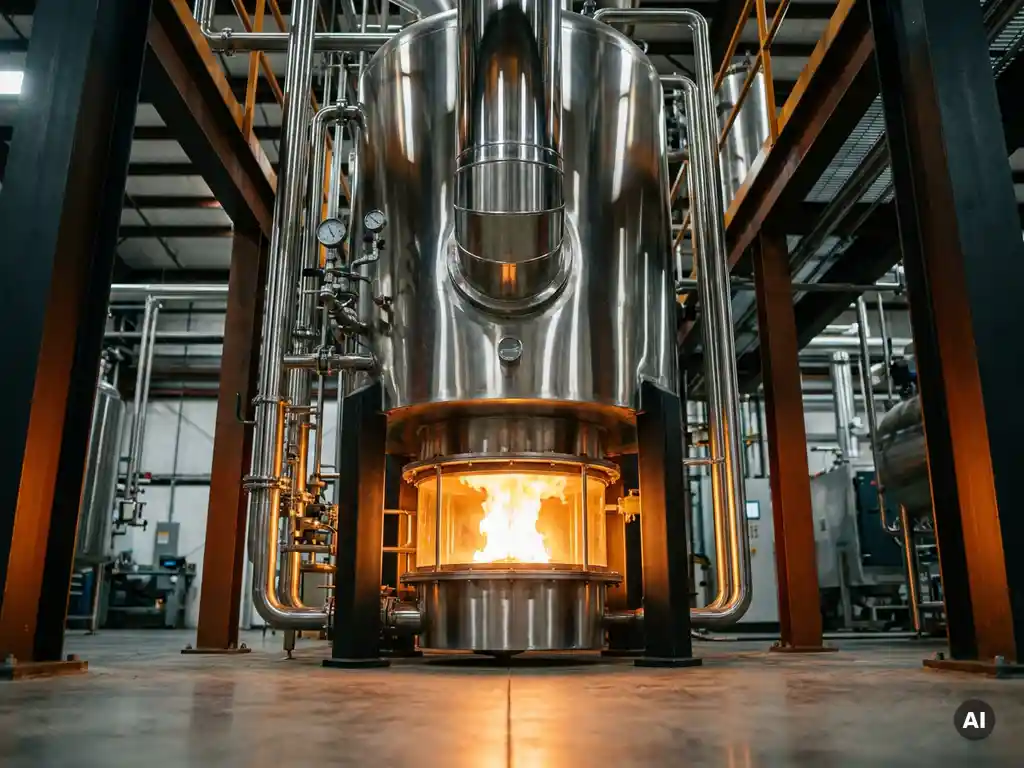
Building a business case for decarbonizing industrial heat in 2026 comes down to three things: quantifying your current emissions exposure, identifying the right technology fit for your process, and structuring a financial argument that speaks to both your sustainability team and your CFO. The urgency is real: EU regulatory pressure is tightening, carbon costs are rising, and the window to act ahead of competitors is narrowing. This article walks through the key questions every sustainability manager should be able to answer before walking into that boardroom.
What makes industrial heat so hard to decarbonize?
Industrial heat is difficult to decarbonize because it requires extremely high temperatures, operates continuously, and is deeply embedded in existing production infrastructure. Unlike electricity, which can be switched to renewables at the grid level, heat must be generated on-site and often cannot be interrupted without halting production entirely.
Two-thirds of all industrial energy consumption goes toward heat generation, and roughly 80% of that heat is still produced by fossil fuels. The challenge is not a lack of ambition: it is a lack of practical alternatives that work at the temperatures, scales, and cost points that industry actually needs.
Full electrification sounds appealing in theory, but for energy-intensive processes it runs into grid congestion, insufficient capacity, and prohibitive infrastructure investment. Hydrogen is promising, but the supply chain is immature and costs remain high for many industrial users. This is exactly why decarbonization of industrial heat has lagged behind other sectors: the solutions that exist today often do not fit the operational and financial realities of a running factory.
What does a business case for clean industrial heat actually include?
A business case for clean industrial heat includes four core components: a baseline emissions assessment, a technology evaluation, a financial model, and a risk and compliance analysis. Together, these give decision-makers a complete picture of what switching away from fossil fuels actually means for the business.
Here is what each component should cover:
- Baseline emissions assessment: Document your current Scope 1 emissions from heat generation, your fuel consumption, and your EU ETS exposure. This establishes the “cost of doing nothing.”
- Technology evaluation: Assess which clean heat technologies are technically compatible with your process temperatures, load profiles, and site constraints.
- Financial model: Compare CAPEX versus OPEX scenarios, factor in carbon pricing, available subsidies (such as the EU Innovation Fund or the VEKI scheme in the Netherlands), and calculate payback period and net present value.
- Risk and compliance analysis: Map out regulatory timelines, supply security risks, and the reputational cost of inaction, including customer expectations and board-level commitments.
A strong business case does not just show that decarbonization is possible. It shows that the cost of transition is lower than the cost of staying on fossil fuels over a defined time horizon.
How do you calculate the financial return on switching from fossil fuels?
The financial return on switching from fossil fuels to clean industrial heat is calculated by comparing the total cost of ownership of your current system against the total cost of the alternative over a 10- to 20-year period, including fuel costs, carbon costs, capital investment, and available subsidies.
Start with your current annual fuel spend and add your EU ETS carbon cost exposure. As carbon prices rise and free allowances phase out, this number will grow significantly. Then model the alternative: what is the upfront capital investment, what does the fuel or energy cost per MWh, and what grants or tax incentives apply?
For example, when evaluating Iron Fuel Technology, the boiler system investment is 0.5 million euros per megawatt thermal, and iron fuel is priced at 140 euros per tonne. The boiler achieves up to 95% energy efficiency, which means less energy input is wasted compared to many conventional fossil fuel systems, a factor that directly improves the cost-per-MWh calculation.
Key financial variables to include in your model:
- Current fossil fuel cost per MWh (including projected price volatility)
- EU ETS carbon cost per tonne of CO₂ (current and projected)
- Capital expenditure for the new system (CAPEX versus OPEX structure)
- Available subsidies and grants (VEKI, EU Innovation Fund, national schemes)
- Fuel cost for the clean alternative (fixed or indexed)
- Operational savings from higher energy efficiency
Volatile energy prices make fossil fuel cost projections inherently uncertain, which is itself an argument for switching: a clean heat technology with a predictable fuel cost offers security of supply and budget stability that natural gas cannot.
Which clean heat technologies are most viable for industry in 2026?
The most viable clean heat technologies for industry in 2026 are electrification, green hydrogen, and emerging solid fuel alternatives such as Iron Fuel Technology, but viability depends heavily on your process temperature requirements, grid access, and site infrastructure. There is no single answer that fits every industrial context.
Electrification
Electric boilers and heat pumps work well for lower-temperature processes and sites with reliable, affordable grid access. However, grid congestion is a growing constraint across Europe, and for high-temperature applications above 200°C, electrification becomes technically complex and expensive. Industries in areas with limited grid capacity face long connection timelines and uncertain costs.
Hydrogen
Hydrogen can reach the high temperatures that industry needs and produces no direct CO₂ when burned. The challenge is infrastructure: hydrogen pipelines are limited, storage is costly, and the supply chain for green hydrogen at competitive prices is still developing. For many industrial sites, hydrogen is a medium-term option rather than a near-term solution.
Iron Fuel Technology
Iron Fuel Technology is a circular, carbon-free energy carrier that burns iron powder to produce high-temperature heat, with only iron oxide as a byproduct, which is then regenerated using hydrogen. It requires no grid connection for heat generation, is transportable in standard containers, and integrates with existing boiler infrastructure. The technology has been demonstrated at megawatt-industrial scale at Technology Readiness Level 7 (TRL 7) in the Netherlands, making it one of the most advanced emerging alternatives for industries where electrification and hydrogen are not yet viable. You can explore our industrial heat solutions to understand how this applies to specific sectors.
How do you get internal buy-in for a decarbonization investment?
Getting internal buy-in for a decarbonization investment requires translating sustainability goals into financial and strategic language that resonates with finance, operations, and executive leadership. The most common reason decarbonization projects stall is not technical: it is that the business case was built for the sustainability team, not for the CFO or the board.
A few principles that make the difference:
- Frame it as risk management, not just climate commitment. Rising EU ETS costs, volatile natural gas prices, and tightening regulations represent real financial exposure. Decarbonizing industrial heat reduces that exposure.
- Show the cost of inaction. Model what your carbon cost liability looks like in five and ten years if you stay on fossil fuels. This reframes the conversation from “investment” to “avoidance of a growing cost.”
- Anchor to regulatory timelines. The EU’s Clean Industrial Deal, updated energy efficiency audit obligations, and the ETS phase-out of free allowances create hard deadlines. Connecting your investment to these timelines gives the project urgency that is external and credible.
- Use pilot projects to reduce perceived risk. A phased approach, starting with one boiler or one production line, lowers the upfront commitment and builds internal confidence before a full rollout.
- Bring in external validation. Technology providers, independent energy auditors, and industry peers who have already made similar transitions can strengthen your internal case significantly.
When is the right time to start building your decarbonization roadmap?
The right time to start building your decarbonization roadmap is now, not because of abstract climate urgency, but because the lead times for clean heat technology procurement, permitting, and integration are long, and the regulatory and financial landscape in 2026 is already creating real cost pressure for companies that wait.
EU ETS carbon prices affect the economics of every tonne of CO₂ you emit today. The Clean Industrial Deal, presented in 2026, is mobilizing over 100 billion euros to support industrial decarbonization across Europe, and companies that move early are better positioned to access grants, favorable financing, and first-mover advantages in their supply chains.
Beyond regulation, customer expectations are shifting. Procurement teams at major brands are increasingly requiring Scope 3 emissions data from their suppliers, which means your industrial heat emissions may soon affect your commercial relationships, not just your compliance status.
A practical decarbonization roadmap does not require you to have all the answers today. It requires you to start the assessment: understand your current emissions baseline, identify which processes are candidates for clean heat, and begin evaluating technology options with realistic timelines. The companies that start that process now will be the ones with commercial contracts and operational systems in place when the regulatory deadlines arrive.
How RIFT helps you decarbonize industrial heat
We develop and deliver Iron Fuel Boilers, purpose-built industrial heat systems that replace fossil fuel-fired boilers with a fully circular, carbon-free alternative. For sustainability managers navigating the complexity of decarbonizing industrial heat, our technology offers a practical path forward that does not require a complete overhaul of existing infrastructure.
Here is what makes our approach concrete and actionable:
- Drop-in compatibility: Our Iron Fuel Boiler is designed to complement existing boiler setups, reducing the integration risk and capital disruption of switching.
- Up to 95% energy efficiency: This outperforms many traditional fossil fuel systems and directly improves the financial case for switching.
- Near-zero emissions: The boiler produces just 10 kg of CO₂ per MWhth, stemming only from a pilot safety flame, and RIFT claims the lowest NOx emissions of any fuel, at under 5 Mg/MJ.
- No grid dependency: Iron fuel is transported in standard containers and burned on-site, making it a viable option for sites affected by grid congestion.
- Long-term fuel supply agreement: We provide not just the boiler but a reliable, long-term iron fuel supply, giving you the cost predictability and security of supply that fossil fuels cannot offer.
- Proven at scale: Our technology is demonstrated at TRL 7 in the Netherlands, and we have signed the first commercial contract worldwide for Iron Fuel Technology with Kingspan Unidek.
If you are building a business case for decarbonizing industrial heat and want to understand whether Iron Fuel Technology fits your process, we are ready to have that conversation. Get in touch with our team and let us work through the numbers together.
Frequently Asked Questions
What is the minimum scale at which it makes sense to invest in a clean industrial heat solution?
There is no universal minimum, but most clean heat technologies — including Iron Fuel Boilers — become financially compelling at sites consuming 1 MW of thermal energy or more on a continuous basis. Below that threshold, the payback period can stretch uncomfortably long unless significant carbon cost exposure or subsidy eligibility shortens it. The best starting point is a site energy audit that quantifies your actual heat demand and maps it against available technology options at your scale.
How do rising EU ETS carbon prices affect the payback period of a clean heat investment?
Every increase in the EU ETS carbon price directly reduces the payback period of a clean heat investment by raising the ‘cost of doing nothing.’ For example, if your facility emits 10,000 tonnes of CO₂ annually from heat generation and the carbon price rises from €60 to €100 per tonne, your annual carbon liability increases by €400,000 — without any change in your operations. Modelling two or three carbon price scenarios (conservative, central, and high) in your financial case is essential to show the board the full range of financial exposure.
What are the most common mistakes companies make when building a decarbonization business case?
The most common mistake is building the case around emissions reduction alone, without translating that into hard financial figures the CFO can act on. Other frequent pitfalls include underestimating integration and permitting lead times, failing to account for the phase-out of free EU ETS allowances in future cost projections, and presenting a single technology option rather than a comparative analysis. A strong business case anticipates the objections of finance and operations teams and addresses them proactively with data.
Can clean heat technologies like Iron Fuel Technology handle the high-temperature requirements of energy-intensive industries such as ceramics, chemicals, or food processing?
Yes — this is precisely where technologies like Iron Fuel Technology offer a meaningful advantage over electrification and heat pumps, which struggle above 200°C. Iron fuel combustion produces high-temperature heat compatible with demanding industrial processes, and the Iron Fuel Boiler is designed to integrate with existing boiler infrastructure rather than replace it wholesale. However, compatibility always depends on your specific process temperatures, load profiles, and site layout, which is why a technical feasibility assessment should be the first step before any investment decision.
What subsidies and funding schemes should we be looking at in Europe in 2026?
The most relevant funding mechanisms for industrial heat decarbonization in Europe in 2026 include the EU Innovation Fund (which supports first-of-a-kind clean technology deployments), the VEKI scheme in the Netherlands (targeting energy efficiency and clean heat investments), and national industrial decarbonization programs in Germany, Belgium, and France. The EU’s Clean Industrial Deal, mobilizing over €100 billion, is also opening new financing pathways for early movers. Engaging an energy consultant or your national energy agency early in the process is strongly recommended, as application windows and eligibility criteria vary significantly.
How long does it typically take to go from initial assessment to operational deployment of a clean heat system?
From initial feasibility assessment to full operational deployment, most industrial clean heat projects take between 18 and 36 months, depending on technology complexity, permitting requirements, and grid or infrastructure work needed. Permitting alone can account for 6–12 months in many European jurisdictions, which is why starting the assessment process now — even without a final technology decision — is critical for meeting upcoming regulatory deadlines. Phased approaches, such as piloting on a single boiler or production line, can compress early timelines and reduce risk while the full rollout is planned.
How should we handle uncertainty in fossil fuel price projections when building the financial model?
The best approach is to run sensitivity analyses using at least three fossil fuel price scenarios — low, central, and high — based on credible sources such as the IEA World Energy Outlook or your energy broker’s forward curves. Importantly, price volatility itself is an argument for switching: a clean heat technology with a fixed or indexed fuel supply agreement offers budget predictability that natural gas fundamentally cannot. Presenting this stability as a strategic financial benefit — not just a sustainability gain — is often one of the most persuasive elements for a CFO-facing business case.
Related Articles
- What are 20 examples of renewable resources?
- What is EIA?
- What is the difference between solar and wind energy?
- Why is renewable energy important?
- How does renewable energy work?
This content was generated with the help of AI and it may contain mistakes