

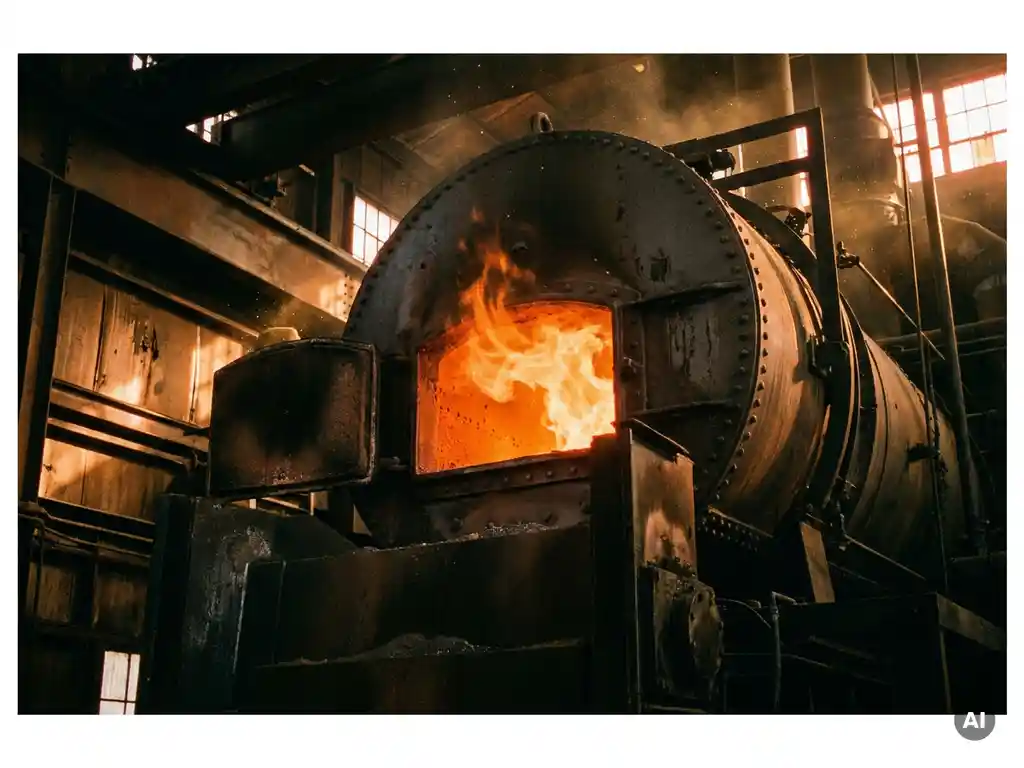
Industrial companies reduce Scope 1 emissions from heat generation primarily by switching away from fossil fuels, through electrification, fuel-switching to low-carbon alternatives, or deploying new clean combustion technologies. Because industrial heat accounts for the majority of many manufacturers’ direct emissions, it is also where the greatest decarbonization gains are possible. The sections below walk through the key questions sustainability managers face when building a heat decarbonization strategy.
What are the main sources of Scope 1 emissions in industrial heat generation?
The main sources of Scope 1 emissions in industrial heat generation are the direct combustion of fossil fuels, primarily natural gas, coal, and fuel oil, in boilers, furnaces, kilns, and dryers. These combustion processes release carbon dioxide directly at the point of use, making them the dominant contributor to a manufacturer’s Scope 1 carbon footprint.
Industry accounts for roughly 37% of total global energy consumption, and approximately two-thirds of that energy is used for heat. Of that heat demand, around 80% is still met by fossil fuels. For sectors like Food and Beverage, Specialty Chemicals, and Pulp and Paper, high-temperature steam and process heat are not optional: they are central to production. As a result, the boiler house is often where Scope 1 emissions are highest and where decarbonization efforts must begin.
Beyond combustion, smaller Scope 1 sources include fugitive emissions from gas pipelines and equipment leaks, but these are typically marginal compared to the volume of CO₂ released through direct fuel burning. For most industrial operators, the boiler is the priority target.
Why is decarbonizing industrial heat harder than decarbonizing electricity?
Decarbonizing industrial heat is harder than decarbonizing electricity because heat demand is high-temperature, continuous, and deeply embedded in physical production processes, whereas electricity grids can integrate renewables at scale through centralized infrastructure. Replacing a wind turbine in the energy mix is structurally different from replacing a gas-fired boiler that runs 24 hours a day at 200°C or higher.
Several factors compound the difficulty:
- Temperature requirements: Many industrial processes need heat above 150°C, and some above 500°C. Heat pumps and standard electric solutions struggle to reach these temperatures economically.
- Grid congestion: Full electrification of heat demand would place enormous additional load on electricity grids that are already congested in many industrial regions. In practice, grid connection capacity is a binding constraint for many facilities.
- Volatile energy prices: Electricity prices are more variable than gas prices in many markets, making the economics of electric heat unpredictable for energy-intensive industries.
- Infrastructure investment: Switching to hydrogen or full electrification often requires significant new infrastructure, pipelines, grid upgrades, or on-site storage, that takes years to build and carries substantial CAPEX.
- Continuous process requirements: Industrial heat often cannot be interrupted. Renewable electricity generation is intermittent, which creates a security-of-supply challenge that does not exist with fossil fuel combustion.
These barriers mean that the decarbonization of industrial heat requires purpose-built solutions, not just a scaled-up version of what worked for the electricity sector.
What technologies can industrial companies use to reduce heat-related Scope 1 emissions?
Industrial companies have several technology options for reducing Scope 1 emissions from heat generation, each with different temperature capabilities, infrastructure requirements, and cost profiles. The right choice depends on process temperature, site infrastructure, and the company’s timeline and budget.
Electrification
Electric boilers and heat pumps can replace gas-fired systems for lower-temperature applications. Heat pumps are efficient but are generally limited to temperatures below 100-150°C. Electric resistance heating can reach higher temperatures but is expensive to operate when electricity prices are volatile, and it is constrained by grid connection capacity, a growing problem given widespread grid congestion across industrial regions in Europe.
Hydrogen combustion
Hydrogen can be burned in modified or purpose-built industrial burners to generate high-temperature heat with zero direct CO₂ emissions. However, hydrogen is challenging to transport and store safely, requires significant infrastructure investment, and its cost remains high in most markets. Green hydrogen availability at industrial scale is still limited in 2026, making this a medium-to-long-term option for many companies.
Biomass and bioenergy
Biomass boilers can provide renewable heat and are a proven technology, but they come with land-use concerns, supply chain complexity, and, depending on the feedstock and methodology, varying lifecycle emission profiles. Regulatory scrutiny of biomass sustainability criteria is also increasing under EU frameworks.
Iron Fuel Technology
Iron fuel, fine iron powder used as a circular, CO₂-free energy carrier, is an emerging option specifically designed for industrial heat. When burned, iron fuel produces high-temperature heat without direct CO₂ emissions. The combustion byproduct is iron oxide, which is regenerated using hydrogen, completing a closed loop. Our Iron Fuel Technology achieves up to 95% energy efficiency and does not require grid upgrades, making it a practical option where electrification is constrained.
What’s the difference between electrification and fuel-switching for industrial heat?
Electrification means replacing a fuel-burning heat source with an electrically powered one, such as an electric boiler or heat pump, while fuel-switching means continuing to burn a fuel in a combustion system, but replacing the fossil fuel with a low-carbon or zero-carbon alternative like hydrogen, biomass, or iron fuel. Both approaches reduce Scope 1 emissions, but they follow fundamentally different paths.
The practical distinction matters enormously for industrial operators. Electrification eliminates combustion entirely, which can simplify emissions accounting and align well with renewable electricity procurement. However, it depends on grid availability, electricity pricing, and temperature ceilings that may not match process requirements.
Fuel-switching, by contrast, preserves the combustion-based heat generation model, which means existing boiler infrastructure can often be adapted or complemented rather than replaced entirely. This reduces disruption to production and lowers the barrier to transition. The trade-off is that the emissions profile of the new fuel matters: a hydrogen-fired boiler is only as clean as the hydrogen supply chain, and the same principle applies to any alternative fuel.
For many industrial companies, the CAPEX versus OPEX decision is also shaped by this distinction. Electrification often requires large upfront grid connection and equipment investment (CAPEX), while some fuel-switching approaches can be structured around fuel supply agreements that shift more of the cost to OPEX. Neither model is universally superior: the right choice depends on the company’s capital position, energy infrastructure, and decarbonization timeline.
How do companies measure and verify Scope 1 emission reductions from heat?
Companies measure Scope 1 emission reductions from heat generation by calculating the difference in CO₂-equivalent emissions between their current fossil fuel consumption and the emissions profile of the alternative heat source, using recognized greenhouse gas accounting methodologies such as the GHG Protocol or EU Innovation Fund GHG methodology.
In practice, this involves several steps:
- Establish a baseline: Quantify current Scope 1 emissions from heat generation using fuel consumption data and standard emission factors for each fuel type.
- Apply a recognized methodology: Use an accepted accounting framework to calculate the emissions of the alternative technology across its full chain, including feedstock production, transport, and combustion. For iron fuel, for example, the full-chain CO₂ reduction is calculated at 0.55 tCO₂eq per tonne of iron fuel, based on low-carbon hydrogen as defined by EU definitions and the EU Innovation Fund GHG methodology including transport.
- Conduct energy audits: Under the revised EU Energy Efficiency Directive, companies above certain energy consumption thresholds are required to carry out energy audits. Large industrial energy consumers must also implement energy management systems. These requirements create a structured framework for ongoing measurement and reporting.
- Report under relevant frameworks: Scope 1 reductions should be disclosed through corporate sustainability reporting, and where applicable, integrated into EU Emissions Trading System (EU ETS) compliance reporting. The EU ETS creates a direct financial incentive to reduce emissions, as companies must surrender allowances for each tonne of CO₂ emitted.
- Verify independently: For regulatory compliance and investor credibility, third-party verification of emission reduction claims is increasingly expected, and in some frameworks, mandatory.
One important nuance: emission reduction figures should always reflect the full chain, not just the combustion stage. A technology that produces zero CO₂ at the point of combustion may still carry upstream emissions depending on how its fuel or energy input is sourced.
When should an industrial company start its heat decarbonization project?
An industrial company should start its heat decarbonization project now, not when a boiler reaches end-of-life or when regulations force action. The lead time for evaluating, procuring, and implementing new heat technologies is typically measured in years, and companies that begin planning earlier have more options, more negotiating leverage, and a smoother transition.
Several factors make early action particularly important in 2026:
- EU ETS carbon prices: As carbon allowance prices rise, the cost of continuing to burn fossil fuels increases. Companies that delay decarbonization face growing exposure to carbon costs that erode competitiveness.
- Grid congestion timelines: If electrification is part of the strategy, grid connection applications in many European industrial regions already face multi-year waiting times. Starting the process late means starting behind.
- Technology availability: Clean heat technologies are moving from demonstration to commercial scale. Early movers gain access to first-generation commercial contracts, often with better terms and stronger supplier relationships.
- Regulatory trajectory: EU frameworks, including the Energy Efficiency Directive and the VEKI subsidy scheme in the Netherlands, are tightening requirements and offering incentives that may not be available indefinitely. Acting while support mechanisms are in place reduces the net cost of transition.
- Stakeholder expectations: Customers, investors, and boards are increasingly scrutinizing Scope 1 performance. A credible heat decarbonization roadmap is becoming a prerequisite for maintaining commercial relationships and access to capital.
The practical starting point is an energy audit and a technology assessment, mapping current heat demand, identifying the highest-emission sources, and evaluating which technologies can realistically address them within the company’s infrastructure and budget constraints.
How We Help Industrial Companies Decarbonize Their Heat
We developed Iron Fuel Technology specifically to address the gap that electrification and hydrogen cannot fill for many industrial companies. Our Iron Fuel Boiler delivers high-temperature industrial heat with zero direct CO₂ emissions and ultra-low NOₓ emissions, without requiring grid upgrades or new pipeline infrastructure.
Here is what makes our approach concrete and practical for sustainability managers:
- Up to 95% energy efficiency – matching or outperforming conventional fossil fuel boilers
- Only 10 kg CO₂ per MWhth – attributable solely to the pilot safety flame, not the combustion of iron fuel itself
- Drop-in compatible – the Iron Fuel Boiler is designed to complement existing boiler infrastructure, reducing disruption to operations
- Grid-independent – iron fuel is stored and transported in standard containers, so security of supply does not depend on grid capacity or hydrogen pipelines
- Full-chain CO₂ reduction of 0.55 tCO₂eq per tonne of iron fuel – calculated using EU Innovation Fund GHG methodology with low-carbon hydrogen as feedstock
- Demonstrated at TRL7 – our technology has been validated at megawatt-industrial scale, not just in a laboratory
Our initial commercial focus is on Food and Beverage, Specialty Chemicals, and Pulp and Paper, sectors where the combination of high heat demand and infrastructure constraints makes Iron Fuel Technology a particularly strong fit. We signed the world’s first commercial contract for industrial Iron Fuel Technology with Kingspan Unidek, and we are actively working with industrial partners ready to take the next step.
If you are building the business case for heat decarbonization at your facility, we are ready to talk. Get in touch with our team to explore what Iron Fuel Technology could mean for your operations.
Frequently Asked Questions
How do I know which heat decarbonization technology is the right fit for my facility?
The right technology depends on three primary factors: your process temperature requirements, your site’s grid connection capacity, and your capital versus operating expenditure preferences. Start with an energy audit to map your heat demand by temperature band — processes below 150°C may be well-suited to heat pumps or electric boilers, while high-temperature continuous processes above 150–200°C will likely require fuel-switching technologies such as hydrogen, biomass, or iron fuel. A technology assessment that stress-tests each option against your infrastructure constraints and decarbonization timeline will give you a defensible basis for the investment decision.
What are the most common mistakes companies make when building a heat decarbonization roadmap?
The most common mistake is treating heat decarbonization as a single decision rather than a phased strategy — choosing one technology and expecting it to solve the entire emissions profile in one step. In practice, most industrial sites have a mix of temperature requirements and process types that benefit from a portfolio approach. A second frequent mistake is underestimating lead times: grid connection upgrades, infrastructure permitting, and technology procurement can each take one to three years, meaning companies that wait for a forcing event — a boiler failure, a regulatory deadline, or a customer ultimatum — often find themselves with far fewer options than they expected.
Can we reduce Scope 1 heat emissions without replacing our existing boiler infrastructure?
In many cases, yes. Fuel-switching technologies, including hydrogen-ready burners, biomass systems, and iron fuel boilers, are specifically designed to complement or integrate with existing combustion infrastructure rather than requiring a complete replacement. Iron Fuel Technology, for example, is designed as a drop-in compatible system that works alongside existing boiler setups, which significantly reduces operational disruption and lowers the capital barrier to transition. The key question is whether your existing equipment can be adapted or supplemented rather than replaced outright — a site assessment will clarify what is feasible within your current footprint.
How does the EU ETS financially impact companies that delay heat decarbonization?
Under the EU Emissions Trading System, companies must surrender one carbon allowance for every tonne of CO₂ they emit. As the supply of free allowances is progressively reduced and carbon prices trend upward, delaying decarbonization directly increases the cost of compliance — meaning that every year of continued fossil fuel combustion carries a growing financial penalty. For energy-intensive manufacturers, this is not a marginal cost: a facility emitting 50,000 tonnes of CO₂ per year faces millions of euros in annual allowance costs at current price levels, a figure that compounds as the carbon price rises. Building a decarbonization roadmap now allows companies to reduce that exposure in a planned, cost-effective way rather than reacting to price shocks.
What does 'full-chain' emissions accounting mean in practice, and why does it matter?
Full-chain emissions accounting means measuring the total greenhouse gas impact of a heat technology across its entire supply chain — from the production and transport of the fuel or energy input, through to the point of combustion — rather than only counting what is emitted at the stack. This matters because a technology that produces zero CO₂ at combustion can still carry significant upstream emissions depending on how its fuel is produced. For example, hydrogen combustion is only genuinely low-carbon if the hydrogen itself is produced using renewable or low-carbon energy. Sustainability managers should always request full-chain emission factors from technology and fuel suppliers, and apply a recognized methodology such as the GHG Protocol or the EU Innovation Fund GHG methodology to ensure reported reductions are credible and comparable.
Are there subsidies or funding mechanisms available to offset the cost of industrial heat decarbonization?
Yes, several funding mechanisms are available, particularly in the EU. The VEKI subsidy scheme in the Netherlands supports energy efficiency and decarbonization investments for industrial companies, and similar national schemes exist across other EU member states. At the EU level, the Innovation Fund provides grants for large-scale demonstration and first commercial deployment of low-carbon technologies, including clean heat solutions. Companies should also evaluate whether their projects qualify for green financing instruments, as banks and institutional lenders are increasingly offering preferential terms for investments with verified emissions reduction benefits. Acting while these mechanisms are active is important, as support conditions and funding availability can change as policy frameworks evolve.
How should we communicate our heat decarbonization progress to customers and investors?
Credibility is the central challenge: customers and investors are increasingly sophisticated in distinguishing between genuine emissions reductions and unsubstantiated claims. The strongest approach is to report Scope 1 reductions using a recognized accounting framework, backed by independently verified data, and to be transparent about the full-chain emissions profile of any technology you deploy. Quantified milestones — such as tonnes of CO₂ reduced per year, percentage of heat demand decarbonized, or progress against a Science Based Target — are more persuasive than qualitative commitments. If you are in early stages, publishing a credible roadmap with clear timelines and technology choices demonstrates strategic intent and is increasingly accepted by sophisticated stakeholders as evidence of genuine progress.
Related Articles
- How does VEKI support the business case for clean industrial heat investments?
- What is the difference between nuclear energy and renewable energy?
- What is the difference between onshore and offshore wind energy?
- How does renewable energy create jobs?
- Is it worth investing in renewable energy for your home?
This content was generated with the help of AI and it may contain mistakes