

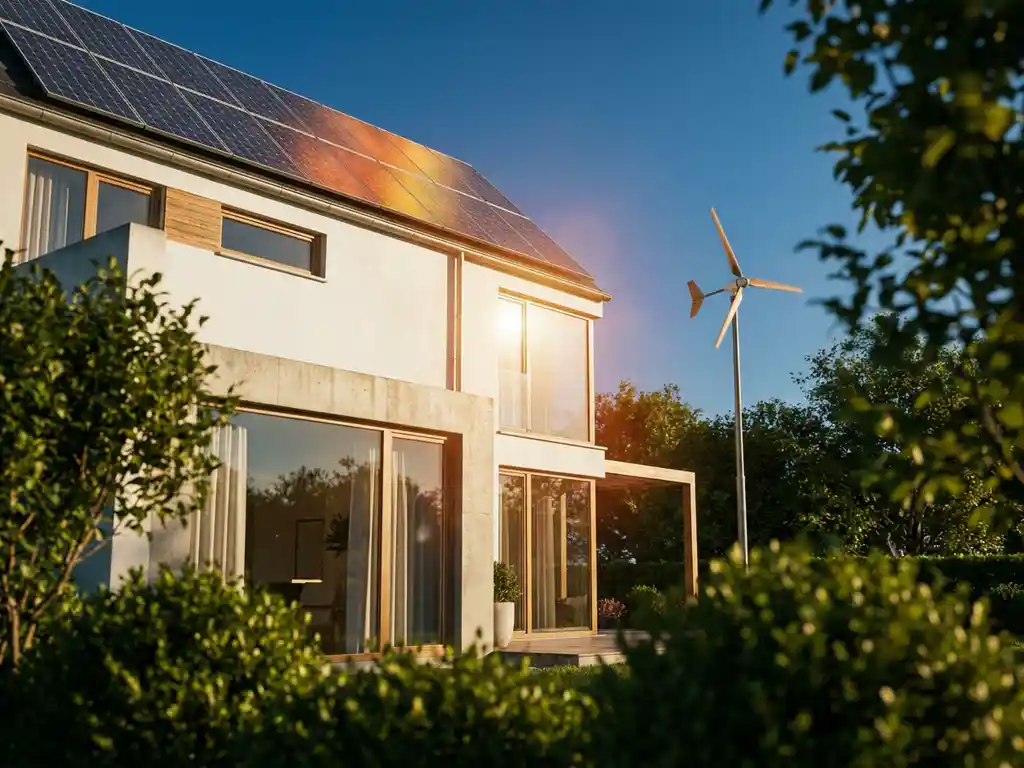
Yes, homes can run entirely on renewable energy. With the right combination of solar panels, battery storage, and efficient heating and cooling systems, a household can meet all its energy needs without relying on fossil fuels. The practicality depends on your location, home size, energy consumption habits, and budget. Many homeowners start with partial renewable setups and gradually move toward full independence from the grid.
Relying on the grid is quietly inflating your energy costs
Every unit of electricity you draw from a fossil-fuel-dependent grid is a unit you pay for at market rates, which have proven volatile and increasingly expensive. When energy prices spike, households with no renewable generation capacity absorb the full impact. The fix is straightforward in principle: reduce your dependence on grid power by generating your own. Even a modest solar installation can offset a significant portion of your electricity bill, and pairing it with a home battery means you use more of what you generate rather than selling it back cheaply and buying it back at a premium.
Heating your home with fossil fuels is the biggest barrier to truly renewable living
Most conversations about home renewable energy focus on electricity, but heating accounts for the largest share of household energy use in many climates. If your home runs on a gas boiler for space heating and hot water, switching to solar panels alone will not get you to fully renewable. The real gap is heat. Heat pumps are the most widely adopted solution, using electricity to move heat rather than generate it, which makes them far more efficient than direct electric resistance heating. Replacing a gas boiler with a heat pump, powered by renewable electricity, closes the loop on the biggest source of household fossil fuel consumption.
What renewable energy sources are available for homes?
The main renewable energy sources available for homes are solar photovoltaic panels, solar thermal collectors, small wind turbines, ground-source or air-source heat pumps, and micro-hydropower for properties near running water. Solar PV is by far the most widely adopted, followed by heat pumps for heating and hot water.
Each source suits different property types and locations. Solar PV works well on most rooftops in temperate and sunny climates and generates electricity that can power lighting, appliances, and electric vehicles. Solar thermal systems heat water directly using roof-mounted collectors, which is a cost-effective way to reduce gas or electric water-heating bills.
Heat pumps extract heat from the air or ground and deliver it into your home at efficiencies well above one-to-one. Small wind turbines can complement solar in exposed rural locations but are rarely practical in urban or suburban settings due to planning restrictions and inconsistent wind speeds. Micro-hydropower is highly effective where it applies, but the geographic requirements are specific.
How does solar power work for residential homes?
Solar power for homes works by converting sunlight into direct current electricity using photovoltaic cells in roof-mounted panels. An inverter then converts that DC electricity into alternating current, which powers household appliances. Excess electricity can be stored in a home battery or exported to the grid. Output depends on panel orientation, roof angle, shading, and local sunlight levels.
A standard residential solar installation typically consists of between six and twenty panels, depending on roof space and household demand. Modern panels convert roughly 20 to 22 percent of incoming sunlight into electricity under ideal conditions. On cloudy days, output drops but does not stop entirely, as panels respond to daylight rather than direct sun alone.
Adding a battery storage system changes how useful solar becomes. Without storage, any power you generate but do not immediately use goes back to the grid. With storage, surplus daytime generation charges the battery, which then powers your home in the evening. This significantly increases the share of your consumption covered by your own renewable generation.
Can a home be fully off-grid with renewable energy?
A home can be fully off-grid with renewable energy, but it requires careful system design and usually a combination of sources. Solar PV with substantial battery storage forms the core of most off-grid setups. A backup generator or small wind turbine is often added to cover extended low-sunlight periods. Full off-grid living is more practical in rural locations with good solar or wind resources.
The main engineering challenge is sizing the system for worst-case conditions, not average ones. A household that consumes 10 to 15 kilowatt-hours per day needs enough panel capacity and battery storage to cover several consecutive cloudy days. This pushes system costs significantly higher than a grid-connected solar installation.
Off-grid homes also need to manage energy demand actively. High-consumption appliances like electric ovens, tumble dryers, and electric vehicle chargers need to be used thoughtfully, ideally during peak generation hours. Many off-grid households use propane or wood as a backup for cooking and heating to reduce the electrical load on the system, which means they are not purely renewable in practice.
What are the biggest challenges of powering a home with renewables?
The biggest challenges of powering a home with renewables are intermittency, upfront cost, heating decarbonization, and grid connection complexity. Solar and wind generate power when conditions allow, not necessarily when demand peaks. Bridging that gap requires storage, backup systems, or a grid connection, each of which adds cost and complexity.
Intermittency is the core technical problem. A home that generates surplus solar power on a sunny summer afternoon may produce almost nothing on a dark winter day, yet heating demand is highest in winter. Battery technology is improving and costs have fallen considerably, but storing enough energy to cover multi-day low-generation periods at home scale remains expensive.
Heating is the other major challenge. Electricity is relatively straightforward to decarbonize with solar and wind, but replacing gas or oil heating requires either a heat pump, electric resistance heating, or a different fuel entirely. Heat pumps work well in well-insulated homes but deliver less heat per unit of electricity in very cold conditions, which is precisely when you need it most.
- Intermittency: Output varies with weather and season, requiring storage or backup.
- Upfront cost: Solar, batteries, and heat pumps require significant initial investment.
- Heating: Replacing gas or oil heating is technically and financially complex.
- Grid connection: Export tariffs, connection rules, and metering vary by country and utility.
- Home suitability: Older, poorly insulated homes lose heat faster, increasing demand on any heating system.
How much does it cost to switch a home to renewable energy?
Switching a home to renewable energy typically costs between €8,000 and €30,000 or more, depending on the scope of the transition. A basic solar PV system costs roughly €5,000 to €10,000 for an average home. Adding battery storage adds €5,000 to €10,000. Replacing a gas boiler with a heat pump costs between €8,000 and €18,000 before subsidies.
The total depends heavily on which systems you install and whether you tackle the transition in stages or all at once. Most homeowners start with solar PV because it has the clearest payback calculation. Electricity generation from solar reduces your grid imports and, in many countries, earns a feed-in tariff or export payment for surplus power. Payback periods for solar typically range from six to twelve years, depending on local electricity prices and sunlight levels.
Government grants and subsidies can significantly reduce upfront costs. Many European countries offer incentives for heat pump installation, solar panels, and home insulation. It is worth checking national and regional schemes before budgeting, as available support changes regularly and can cover a meaningful share of the total investment.
- Audit your current energy use to understand where your consumption is highest and where renewable alternatives will have the most impact.
- Improve insulation first to reduce heating demand before investing in a new heating system.
- Install solar PV to begin generating your own electricity and reduce grid dependence.
- Add battery storage to increase the share of your own generation that you actually use.
- Replace fossil fuel heating with a heat pump or an alternative clean heating system.
- Check available subsidies at each stage to reduce the net cost of each investment.
How RIFT helps industries tackle the renewable heat challenge
At the household scale, renewable energy is a growing reality. At the industrial scale, the challenge is far harder. High-temperature heat for manufacturing, food processing, and chemical production cannot be met by solar panels or standard heat pumps. This is where we come in.
We develop Iron Fuel Technology, a circular, carbon-free energy carrier that delivers high-temperature industrial heat without CO₂ emissions. Our Iron Fuel Boiler integrates with existing infrastructure, making the transition practical rather than disruptive. For sustainability managers in industry who face the same pressure to decarbonize as homeowners do—but at a scale where conventional solutions fall short—our technology offers a credible path forward.
- Zero direct CO₂ emissions during combustion, with only 10 kg CO₂ per MWh attributable to the pilot safety flame.
- Up to 95% energy efficiency, outperforming many fossil fuel boiler systems.
- Plug-and-play integration with existing boiler infrastructure, minimising disruption.
- Long-term fuel supply agreements to guarantee operational continuity.
- Demonstrated at megawatt scale at Technology Readiness Level 7 in the Netherlands.
If you are a sustainability manager or energy decision-maker exploring decarbonisation options for industrial heat, the form below is a good starting point. It takes less than a minute and helps our team understand your situation before we connect.
If you want to understand how Iron Fuel Technology works and whether it fits your industrial heat requirements, or if you are exploring clean heat solutions for your sector, we are ready to talk. Get in touch with our team to start the conversation.
Related Articles
- Who uses the EIA report?
- How does renewable energy reduce carbon emissions?
- What will replace fossil fuels in the future?
- What is the most efficient form of renewable energy?
- Why is renewable energy important?
This content was generated with the help of AI and it may contain mistakes