

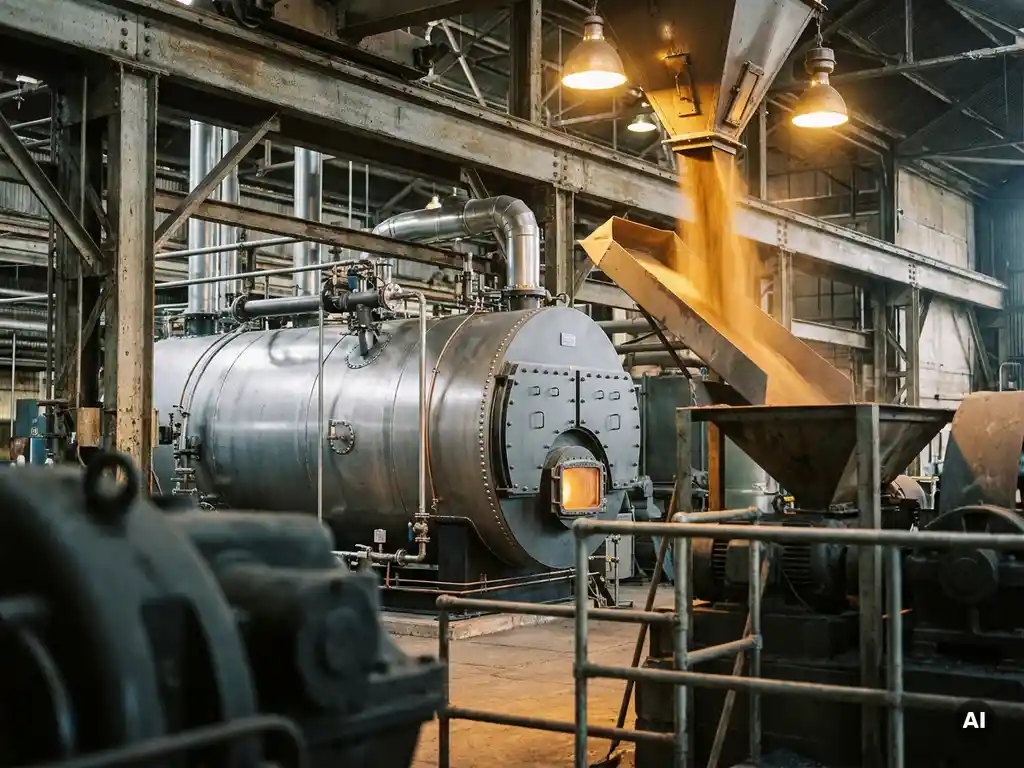
Manufacturers can reduce upfront investment when switching to clean heat by combining phased deployment, compatible equipment design, and available public funding. Rather than replacing entire systems at once, the most cost-effective approach is to integrate new clean heat technology alongside existing infrastructure, spread capital expenditure over time, and leverage grants such as the EU Innovation Fund to offset initial costs.
This approach is especially relevant for energy-intensive industries like Food & Beverage, Specialty Chemicals, and Pulp & Paper, where the pressure to decarbonize industrial heat is growing but full system overhauls are rarely financially viable in a single budget cycle. The sections below unpack each dimension of that challenge, from identifying the real cost barriers to building a compelling internal business case.
What are the biggest cost barriers when switching to clean industrial heat?
The biggest cost barriers when switching to clean industrial heat are high upfront capital expenditure, infrastructure incompatibility, and the price gap between fossil fuels and cleaner alternatives. For most manufacturers, the combination of these three factors makes decarbonization of industrial heat feel financially out of reach, even when the long-term case is clear.
Understanding where the real friction lies helps sustainability managers target the right solutions. The barriers typically fall into three categories:
- Capital investment: New clean heat systems require significant upfront spending. For context, an Iron Fuel Boiler system requires an investment of around 0.5 million euros per megawatt thermal (M€/MWth). For large industrial operations, that adds up quickly.
- Infrastructure and grid constraints: Full electrification is often blocked by grid congestion, particularly in industrial zones where network capacity is already strained. This makes electrification a slow and expensive route for many manufacturers.
- Energy price volatility: Volatile energy prices make it difficult to model a reliable return on investment. When fossil fuel costs fluctuate sharply, the payback period for clean alternatives becomes harder to predict, which weakens the internal business case.
- Carbon cost exposure: Under the EU Emissions Trading System (EU ETS), companies face rising costs for every tonne of CO₂ they emit. While this creates pressure to act, it also adds financial complexity to transition planning.
- Replacement of natural gas: Natural gas is deeply embedded in industrial processes. Replacing it requires not just new equipment, but also a rethinking of fuel logistics, storage, and supply chains.
Security of supply is another underappreciated barrier. Manufacturers are understandably cautious about adopting an energy carrier that lacks a proven commercial supply chain. Technologies that cannot demonstrate reliable, long-term fuel availability will struggle to gain traction, regardless of their emissions credentials.
Which financing models can lower the capital burden of clean heat adoption?
The most effective financing models for lowering the capital burden of clean heat adoption are OPEX-based service agreements, public co-financing, and phased investment structures. These approaches shift or spread capital expenditure rather than requiring manufacturers to fund the full transition from their own balance sheet in one go.
The CAPEX versus OPEX distinction is central to this conversation. A traditional CAPEX model means purchasing and owning the heat system outright, which delivers long-term value but demands significant upfront capital. An OPEX model, by contrast, structures clean heat as a service, where the technology provider retains ownership and the manufacturer pays for heat delivered, similar in logic to a power purchase agreement in the energy sector.
For manufacturers with constrained capital budgets or those operating in leased facilities, an OPEX or heat-as-a-service model can make adoption financially feasible without disrupting core capital allocation. The trade-off is that long-term total cost may be higher than ownership, so the right model depends on the company’s financial position, time horizon, and risk appetite.
Phased deployment is another practical approach. Rather than replacing all fossil fuel capacity at once, manufacturers can install clean heat systems alongside existing boilers, gradually shifting load as confidence and cash flow allow. This reduces peak capital requirements and lets operations teams build familiarity with the new technology before full commitment.
How does a drop-in compatible boiler reduce switching costs?
A drop-in compatible boiler reduces switching costs by integrating with existing industrial infrastructure rather than requiring a complete system rebuild. When a new clean heat system can connect to current pipework, steam distribution, and control systems, manufacturers avoid the additional engineering, civil works, and downtime costs that come with a full replacement.
This compatibility factor is one of the most significant practical advantages of Iron Fuel Technology. The Iron Fuel Boiler is designed to complement existing fossil fuel boilers, meaning it can be introduced as an additional heat source without decommissioning current infrastructure. This allows manufacturers to decarbonize incrementally, maintaining operational continuity throughout the transition.
Drop-in compatibility also lowers the risk profile of the investment. When integration is straightforward, the engineering unknowns are fewer, project timelines are shorter, and the likelihood of costly overruns decreases. For sustainability managers who need to build internal support for a clean heat project, a simpler installation story is a meaningful advantage when presenting to operations and finance teams.
Unlike hydrogen, which requires new storage infrastructure, high-pressure pipework, and specialist handling, iron fuel is transported in standard containers. This means the fuel supply chain does not demand significant new infrastructure investment, further reducing the total cost of switching.
What funding and grants are available for industrial clean heat projects?
Several public funding mechanisms are available for industrial clean heat projects in Europe, including the EU Innovation Fund, national co-financing schemes, and support through the EU’s Clean Industrial Deal. These instruments are designed specifically to reduce the financial gap between fossil fuels and decarbonized energy carriers.
The EU Innovation Fund is one of the most significant sources of capital for industrial decarbonization. It has already supported projects at scale, including RIFT’s own development, which received a €30.7 million grant as part of a broader €113.8 million funding package. The fund targets technologies that reduce greenhouse gas emissions in hard-to-abate sectors, making industrial heat projects directly eligible.
The Clean Industrial Deal, presented by the European Commission in 2026, signals a further expansion of public support for clean manufacturing. The deal aims to mobilize over €100 billion for EU-made clean technology, with the Commission proposing an industrial decarbonization bank targeting €100 billion in funding. For manufacturers evaluating clean heat investments, this creates a growing pool of co-financing options to explore.
At the national level, schemes such as the Dutch VEKI (Versnelde klimaatinvesteringen industrie) subsidy provide targeted support for industrial companies investing in energy efficiency and emissions reduction. Sustainability managers should assess which national instruments apply to their sector and geography, as eligibility criteria and funding levels vary.
The key steps for accessing available funding are:
- Map applicable schemes: Identify EU-level, national, and regional instruments relevant to your sector and technology choice.
- Assess eligibility early: Funding criteria often require specific emissions reduction thresholds or technology readiness levels. Confirm fit before investing time in an application.
- Align project timing: Many grant schemes have application windows tied to budget cycles. Build funding timelines into your project planning from the outset.
- Engage technology partners: Experienced clean heat providers often have direct knowledge of relevant funding instruments and can support the application process.
- Combine sources: The most competitive projects typically stack multiple funding layers, combining grants with equity, debt, and operational savings to close the financing gap.
How do you build a business case for clean heat investment?
A strong business case for clean heat investment is built by combining total cost of ownership analysis, carbon cost projections, regulatory risk assessment, and operational continuity arguments. The goal is to move the conversation beyond upfront capital and demonstrate the full financial picture over a realistic investment horizon.
Start with the cost of inaction. Under the EU ETS, the price of emitting CO₂ is not static. As carbon costs rise, the financial penalty for continuing to use fossil fuels increases year on year. A business case that models this trajectory alongside the cost of a clean heat system often reveals a crossover point where the clean alternative becomes the lower-cost option, even before factoring in energy savings or grant support.
Energy efficiency is another material factor. A system achieving up to 95% energy efficiency, as RIFT’s Iron Fuel Boiler does at demo scale, can deliver meaningful reductions in fuel consumption compared to older fossil fuel systems. These operational savings should be modelled explicitly in the financial analysis.
Regulatory risk deserves its own section in any business case. The EU’s revised Energy Efficiency Directive extends mandatory energy audit obligations to companies above certain consumption thresholds, and fossil fuel use in new heat generation capacity faces tightening restrictions. Presenting clean heat investment as a hedge against regulatory exposure strengthens the case for decision-makers who are focused on long-term risk management.
Finally, align the business case with board-level commitments. Many industrial companies have made public net-zero pledges or are responding to customer sustainability requirements. A clean heat investment that directly reduces Scope 1 emissions from heat generation speaks directly to those commitments, making it easier to secure internal approval.
How RIFT helps manufacturers reduce clean heat switching costs
We developed the Iron Fuel Boiler specifically to address the financial and operational barriers that make clean heat adoption difficult for manufacturers. Here is how our approach directly reduces switching costs:
- Drop-in integration: Our Iron Fuel Boiler is designed to work alongside existing boiler infrastructure, so manufacturers do not need to decommission current systems to get started.
- No grid dependency: Iron Fuel Technology operates independently of the electricity grid, removing grid congestion as a barrier and protecting against volatile energy prices.
- Long-term fuel supply: We provide a reliable, long-term iron fuel supply agreement alongside the boiler, giving manufacturers the security of supply they need to commit to the transition.
- Near-zero direct emissions: The Iron Fuel Boiler produces just 10 kg of CO₂ per MWhth, exclusively from the pilot safety flame, and RIFT claims the lowest NOx emissions of any fuel, making it a strong candidate for regulatory compliance and EU ETS cost reduction.
- Proven at scale: Our technology has been demonstrated at Technology Readiness Level 7 (TRL 7), giving manufacturers confidence that what we offer is commercially viable, not just a laboratory concept.
If you are evaluating clean heat solutions for your facility and want to understand what a transition to Iron Fuel Technology could look like for your specific situation, we would be glad to have that conversation. Get in touch with our team to explore the options.
Frequently Asked Questions
How long does a typical phased clean heat transition take for an industrial facility?
The timeline varies depending on facility size, existing infrastructure, and how aggressively load is shifted from fossil fuels to clean heat, but most manufacturers can expect a phased transition to span three to seven years. Starting with a parallel installation alongside existing boilers allows operations teams to build confidence and optimise performance before committing to full displacement. Working with a technology partner who can model your specific heat demand profile will give you a more accurate project roadmap from the outset.
What happens to our existing boilers during and after the transition to clean heat?
With a drop-in compatible system like the Iron Fuel Boiler, your existing boilers remain fully operational throughout the transition and can continue serving as backup or peak-load capacity even after the clean heat system is running at scale. This parallel operation model eliminates the risk of production downtime during switchover and gives you a practical safety net while the new system proves itself in your specific process environment. Over time, as confidence grows and carbon cost pressures increase, you can progressively reduce reliance on fossil fuel capacity without a hard cutover.
How do rising EU ETS carbon prices affect the payback period for a clean heat investment?
Rising EU ETS carbon prices directly shorten the payback period for clean heat investments by increasing the annual cost of maintaining fossil fuel systems. A robust business case should model carbon price trajectories over a 10- to 15-year horizon rather than using today’s price as a fixed assumption, since analysts broadly expect ETS prices to continue climbing as the cap tightens. Including this escalating cost of inaction in your financial model often reveals a crossover point where the clean alternative becomes the cheaper option considerably sooner than a static price analysis would suggest.
Is Iron Fuel Technology suitable for continuous, high-temperature industrial processes, or only for lower-temperature heat applications?
Iron Fuel Technology is primarily suited to steam and hot water generation applications that are common across Food & Beverage, Specialty Chemicals, and Pulp & Paper industries, where process heat demands are typically in the low-to-medium temperature range. For very high-temperature processes such as direct-fired kilns or furnaces operating above 500°C, the technology fit should be assessed on a case-by-case basis with the RIFT engineering team. Engaging in a detailed heat demand audit early in the evaluation process is the best way to determine whether Iron Fuel Technology can meet your specific process requirements.
What are the most common mistakes manufacturers make when evaluating clean heat investments?
The most common mistake is evaluating clean heat purely on upfront capital cost rather than total cost of ownership over the asset’s full lifetime, which causes many financially attractive projects to be rejected prematurely. A second frequent error is underestimating the value of operational continuity — technologies that require a full system shutdown for installation carry hidden costs in lost production that rarely appear in initial cost comparisons. Finally, many manufacturers delay funding applications until the project is fully defined internally, missing grant windows that could have significantly improved the financial case.
Can smaller manufacturers or mid-sized industrial sites access the same EU funding instruments as large corporations?
Yes, although the application process can be more demanding relative to internal resources for smaller organisations. The EU Innovation Fund and several national schemes such as the Dutch VEKI subsidy are open to companies of varying sizes, and some national instruments specifically target SMEs with simplified application tracks or higher co-financing rates. Partnering with an experienced clean heat technology provider can significantly reduce the administrative burden, as established providers often have direct familiarity with relevant funding instruments and can support or co-develop the application.
How should we approach internal stakeholder buy-in for a clean heat project, particularly with finance and operations teams?
Finance teams are most effectively engaged through a business case that leads with the cost of inaction — specifically, the rising EU ETS liability and regulatory risk exposure — rather than opening with the capital expenditure figure. Operations teams, on the other hand, are typically most concerned about reliability, integration complexity, and production continuity, so presenting a phased, drop-in deployment plan with clear technical validation data (such as TRL 7 demonstration results) addresses their core concerns directly. Bringing both teams into the evaluation process early, rather than presenting a finished proposal for approval, also builds ownership and reduces the likelihood of late-stage objections.
Related Articles
- What is the importance of green energy?
- What exactly is clean energy?
- Can renewable energy replace fossil fuels?
- How does renewable energy affect local ecosystems?
- What country has the least renewable energy?
This content was generated with the help of AI and it may contain mistakes