

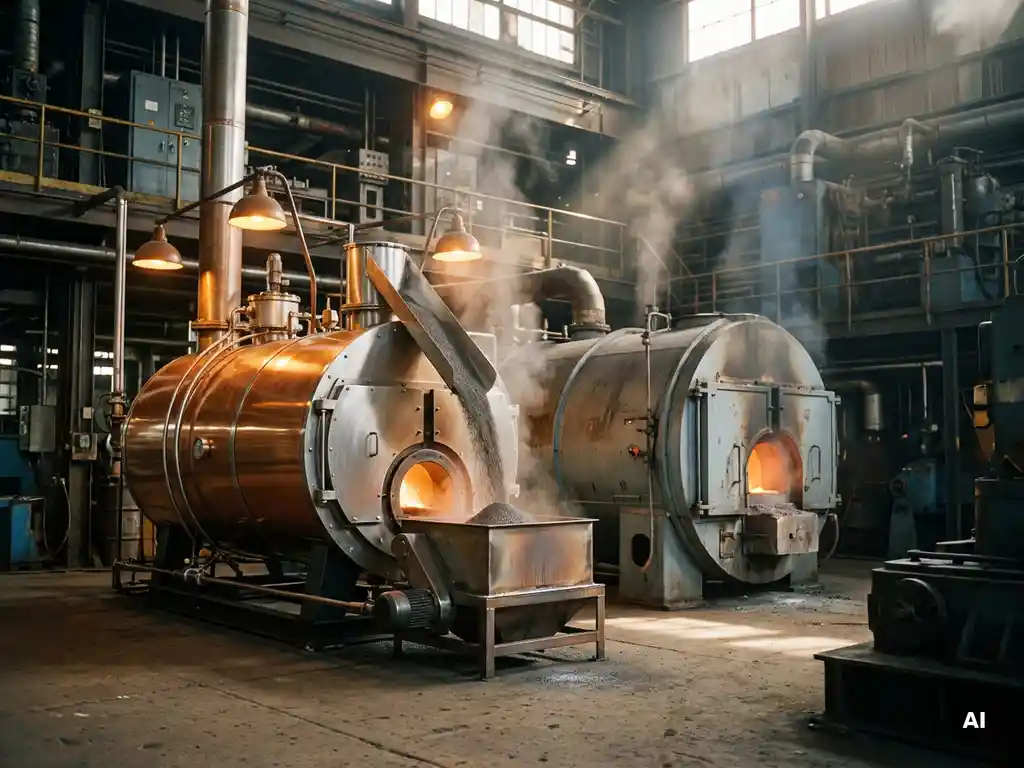
Balancing emissions targets with operational continuity in manufacturing means pursuing decarbonisation in a way that reduces Scope 1 emissions without disrupting production output, product quality, or supply reliability. The key is choosing clean energy technologies that integrate with existing infrastructure rather than replacing it entirely. The sections below unpack the most common questions sustainability managers face when navigating this challenge.
Why is decarbonising industrial heat harder than other emissions sources?
Decarbonising industrial heat is harder than other emissions sources because high-temperature heat processes cannot simply be switched off or replaced with a plug-in alternative. Unlike lighting or transport, industrial heat often needs to be continuous, precise, and capable of reaching temperatures that only combustion fuels have historically delivered at scale and at an acceptable cost.
Industry accounts for roughly 37% of total global energy consumption, and around two-thirds of that is used for heat generation. Of that heat demand, approximately 80% is still met by fossil fuels. The reasons are structural. Many industrial processes in sectors like Food and Beverage, Specialty Chemicals, and Pulp and Paper require sustained high-temperature heat that electrification struggles to deliver cost-effectively, particularly where grid connections are limited or where grid congestion makes reliable power supply uncertain.
The EU Emissions Trading System (EU ETS) adds financial urgency to this challenge. As carbon prices rise, the cost of continuing to burn natural gas for heat increases year on year. Yet the alternatives each come with their own constraints. Full electrification demands significant grid upgrades. Hydrogen requires new infrastructure and faces its own cost and availability barriers. Biomass raises land-use and sustainability questions. The result is a decarbonisation gap that is genuinely difficult to close with existing mainstream solutions.
What does ‘operational continuity’ actually mean when switching energy carriers?
Operational continuity when switching energy carriers means maintaining uninterrupted heat supply, consistent process temperatures, and predictable fuel availability throughout and after the transition. It is not just about keeping the lights on during installation. It covers everything from commissioning timelines and staff training to long-term security of supply and the ability to scale capacity in line with production growth.
For a sustainability manager, the practical concerns look like this:
- Heat quality and consistency: Does the new fuel deliver the same temperature profile and thermal output that current processes depend on?
- Infrastructure compatibility: Can the new system integrate with existing boilers and heat distribution networks, or does it require a full rebuild?
- Fuel supply reliability: Is the energy carrier available in sufficient volumes, and are supply chains resilient enough to avoid production stoppages?
- Transition risk: Can the switch be staged so that fossil fuel backup remains available during the ramp-up period?
Volatile energy prices and the risk of grid congestion make security of supply a growing concern alongside emissions performance. A clean energy carrier that is also dependable, storable, and transportable without specialist infrastructure significantly reduces transition risk compared to alternatives that depend on real-time grid availability or pressurised gas networks.
How do sustainability managers build the internal business case for cleaner heat?
Sustainability managers build the internal business case for cleaner heat by framing decarbonisation as a financial and operational risk management decision, not just an environmental one. The most persuasive cases combine regulatory exposure, long-term energy cost projections, and a credible technology pathway with a clear CAPEX versus OPEX breakdown.
A strong internal business case typically works through the following steps:
- Quantify regulatory risk: Map current and projected EU ETS carbon costs against your existing heat consumption. Rising carbon prices mean the cost of inaction is not zero.
- Model total cost of ownership: Compare the upfront capital investment of a clean heat solution against avoided carbon costs, potential energy savings, and reduced exposure to volatile fossil fuel prices over a 10 to 15-year horizon.
- Assess infrastructure requirements: Identify what changes are needed to existing plant and whether a phased integration is possible, which reduces capital outlay in any single year.
- Identify available funding: The EU Innovation Fund, InvestEU guarantees, and national grant schemes such as the Dutch VEKI subsidy can meaningfully reduce the net CAPEX burden. The EU’s Clean Industrial Deal is also mobilising significant capital to support industrial decarbonisation.
- Demonstrate operational credibility: Board-level decision-makers want evidence that the technology works at industrial scale before committing. Referencing deployments at Technology Readiness Level 7 (TRL 7) or early commercial contracts provides that reassurance.
The business case becomes significantly stronger when the clean heat solution does not require replacing the entire boiler setup immediately. Technologies that complement existing infrastructure lower the barrier to approval and reduce the risk profile of the investment.
What are the real trade-offs between electrification, hydrogen, and iron fuel for industrial heat?
The real trade-offs between electrification, hydrogen, and iron fuel for industrial heat come down to temperature capability, infrastructure dependency, cost structure, and supply security. Each option has genuine strengths, but each also carries constraints that make it unsuitable for every industrial context.
Electrification
Electric heating is well-suited to lower-temperature processes and sites with strong, reliable grid connections. However, for high-temperature industrial heat, the energy density of electricity is a limiting factor. Grid congestion is a growing reality across Europe, and the capital cost of upgrading electrical infrastructure to support large industrial heat loads can be prohibitive. Electrification also ties energy costs directly to electricity market volatility.
Hydrogen
Hydrogen can theoretically deliver high-temperature heat with zero direct carbon emissions. The challenge is infrastructure. Hydrogen requires pressurised storage and transport, dedicated pipelines or delivery networks, and significant modifications to existing combustion equipment. Green hydrogen remains expensive in 2026, and supply chains are not yet mature enough to guarantee the volumes and reliability that continuous industrial processes demand.
Iron fuel
Iron fuel, in the form of fine iron powder, offers a fundamentally different profile. It is solid, stable at ambient conditions, and transportable in standard containers without specialist infrastructure. When burned, it produces high-temperature heat with near-zero direct CO₂ emissions. Only iron oxide remains after combustion, and that oxide is regenerated back into iron fuel using hydrogen, completing a fully circular fuel cycle. RIFT’s Iron Fuel Boiler achieves up to 95% energy efficiency and is designed to complement existing fossil fuel boilers rather than replace them outright, which significantly reduces transition complexity. The technology is independent of the electricity grid, which addresses both grid congestion concerns and security of supply.
When should a manufacturer start piloting a new heat technology?
A manufacturer should start piloting a new heat technology when the combination of regulatory pressure, energy cost exposure, and technology readiness makes the cost of waiting greater than the cost of acting. In practical terms, that means now for most energy-intensive industrial companies operating under the EU ETS, given the trajectory of carbon pricing and the lead times involved in deploying new heat systems.
Waiting for a technology to be fully mature before piloting it means arriving late to the learning curve. Companies that pilot early gain operational knowledge, influence supplier relationships, and build internal capability before competitors. They also position themselves to benefit from first-mover advantages in regulatory frameworks that increasingly reward low-carbon production, including public procurement criteria introduced under the EU’s Net-Zero Industry Act.
The right moment to pilot is typically when a technology has reached industrial-scale demonstration, when a credible supply agreement can be structured alongside the equipment contract, and when at least one existing process line can absorb the pilot without threatening core production. Phased integration, starting with a single boiler or a portion of total heat demand, limits capital commitment while generating the operational data needed to justify broader rollout.
How do you measure progress when emissions targets and production targets conflict?
When emissions targets and production targets appear to conflict, progress is best measured by tracking emissions intensity rather than absolute emissions alone. Emissions intensity measures CO₂ per unit of production output, which means a company can grow output while still demonstrating genuine decarbonisation progress as long as the carbon per unit is falling.
This framing matters because absolute emissions reductions are sometimes genuinely impossible during periods of production growth. Insisting on absolute reduction targets in those periods can create perverse incentives, such as cutting production rather than investing in cleaner processes. Intensity-based metrics, combined with a credible roadmap toward absolute reductions, give sustainability managers a more defensible and operationally honest framework.
Practically, a robust measurement approach combines:
- Scope 1 emissions per tonne of product as the primary operational metric
- Absolute Scope 1 emissions tracked against a baseline year to demonstrate trajectory
- Energy efficiency metrics to separate fuel-switching gains from efficiency improvements
- Carbon cost exposure under the EU ETS, updated quarterly as carbon prices shift
When a new clean heat technology is introduced, it is also worth tracking avoided emissions separately from baseline performance. This makes the contribution of each investment decision visible and helps build the internal case for continued capital allocation toward decarbonisation.
How RIFT helps manufacturers balance emissions targets with operational continuity
We developed Iron Fuel Technology precisely to address the tension that sustainability managers face every day: the need to decarbonise heat without disrupting the production processes that keep the business running. Our Iron Fuel Boiler is designed to work alongside existing fossil fuel boilers, which means you do not have to shut down operations or rebuild your heat infrastructure to start reducing emissions.
Here is what that means in practice:
- Zero direct CO₂ emissions during combustion, with only 10 kg of CO₂ per MWhth stemming from the pilot safety flame
- Up to 95% energy efficiency, outperforming many conventional fossil fuel systems
- Grid-independent operation, removing exposure to grid congestion and electricity price volatility
- Drop-in compatible design, integrating with existing industrial setups in Food and Beverage, Specialty Chemicals, and Pulp and Paper
- Long-term fuel supply agreements, providing the security of supply that continuous industrial processes require
- Demonstrated at TRL 7, giving decision-makers confidence in real-world industrial performance before committing capital
Our technology is circular by design. Iron fuel burns to produce heat, leaves only iron oxide, and that oxide is regenerated back into iron fuel using hydrogen, completing the loop. The first commercial contract for Iron Fuel Technology has already been signed with Kingspan Unidek, making this a proven commercial pathway, not a theoretical one.
If you are building the business case for cleaner industrial heat and want to understand how Iron Fuel Technology fits your specific situation, get in touch with our team to start the conversation.
Frequently Asked Questions
How long does it typically take to integrate an iron fuel boiler alongside an existing fossil fuel setup?
Integration timelines vary depending on site complexity, but a phased installation designed to work alongside existing boilers is generally faster than a full system replacement. Because iron fuel technology is built for drop-in compatibility with current industrial heat infrastructure, major civil engineering works or grid upgrades are typically not required. Most manufacturers can expect to move from initial site assessment to commissioning within a matter of months rather than years, significantly reducing the operational disruption associated with the transition.
What happens to our existing fossil fuel boilers once we start using iron fuel technology?
You do not need to decommission your existing boilers immediately. Iron fuel technology is specifically designed to complement rather than replace fossil fuel systems, meaning your current boilers can remain operational as a backup or supplementary heat source during the ramp-up period. This staged approach protects operational continuity, reduces capital commitment in year one, and allows your team to build confidence in the new technology before increasing its share of total heat supply.
Is iron fuel technology suitable for all industrial temperature ranges, or only specific heat applications?
Iron fuel combustion delivers high-temperature heat, making it particularly well-suited to the demanding thermal requirements found in sectors like Food and Beverage, Specialty Chemicals, and Pulp and Paper. It is not limited to low-temperature applications the way some electrification solutions are. If your process requires sustained, high-quality heat at industrial scale, iron fuel is worth evaluating as a primary decarbonisation pathway rather than a niche supplement.
What are the main risks of moving too slowly on industrial heat decarbonisation?
The most immediate financial risk is rising EU ETS carbon costs, which increase the cost of every MWh of fossil-fuel-derived heat year on year. Beyond direct carbon costs, manufacturers that delay also face the risk of being locked out of public procurement opportunities under frameworks like the EU Net-Zero Industry Act, which increasingly favours low-carbon producers. There is also a competitive risk: companies that pilot clean heat technologies early build operational knowledge and supplier relationships that late movers will struggle to replicate quickly.
How do we handle fuel supply security when transitioning away from natural gas?
Fuel supply security is one of the most legitimate concerns when moving away from an established energy carrier like natural gas. With iron fuel technology, long-term fuel supply agreements can be structured alongside the equipment contract, providing the same kind of supply certainty that manufacturers currently rely on from gas utilities. Iron powder is solid, stable at ambient conditions, and transportable in standard containers, which means it does not depend on dedicated pipelines or pressurised gas networks — significantly reducing supply chain fragility compared to hydrogen alternatives.
Can iron fuel technology help us meet Science Based Targets (SBTi) commitments, not just EU ETS obligations?
Yes. Because iron fuel combustion produces near-zero direct CO₂ emissions — with only 10 kg of CO₂ per MWhth from the pilot safety flame — switching a meaningful portion of your heat demand to iron fuel will materially reduce your Scope 1 emissions intensity and absolute Scope 1 figures. This directly supports progress against Science Based Targets, which require demonstrated reductions in operational emissions rather than offset-based accounting. Tracking avoided emissions from each iron fuel deployment separately also makes your SBTi progress more transparent and auditable.
What internal stakeholders do we need to involve early when building the case for a clean heat pilot?
The most effective business cases involve finance, operations, and sustainability teams from the outset rather than treating the decision as solely a sustainability function responsibility. Finance needs to see the total cost of ownership model and regulatory risk quantification. Operations needs confidence that heat quality, supply reliability, and process compatibility have been validated at industrial scale — which is where TRL 7 demonstration data and reference contracts like the Kingspan Unidek deployment become critical. Bringing procurement in early also helps structure the fuel supply agreement in parallel with the equipment decision, avoiding delays once board approval is secured.
Related Articles
- What clean heat technologies are commercially available for industry today?
- What role does renewable energy play in fighting climate change?
- What is energy independence and how do renewables enable it?
- Is it worth investing in renewable energy for your home?
- What countries use the most renewables?
This content was generated with the help of AI and it may contain mistakes