

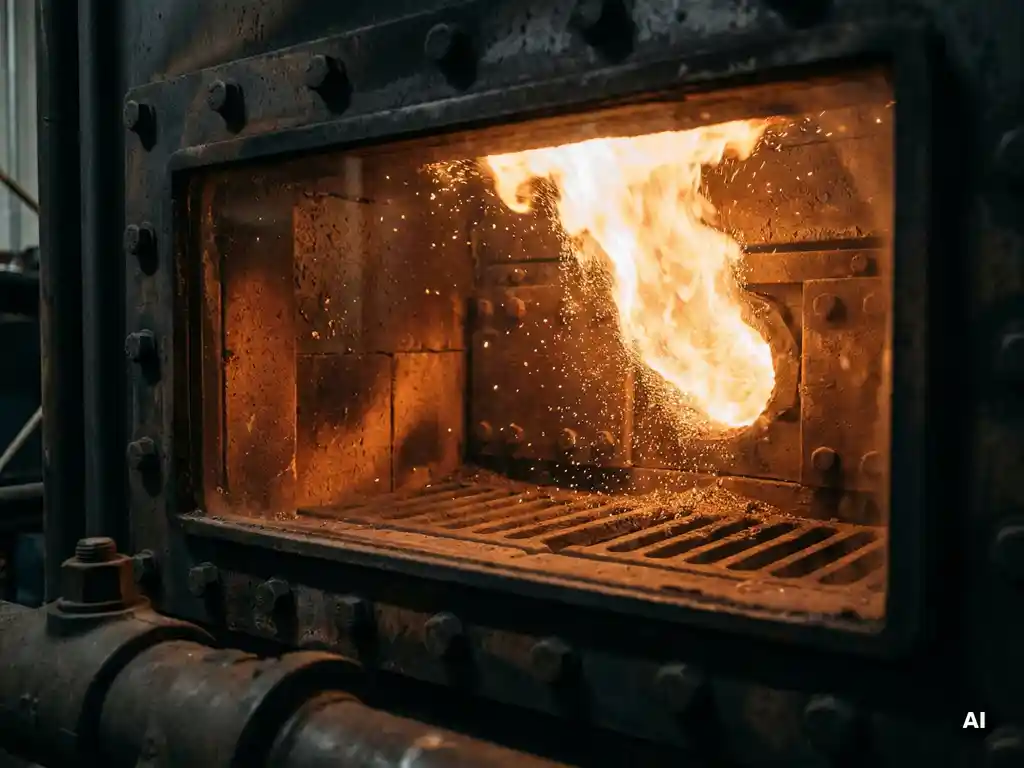
Replacing natural gas in high-temperature industrial processes is genuinely possible today, but it requires choosing the right alternative for your specific setup. Iron fuel, electrification, green hydrogen, and biomass each offer a different trade-off between cost, infrastructure, and decarbonization depth. For many energy-intensive industries, iron fuel is emerging as the most practical drop-in option, delivering high-temperature, carbon-free heat without a complete overhaul of existing infrastructure. Below, we unpack the key questions sustainability managers are asking right now.
What makes high-temperature industrial heat so hard to decarbonize?
High-temperature industrial heat is difficult to decarbonize because most clean energy alternatives either cannot reach the required temperatures or are too costly and infrastructure-dependent to deploy at scale. Natural gas burns reliably at temperatures that many industrial processes depend on, often above 500°C and sometimes well above 1,000°C, and no single clean alternative has yet matched that combination of availability, temperature range, and price.
The scale of the challenge is significant. Two-thirds of total industrial energy consumption goes toward heat generation, and around 80% of that heat is still produced by burning fossil fuels. For sectors like Food and Beverage, Specialty Chemicals, and Pulp and Paper, heat is not a peripheral concern, it is the core of the production process.
Several structural barriers make switching harder than it sounds:
- Temperature requirements: Many industrial processes need sustained, controllable heat at temperatures that electrification struggles to reach economically.
- Grid congestion: Connecting large new electrical loads to the grid is slow, expensive, and in many regions simply not possible in the near term.
- Infrastructure gaps: Green hydrogen requires entirely new pipelines, storage, and handling systems that most industrial sites do not yet have.
- CAPEX versus OPEX trade-offs: Switching technologies often involves high upfront capital expenditure, which is difficult to justify when fossil fuel alternatives remain cheaper on a day-to-day operating cost basis.
- Volatile energy prices: Uncertainty about future energy costs makes long-term investment decisions harder for industrial operators.
Add to this the pressure of the EU Emissions Trading System (EU ETS), which makes every tonne of CO₂ more expensive over time, and sustainability managers face a genuine dilemma: act now with imperfect alternatives, or wait for better options while costs and regulatory risk mount.
What are the main alternatives to natural gas for industrial heat?
The main alternatives to natural gas for industrial heat are electrification, green hydrogen, biomass, and iron fuel. Each has a distinct profile in terms of temperature capability, infrastructure requirements, emissions performance, and cost. No single option is right for every industry, but understanding the trade-offs helps narrow down what is realistic for a given site.
Electrification
Electric heat pumps and electric resistance heating work well for low- to medium-temperature applications, typically below 200°C. For higher temperatures, the technology exists but becomes significantly more expensive. Beyond the technology itself, grid congestion is a major practical barrier. Many industrial sites cannot access the grid capacity they would need, and the timeline for grid upgrades in many European countries extends well beyond what decarbonization targets allow.
Green hydrogen
Hydrogen burns at high temperatures and produces no direct CO₂ emissions, making it theoretically well suited to replacing natural gas in industrial burners. The challenge is infrastructure. Hydrogen requires new storage systems, dedicated pipelines, and significant safety provisions. Supply chains are still maturing, and the cost of green hydrogen remains high relative to natural gas. For many sites, hydrogen is a long-term ambition rather than a near-term solution.
Biomass
Biomass boilers are commercially available and can deliver high-temperature heat. However, biomass sustainability is increasingly scrutinized under EU regulations, feedstock availability is geographically uneven, and the emissions profile depends heavily on sourcing. For some industries, biomass is a viable bridge fuel. For others, it introduces new supply chain risks.
Iron fuel
Iron fuel is a newer entrant, but one that directly addresses many of the limitations above. It burns at temperatures up to 2,000°C, requires no grid connection for the heat generation itself, and can be transported in standard containers. The Iron Fuel Technology cycle is fully circular: iron powder burns to produce heat, leaves only iron oxide as a residue, and is regenerated using hydrogen, ready to burn again.
How does iron fuel work as a replacement for natural gas?
Iron fuel replaces natural gas by burning fine iron powder in a boiler to generate high-temperature heat, producing steam, hot water, or hot air with near-zero carbon emissions. The combustion process releases no CO₂ from the fuel itself. The only CO₂ output comes from a small pilot safety flame, resulting in just 10 kg of CO₂ per megawatt-hour of thermal energy (MWhth), a figure RIFT attributes to this specific system configuration at demonstration scale.
After combustion, iron oxide remains. This residue is sent back through an Iron Fuel Production system, where hydrogen reduces it back to iron powder. The cycle then starts again. Think of it as a rechargeable battery for industrial heat: energy goes in via hydrogen, comes out as high-temperature heat, and the carrier material is reused indefinitely.
From a practical standpoint, the Iron Fuel Boiler is designed to integrate with existing industrial setups rather than replace them entirely. It can operate alongside existing fossil fuel boilers, allowing companies to decarbonize incrementally. The boiler achieves an energy efficiency of up to 95%, a strong performance compared to many conventional fossil fuel systems.
RIFT also claims the Iron Fuel Boiler achieves the lowest nitrogen oxide (NOₓ) emissions of any fuel, at under 5 mg/MJ. This is RIFT’s own claim based on demonstration-scale results and should be understood in that context rather than as a universally verified benchmark.
Iron fuel is also independent of the electricity grid for heat generation, which makes it particularly relevant for sites facing grid congestion or unreliable supply, a growing concern across European industrial zones.
Which industries can realistically switch away from natural gas today?
Industries that can realistically switch away from natural gas today are those with high, continuous heat demand and the operational flexibility to integrate a new fuel system alongside existing infrastructure. Food and Beverage, Specialty Chemicals, and Pulp and Paper are among the most viable candidates, they have stable heat profiles, clear decarbonization targets, and face significant EU ETS cost exposure as carbon prices rise.
These sectors share a few characteristics that make the transition more practical:
- Consistent, large-scale heat demand: High utilization rates make the economics of a new boiler system more attractive, as capital costs are spread across more operating hours.
- Scope 1 emission pressure: Direct emissions from heat generation are squarely in scope for EU ETS compliance and internal net-zero commitments, creating a clear financial and regulatory incentive to act.
- Existing boiler infrastructure: Companies with existing boiler rooms can integrate new systems without rebuilding their entire production setup.
- Security of supply concerns: Industries that have experienced the impact of volatile energy prices and gas supply disruptions are actively looking for alternatives that reduce exposure to fossil fuel markets.
Industries with very specific or highly variable heat profiles, or those located in areas without access to low-carbon hydrogen supply chains, may face additional hurdles in the near term. For them, the transition is more likely to follow a phased approach, beginning with the parts of the process where clean heat alternatives are most cost-competitive.
What does it actually cost to replace natural gas in an industrial boiler?
The cost of replacing natural gas in an industrial boiler depends on the technology chosen, the scale of the installation, and the balance between upfront capital expenditure and ongoing operating costs. For iron fuel specifically, the Iron Fuel Boiler system requires an investment of approximately 0.5 million euros per megawatt thermal (M€/MWth), and iron fuel is priced at 140 €/tonne.
These figures reflect demonstration-scale economics at TRL7 and will evolve as the technology scales commercially. That context matters when building a business case.
When comparing alternatives, the CAPEX versus OPEX trade-off looks different for each option. Full electrification may have lower fuel costs if electricity prices are favorable, but grid connection costs and capacity constraints can make the upfront investment prohibitive. Green hydrogen has potential at scale, but current production costs remain high and infrastructure investment is substantial. Biomass can be cost-competitive in some regions but introduces feedstock price risk.
The EU ETS adds another layer to the calculation. As the carbon price rises, the cost of continuing to burn natural gas increases year on year. Sustainability managers who factor in the expected trajectory of carbon costs, rather than today’s price alone, often find that the economics of switching shift meaningfully in favor of clean alternatives within a five-to-ten-year horizon.
Funding mechanisms also play a role. The EU Innovation Fund and national subsidy programs in several member states are designed to bridge the gap between the cost of clean heat and the market price of fossil fuel-generated energy, reducing the effective CAPEX burden for qualifying projects.
When will iron fuel technology be commercially available at scale?
Iron Fuel Technology is already at Technology Readiness Level 7 (TRL7), meaning it has been demonstrated at megawatt industrial scale. The first commercial contract was signed with Kingspan Unidek, covering the delivery of an Iron Fuel Boiler and a long-term iron fuel supply agreement, making it the first industrial deployment of this technology in the world. Commercial availability is not a future promise, it is happening now.
Scaling from demonstration to broad commercial deployment takes time, and it is honest to say that widespread availability across all industrial sectors will be a gradual process. RIFT secured €113.8 million to support this scale-up, including an €83.1 million Series B led by PGGM and a €30.7 million grant from the EU Innovation Fund, which provides the financial foundation to move from pilot to commercial reality.
The long-term ambition is to eliminate 1 gigaton of CO₂ from industrial heat annually by 2050. That target requires significant deployment across multiple industries and geographies. But for sustainability managers evaluating options in 2026, the relevant question is not whether the technology will eventually exist, it is whether they can access it now and begin building it into their decarbonization roadmap.
How RIFT helps you replace natural gas with carbon-free heat
We develop and deliver industrial Iron Fuel Boilers that replace fossil fuel-fired heat generation with a fully circular, carbon-free alternative. Our solution is built for the practical realities of industrial operations, not a theoretical future state.
Here is what makes our approach relevant for sustainability managers evaluating their options today:
- Grid-independent heat generation: Our Iron Fuel Boiler does not rely on the electricity grid, making it a viable option even where grid congestion is a barrier.
- Up to 95% energy efficiency: The system outperforms many conventional fossil fuel boilers on energy utilization.
- Near-zero direct CO₂ emissions: Combustion of iron fuel produces no CO₂. The only output is 10 kg CO₂/MWhth from the pilot safety flame.
- Drop-in compatible: Our boiler integrates with existing industrial infrastructure, so you do not need to rebuild your entire production setup.
- Long-term fuel supply: We provide both the boiler system and a reliable, long-term iron fuel supply agreement, reducing your exposure to volatile energy prices.
- Commercially proven: The first commercial contract has already been signed and delivered, so you are not taking a leap into unproven territory.
If you are building the business case for decarbonizing your industrial heat and want to understand what an iron fuel solution could look like for your site, we would be glad to have that conversation. Get in touch with our team to explore what is possible.
Frequently Asked Questions
Can an iron fuel boiler fully replace our existing natural gas boiler, or does it only work as a supplementary system?
Iron fuel boilers are designed to work both as a full replacement and as a parallel system running alongside existing fossil fuel infrastructure. For most industrial sites, the recommended approach is incremental integration — running the iron fuel boiler in parallel first to validate performance and build operational familiarity, then gradually increasing its share of heat output. This phased approach reduces operational risk and allows capital expenditure to be spread over time.
What happens if our iron fuel supply is interrupted — do we lose all heat production?
Because iron fuel boilers are designed to integrate alongside existing boiler infrastructure rather than replace it outright, your conventional backup systems remain available during any supply disruption. Iron fuel itself is transported in standard containers, making it logistically comparable to other solid fuel deliveries — and RIFT’s commercial agreements include long-term fuel supply commitments specifically to ensure continuity. Unlike dependence on pipeline-delivered natural gas, the containerized nature of iron fuel also means you can maintain on-site inventory as a buffer.
How do we start building the internal business case for switching to iron fuel or another clean heat alternative?
The strongest business cases combine three elements: current and projected EU ETS carbon costs applied to your Scope 1 emissions, a realistic CAPEX-versus-OPEX comparison that accounts for grid connection costs if electrification is on the table, and any available EU Innovation Fund or national subsidy offsets that reduce net capital outlay. Start by quantifying your annual CO₂ output from heat generation and mapping it against the expected carbon price trajectory over a five-to-ten-year horizon — this alone often shifts the financial picture significantly in favor of clean alternatives.
Is green hydrogen a prerequisite for using iron fuel, and does that create a new supply chain dependency?
Green hydrogen is used in the back-end regeneration step — converting iron oxide residue back into iron powder — but this process happens at the Iron Fuel Production facility, not at your industrial site. From an operational standpoint, you receive ready-to-use iron fuel and return spent iron oxide, without needing to manage hydrogen on-site. This means iron fuel does not expose your facility to the direct infrastructure and safety requirements that on-site hydrogen use would entail, though the broader availability of green hydrogen does influence the long-term scalability and emissions profile of the full cycle.
How does iron fuel's emissions profile hold up under EU regulatory scrutiny, including the EU ETS and potential carbon border adjustments?
Iron fuel combustion produces no CO₂ from the fuel itself, with only 10 kg CO₂/MWhth attributed to the pilot safety flame — a figure that compares favorably against natural gas, which typically emits around 200 kg CO₂/MWhth. This near-zero direct emissions profile means iron fuel heat generation would largely fall outside EU ETS compliance costs, directly reducing your carbon cost exposure as prices rise. As the Carbon Border Adjustment Mechanism (CBAM) expands, industries that have already decarbonized their heat processes will also be better positioned competitively when supplying into or trading with the EU market.
What are the most common mistakes sustainability managers make when evaluating natural gas alternatives?
The most frequent mistake is evaluating alternatives purely on today’s operating costs without factoring in the rising trajectory of EU ETS carbon prices, which systematically makes fossil fuel heat more expensive year on year. A second common error is treating electrification as the default clean option without fully accounting for grid connection costs, upgrade timelines, and capacity constraints at the specific site. Finally, many managers underestimate the value of drop-in compatibility — technologies that integrate with existing infrastructure avoid the hidden costs and operational disruption of a full system rebuild, which can make a meaningful difference to total project economics.
Are there specific certifications or regulatory approvals we should verify before committing to any industrial heat decarbonization technology?
For any new industrial heat technology, you should verify conformity with the EU Machinery Regulation and relevant pressure equipment directives (PED), as well as local permitting requirements for boiler installations and emissions. For iron fuel specifically, confirming the technology’s TRL status and referencing its demonstrated performance at existing commercial installations — such as the Kingspan Unidek deployment — provides a stronger basis for regulatory and board-level approval than pilot-only data. It is also worth engaging early with your national environmental agency, as novel fuel systems may require a pre-application consultation before formal permitting begins.
Related Articles
- How can manufacturers reduce upfront investment when switching to clean heat?
- How can companies use renewable energy?
- Is nuclear energy considered renewable?
- What industries are most affected by the shift to renewable energy?
- What is the difference between renewable and non-renewable energy?
This content was generated with the help of AI and it may contain mistakes