

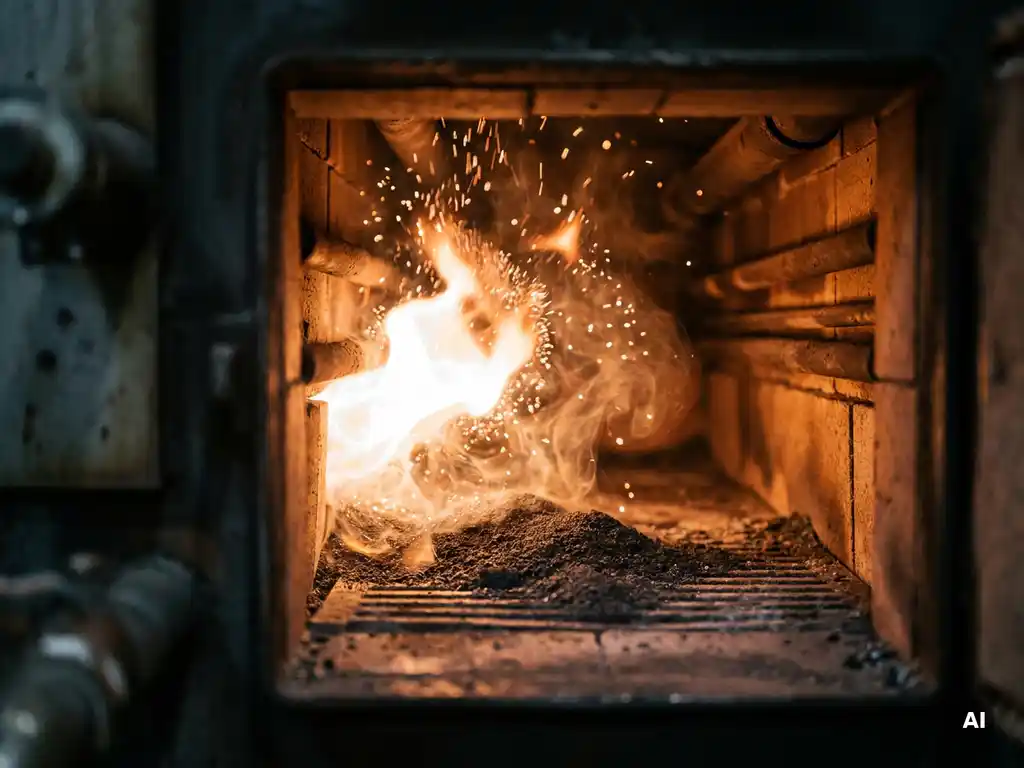
Iron fuel eliminates CO₂ from industrial boilers by replacing fossil fuels with iron powder as the energy carrier. When iron burns, it releases high-temperature heat without producing any carbon dioxide because iron contains no carbon. The only CO₂ output in RIFT’s Iron Fuel Boiler comes from a small pilot safety flame, resulting in just 10 kg of CO₂ per megawatt-hour of thermal energy. Below, we answer the most common questions about how this works in practice.
What happens when iron powder burns in a boiler?
When iron powder burns inside an Iron Fuel Boiler, it reacts with oxygen from the air to produce intense heat, reaching flame temperatures of up to 2,000°C, without releasing any carbon dioxide. The combustion leaves behind only one by-product: iron oxide, a rust-like powder. Because iron contains no carbon atoms, there is simply no CO₂ to emit during the process.
This is what makes Iron Fuel Technology fundamentally different from burning natural gas, coal, or oil. Fossil fuels release carbon that was locked underground for millions of years. Iron, by contrast, cycles between two states, metallic iron and iron oxide, without ever releasing carbon into the atmosphere.
Inside the boiler, the combustion of fine iron powder generates steam, hot water, or hot air, depending on what the industrial process requires. The system achieves an energy efficiency of up to 95%, which outperforms many conventional fossil fuel boilers. The iron oxide that remains after combustion is collected and sent back into the production cycle to be regenerated into fresh iron fuel.
How is iron oxide turned back into iron fuel?
Iron oxide is converted back into iron fuel using hydrogen in a dedicated Iron Fuel Production system. In this regeneration step, hydrogen reacts with the iron oxide to strip away the oxygen, leaving behind metallic iron powder ready to be burned again. The process emits zero CO₂ and zero NOₓ, and operates at an energy efficiency of 86%.
This is what makes Iron Fuel Technology circular. The fuel cycle works like a rechargeable battery: iron burns to produce heat, becomes iron oxide, and is then recharged back into iron using hydrogen. The iron itself never gets consumed; it simply changes chemical state and returns to the start of the cycle.
One important nuance: the CO₂ reduction benefit of the full chain depends on the type of hydrogen used in regeneration. When low-carbon hydrogen is used as feedstock and measured according to EU greenhouse gas methodology, the full production and combustion cycle delivers a CO₂ reduction of 0.55 tonnes of CO₂ equivalent per tonne of iron fuel. This figure applies specifically when carbon-lean hydrogen is used; it is not an absolute or universal reduction figure independent of the hydrogen source.
What CO₂ and NOₓ emissions does an iron fuel boiler actually produce?
An Iron Fuel Boiler produces just 10 kg of CO₂ per megawatt-hour of thermal energy (MWhth), and this trace amount comes exclusively from a pilot safety flame, not from the iron combustion itself. In terms of NOₓ, RIFT claims the Iron Fuel Boiler achieves the lowest nitrogen oxide emissions of any fuel, at under 5 mg/MJ. These figures are based on demo-scale performance at Technology Readiness Level 7 (TRL 7).
To put the CO₂ figure in context: natural gas combustion typically produces around 200 kg of CO₂ per MWhth. The iron fuel figure of 10 kg represents a reduction of roughly 95% at the point of combustion, achieved without carbon capture equipment.
It is worth being precise here. RIFT’s own position is that the boiler operates with near-zero carbon emissions, not zero, because of that pilot safety flame. Similarly, the NOₓ claim is RIFT’s own assessment based on demo-scale testing, not an independently verified industry benchmark. These are meaningful, well-documented results, but they reflect performance at TRL 7 scale and may evolve as the technology moves into full commercial deployment.
How does iron fuel compare to hydrogen and electrification for industrial heat?
Iron fuel, direct electrification, and hydrogen are all pathways for decarbonising industrial heat, but they serve different situations. For high-temperature industrial processes where electrification is too costly or constrained by grid capacity, and where hydrogen infrastructure is not yet available, iron fuel offers a practical alternative that can integrate with existing boiler setups without requiring a complete overhaul.
Here is how the three options compare across the factors that matter most to industrial operators:
- Grid dependency: Electrification requires significant grid upgrades and reliable access to large amounts of renewable electricity. Iron fuel operates independently of the electricity grid, making it suitable for sites with limited grid capacity.
- Infrastructure requirements: Hydrogen requires new pipelines, storage systems, and safety infrastructure. Iron fuel is transported as a powder in standard containers, with no specialist infrastructure needed at the point of use.
- Temperature range: Many electrification technologies struggle to reach the high temperatures required for industrial processes. Iron fuel combustion reaches up to 2,000°C, covering the full range of industrial heat demand.
- Integration with existing equipment: The Iron Fuel Boiler is designed to complement existing fossil fuel boilers rather than replace entire systems, reducing capital disruption.
- Emissions at point of use: All three options can achieve near-zero direct CO₂ when powered by clean energy sources. Iron fuel and green hydrogen both depend on low-carbon hydrogen upstream; the difference lies in how that energy is stored and delivered.
None of these technologies is universally superior. The right choice depends on a site’s existing infrastructure, energy demand profile, and access to renewable energy or hydrogen. Iron fuel is particularly well suited to companies that need a reliable, drop-in-compatible solution today, without waiting for grid upgrades or hydrogen pipelines.
Which industries are best suited to switching to iron fuel?
Iron fuel is best suited to energy-intensive industries that require high-temperature process heat, cannot easily electrify their operations, and face real barriers to adopting hydrogen due to infrastructure or cost constraints. RIFT’s initial commercial focus covers three sectors: Food and Beverage, Specialty Chemicals, and Pulp and Paper.
These industries share several characteristics that make iron fuel a strong fit:
- High and continuous heat demand: These sectors run boilers around the clock to produce steam or hot air for drying, cooking, sterilising, or chemical processing. Iron fuel delivers reliable, consistent heat output at the temperatures these processes require.
- Scope 1 emissions pressure: Industrial boilers burning fossil fuels are a primary source of direct CO₂ emissions. Sustainability managers in these sectors face mounting pressure from regulators, customers, and internal net-zero commitments to address these emissions.
- Electrification constraints: Many sites in these industries are not close to upgrading to full electric heating due to grid limitations, the cost of electric alternatives at scale, or the sheer volume of heat they consume.
- Existing boiler infrastructure: These sectors already operate large boiler systems. Iron fuel integrates with existing setups, which reduces the capital disruption of switching compared to a full technology replacement.
The first commercial deployment of Iron Fuel Technology is with Kingspan Unidek, a company in the building materials sector, demonstrating that the technology’s applicability extends beyond the initial three focus sectors as the market develops.
What does it cost to implement iron fuel technology in an existing facility?
Implementing iron fuel technology involves two cost components: the boiler system investment and the ongoing fuel cost. The Iron Fuel Boiler system requires an investment of approximately 0.5 million euros per megawatt of thermal capacity (M€/MWth). Iron fuel itself is priced at 140 euros per tonne. These figures are based on current demo-scale performance at TRL 7 and will be refined as the technology scales commercially.
For sustainability managers building an internal business case, it helps to look at these costs alongside the regulatory and financial context. Industrial companies in the EU face carbon pricing through the Emissions Trading System, and subsidy programmes such as the VEKI scheme in the Netherlands are specifically designed to support investments in industrial decarbonisation with payback periods of more than five years. Iron fuel investments may qualify for such support, reducing the effective cost gap relative to continuing with fossil fuel systems.
The boiler system is designed to complement existing fossil fuel boilers rather than replace them outright, which means the initial capital commitment can be phased. This reduces the financial risk of adoption and allows companies to test performance before committing to a full transition. Combined with a long-term fuel supply agreement, as demonstrated in the contract with Kingspan Unidek, operators gain cost predictability over time.
Explore our industrial heat solutions to get a clearer picture of what implementation looks like in practice for your sector.
How RIFT helps decarbonise industrial heat with iron fuel
We develop and deliver industrial Iron Fuel Boilers that give energy-intensive companies a practical route to eliminating direct CO₂ from their heat generation, without waiting for grid upgrades or hydrogen pipelines. Here is what makes our approach concrete and commercially viable:
- Up to 95% energy efficiency – outperforming many conventional fossil fuel boilers
- Near-zero carbon combustion – just 10 kg of CO₂ per MWhth, from a pilot safety flame only
- Drop-in compatibility – the Iron Fuel Boiler integrates with existing industrial setups, reducing capital disruption
- Grid-independent operation – no reliance on electricity network upgrades
- Long-term fuel supply agreements – predictable costs backed by a circular, domestic fuel cycle
- Backed by €113.8 million in funding – including a €30.7 million EU Innovation Fund grant, confirming our technology’s credibility and commercial trajectory
We are already in commercial deployment with Kingspan Unidek, the first company in the world to adopt Iron Fuel Technology at industrial scale. If you are a sustainability manager evaluating decarbonisation options for your facility, we would be glad to talk through what iron fuel could mean for your operations. Get in touch with our team to start the conversation.
Frequently Asked Questions
How long does it take to integrate an Iron Fuel Boiler into an existing facility?
The integration timeline will vary depending on the size and complexity of your existing boiler infrastructure, but because the Iron Fuel Boiler is designed to complement rather than replace existing fossil fuel systems, significant demolition or full system overhauls are not required. This phased, drop-in approach means disruption to ongoing operations can be minimised during installation. For a more accurate timeline specific to your site and sector, it is best to discuss your setup directly with RIFT’s technical team.
What happens if the supply of iron fuel is interrupted — can we fall back on our existing fossil fuel boilers?
Yes, and this is one of the practical advantages of the drop-in integration model. Because the Iron Fuel Boiler is designed to work alongside existing fossil fuel boilers rather than replace them outright, operators retain the ability to fall back on conventional systems if needed. This redundancy reduces operational risk during the early stages of adoption and gives companies a safety net while the iron fuel supply chain matures toward full commercial scale.
Does the source of hydrogen used in iron fuel regeneration affect our company's reported Scope 1 and Scope 2 emissions?
The Iron Fuel Boiler itself produces near-zero direct CO₂ at the point of combustion, which directly reduces your Scope 1 emissions — the primary target for industrial decarbonisation. However, the upstream hydrogen used to regenerate iron oxide back into iron fuel will affect your overall carbon accounting depending on its source. When low-carbon or green hydrogen is used in regeneration, the full fuel cycle delivers a CO₂ reduction of 0.55 tonnes of CO₂ equivalent per tonne of iron fuel under EU greenhouse gas methodology. It is worth working with your sustainability team to account for this upstream factor when building your emissions reporting and net-zero business case.
Are there any safety considerations specific to storing and handling iron powder on an industrial site?
Iron powder, like many fine metal powders, requires careful handling procedures, particularly around ignition sources and moisture exposure, as fine metallic particles can be reactive under certain conditions. However, a key practical advantage of iron fuel over hydrogen is that it is transported and stored as a solid powder in standard containers, without the need for pressurised tanks, cryogenic systems, or specialist pipeline infrastructure. RIFT’s system is designed with these handling requirements built in, and your operations team would receive guidance on safe storage and handling protocols as part of the implementation process.
Can iron fuel technology help us meet EU Emissions Trading System (ETS) obligations and reduce our carbon costs?
Yes, switching to an Iron Fuel Boiler can significantly reduce the volume of CO₂ emissions your facility is required to surrender allowances for under the EU ETS, since combustion emissions drop from around 200 kg of CO₂ per MWhth with natural gas to just 10 kg per MWhth with iron fuel. This reduction in direct Scope 1 emissions translates directly into fewer carbon allowances needed, lowering your compliance cost exposure as ETS carbon prices evolve. Combined with potential eligibility for subsidy schemes like the VEKI programme in the Netherlands, the regulatory and financial environment can meaningfully improve the business case for adoption.
What is the current technology readiness level of iron fuel, and what does that mean for early adopters?
RIFT’s Iron Fuel Boiler is currently at Technology Readiness Level 7 (TRL 7), meaning it has been successfully demonstrated at demo scale in an operational environment — a significant milestone that goes well beyond laboratory or pilot testing. The first commercial deployment is already underway with Kingspan Unidek, marking the transition toward full commercial scale. For early adopters, this means the technology is proven and operational, though some performance figures — including emissions data and cost benchmarks — may be refined further as the system scales. Early adopters also benefit from long-term fuel supply agreements that provide cost predictability from the outset.
What should a sustainability manager do first if they want to evaluate iron fuel for their facility?
The most practical first step is to map your facility’s current heat demand profile — including the temperatures required, the volume of steam or hot air consumed, and the capacity of your existing boiler systems — alongside your current Scope 1 CO₂ emissions from combustion. This gives you the baseline data needed to assess how an Iron Fuel Boiler could fit into your operations and what the emissions and cost impact could look like. From there, reaching out directly to RIFT’s team allows you to get a sector-specific assessment and explore whether your facility qualifies for available subsidy support to offset the capital investment.
Related Articles
- How can I access EIA data?
- What is clean energy and is it the same as renewable energy?
- How does offshore wind energy work?
- Is it worth investing in renewable energy for your home?
- How does renewable energy work?
This content was generated with the help of AI and it may contain mistakes