

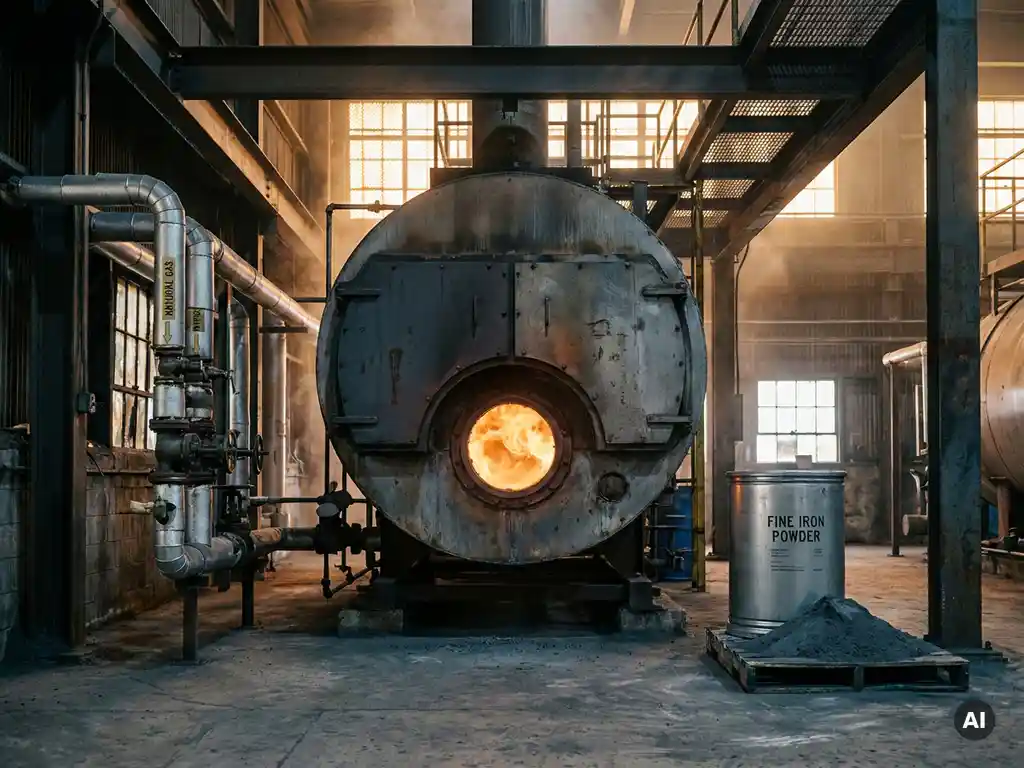
For most industrial facilities, replacing natural gas with hydrogen in existing boilers is not yet realistic at scale. The technology to burn hydrogen exists, but the barriers, infrastructure gaps, cost volatility, NOx challenges, and supply constraints, make a full switch impractical for the majority of industrial operators in 2026. That said, the picture varies significantly depending on sector, location, and what “realistic” means for your specific operation. Below, we unpack the key questions sustainability managers are asking right now.
What are the main technical barriers to using hydrogen in industrial boilers?
The main technical barriers to burning hydrogen in industrial boilers are material compatibility, flame behaviour, and infrastructure requirements. Hydrogen burns hotter and faster than natural gas, which means most existing burner components, seals, valves, and combustion chambers, need modification or full replacement. Blending hydrogen into natural gas is possible at low concentrations, but running on pure hydrogen demands a purpose-built system.
Beyond the burner itself, hydrogen’s low volumetric energy density creates practical complications. You need significantly larger volumes to deliver the same amount of heat, which affects pipeline sizing, storage, and pressure management. Many industrial sites simply were not designed with these requirements in mind.
There is also the question of safety. Hydrogen is odourless, highly flammable, and prone to embrittlement of steel components over time. This means additional detection systems, specialised maintenance protocols, and in many cases, regulatory recertification of the entire installation. For a production facility that cannot afford downtime, these are serious operational considerations, not just engineering footnotes.
How much does it cost to convert an industrial boiler from natural gas to hydrogen?
Converting an industrial boiler from natural gas to hydrogen typically involves substantial capital expenditure, with costs varying widely depending on boiler size, age, and the hydrogen concentration being targeted. A partial blend conversion is cheaper, but a full hydrogen conversion can require replacing the entire burner system and upgrading associated pipework and safety infrastructure, easily running into hundreds of thousands of euros for a mid-sized installation.
The CAPEX versus OPEX equation is complicated further by hydrogen’s current market price. Green hydrogen remains significantly more expensive than natural gas on an energy-equivalent basis, which means the operating costs after conversion are likely to be higher, sometimes substantially so, depending on your hydrogen supply contract and regional pricing.
Regulatory compliance adds another layer of cost. Recertification, updated risk assessments, and potential site modifications to meet safety standards all carry price tags that are easy to underestimate in initial project planning. For sustainability managers building an internal business case, it is important to model the total cost of ownership over a realistic timeframe, not just the upfront conversion figure.
The EU Emissions Trading System (EU ETS) does improve the relative economics of low-carbon fuels over time, as the carbon price creates an effective penalty on continued natural gas use. But for many companies, the gap between current fossil fuel costs and the full cost of a hydrogen transition remains a genuine obstacle, particularly when hydrogen supply agreements are short-term or price-volatile.
Is green hydrogen available at the scale industrial facilities need?
Green hydrogen is not yet available at the scale most industrial heat applications require. Production capacity is growing, but global electrolyser deployment remains concentrated in a small number of regions, and the distribution infrastructure, pipelines, storage, and transport logistics, is still in early development across most of Europe. For an industrial facility that needs a consistent, large-volume fuel supply, this creates a real security of supply risk.
The mismatch between ambition and availability is significant. Many national hydrogen strategies project large-scale availability in the early 2030s, but industrial operators who need to make investment decisions today cannot wait for infrastructure that may arrive late, at higher cost, or in insufficient volumes.
Grid congestion compounds the problem. Producing green hydrogen at scale requires large amounts of renewable electricity. In regions where the electricity grid is already under strain, adding electrolyser capacity increases competition for limited grid connections, pushing up costs and timelines. This is a live constraint in the Netherlands and across much of northern Europe right now.
For sustainability managers evaluating hydrogen as a near-term decarbonisation pathway, the honest answer is that supply availability needs to be assessed region by region, not assumed from headline policy targets. A technology that depends on infrastructure that does not yet exist is a planning risk, not a solution.
What happens to NOx emissions when industrial boilers burn hydrogen?
Burning hydrogen in industrial boilers tends to increase nitrogen oxide (NOx) emissions compared to natural gas. Hydrogen’s higher flame temperature accelerates the formation of thermal NOx, the reaction between nitrogen and oxygen in air at high temperatures. This is a well-documented combustion chemistry issue, and it creates a regulatory compliance challenge for facilities subject to industrial emissions standards.
The irony is that hydrogen is often positioned as a clean fuel, but its NOx profile can make air quality worse rather than better, particularly in high-temperature applications. Mitigation strategies exist, including flameless combustion, exhaust gas recirculation, and selective catalytic reduction, but each adds complexity and cost to the system.
This is one area where alternative clean fuels can offer a meaningful advantage. For context, Iron Fuel Technology achieves NOx emissions of less than 5 mg/MJ, which we at RIFT claim is the lowest of any fuel, because iron combustion does not involve the same thermal NOx formation pathways as hydrogen or fossil fuels. For facilities in areas with strict air quality regulations, this distinction matters when comparing decarbonisation options.
What are the realistic alternatives to hydrogen for decarbonising industrial heat?
The realistic alternatives to hydrogen for decarbonising industrial heat include electrification, biomass, and emerging solid fuel technologies such as iron fuel. Each has a different profile of cost, infrastructure requirement, emissions performance, and operational fit, and the right choice depends heavily on your industry, process temperatures, and existing infrastructure.
Here is how the main options compare:
- Electrification: Viable for lower-temperature processes, but limited by grid congestion, high connection costs, and the challenge of delivering consistent high-temperature heat at industrial scale. Not a practical near-term option for many energy-intensive sectors.
- Biomass: Commercially available and compatible with existing boiler infrastructure in many cases, but faces sustainability concerns, feedstock competition, and regulatory uncertainty around long-term eligibility under EU frameworks.
- Hydrogen: Technically capable of delivering high-temperature heat with low direct carbon emissions, but constrained by supply availability, infrastructure gaps, volatile energy prices, and NOx challenges as described above.
- Iron fuel: A circular, solid energy carrier that burns without direct CO₂ emissions and with ultra-low NOx output. Compatible with existing industrial boiler setups and independent of the electricity grid, making it relevant for facilities where electrification and hydrogen are not yet viable.
The decarbonisation of industrial heat does not have a single answer. For many companies, the most pragmatic path in 2026 involves a combination of technologies phased over time, starting with the options that can be deployed without waiting for infrastructure that does not yet exist.
How RIFT helps with decarbonising industrial heat
We at RIFT developed Iron Fuel Technology specifically for industrial companies that need a practical, high-performance alternative to fossil fuels, one that does not depend on grid access or hydrogen infrastructure that is still years away from being reliable at scale.
Here is what makes our Iron Fuel Boiler relevant to the questions raised in this article:
- Zero direct CO₂ emissions during combustion. The only CO₂ output is 10 kg/MWhth, attributable solely to the pilot safety flame, not the combustion of iron fuel itself.
- Ultra-low NOx emissions. RIFT claims less than 5 mg/MJ, avoiding the NOx increase that hydrogen combustion typically introduces.
- Up to 95% energy efficiency. Outperforming many conventional fossil fuel systems.
- Grid-independent operation. Iron fuel is transported in standard containers and stored on-site, eliminating dependence on grid connections or hydrogen pipelines.
- Drop-in compatibility. Designed to integrate with existing industrial infrastructure, reducing conversion complexity and CAPEX risk.
- Long-term fuel supply included. We provide both the boiler and a reliable iron fuel supply agreement, so security of supply is built into the solution from day one.
Our technology is already demonstrated at TRL7, megawatt-industrial scale, and our first commercial contract has been signed with Kingspan Unidek. If you are evaluating your options for decarbonising industrial heat and want to understand whether Iron Fuel Technology fits your operation, get in touch with our team.
Frequently Asked Questions
Can I start with a hydrogen blend in my existing boiler rather than committing to a full conversion?
Yes, blending hydrogen with natural gas at low concentrations (typically up to 20% by volume) is generally possible in many existing boilers without a full system overhaul, and it is a common first step for facilities wanting to reduce carbon intensity without major capital commitment. However, the emissions reduction achieved at low blend ratios is modest, since hydrogen’s lower volumetric energy density means a 20% hydrogen blend by volume delivers only around 7% reduction in CO₂. As blend ratios increase, the technical requirements escalate quickly, so a blending strategy should be evaluated as a transitional measure, not a long-term decarbonisation solution.
What should I prioritise when building an internal business case for industrial heat decarbonisation?
Start by modelling total cost of ownership across a realistic 10–15 year horizon, not just upfront CAPEX, since operating costs, fuel price volatility, and regulatory compliance costs can dwarf the initial conversion figure. Factor in the EU ETS carbon price trajectory, as the effective penalty on natural gas use will increase over time and shift the economics in favour of low-carbon alternatives. Equally important is assessing security of supply for whichever fuel you choose — a decarbonisation pathway that depends on infrastructure or supply chains that do not yet exist reliably in your region carries real planning risk that should be quantified, not assumed away.
How do I assess whether my facility is in a region where green hydrogen supply will be viable in the near term?
The most reliable approach is to look beyond national headline targets and assess regional infrastructure specifically: proximity to planned or operational electrolyser capacity, access to dedicated hydrogen pipelines or established transport logistics, and the current state of grid congestion in your area. Organisations such as Hydrogen Europe and national energy agencies publish updated infrastructure maps, and engaging directly with hydrogen suppliers for supply term sheets will give you a realistic picture of pricing and availability timelines. If credible supply agreements cannot be secured for the volumes and timeframes your operation requires, that is a concrete signal to evaluate alternative decarbonisation pathways in parallel.
What are the most common mistakes sustainability managers make when evaluating hydrogen for industrial heat?
The most frequent mistake is treating national or EU-level hydrogen policy targets as a proxy for near-term operational availability — ambitious 2030 projections do not guarantee reliable, cost-competitive supply at your specific site within your investment window. A second common error is underestimating the full scope of compliance costs: regulatory recertification, updated risk assessments, and safety infrastructure upgrades are often excluded from initial cost models, leading to significant budget overruns. Finally, evaluating hydrogen in isolation rather than as part of a broader technology comparison often means missing alternatives that may offer a faster, lower-risk path to meaningful emissions reduction.
How does iron fuel handle the storage and logistics challenges that make hydrogen so complex to manage on-site?
Iron fuel is a solid energy carrier, which means it is transported in standard shipping containers and stored on-site without the pressurised systems, embrittlement risks, or specialist detection infrastructure that hydrogen requires. This dramatically simplifies both the logistics chain and the on-site safety regime compared to gaseous hydrogen, and it eliminates dependence on pipeline access entirely. The spent iron oxide produced after combustion is collected, re-reduced using renewable energy, and returned as fresh fuel — a closed-loop cycle that also removes the waste disposal complexity associated with some other industrial fuel alternatives.
At what stage of technology readiness is iron fuel, and what does that mean for facilities considering it today?
Iron Fuel Technology from RIFT is currently at TRL7 (Technology Readiness Level 7), meaning it has been demonstrated at megawatt-industrial scale in a relevant operational environment — this is the stage between prototype and full commercial deployment. RIFT’s first commercial contract has been signed with Kingspan Unidek, which provides a concrete reference point for industrial operators conducting due diligence. For facilities evaluating it today, TRL7 means the core technology risk has been substantially de-risked, but it is important to engage early with the RIFT team to understand lead times, integration requirements, and fuel supply agreement terms specific to your operation.
Is it possible to run iron fuel and natural gas in parallel during a transition period, rather than switching all at once?
A phased transition approach is worth discussing directly with RIFT’s engineering team, as the feasibility depends on your specific boiler configuration, process heat requirements, and site layout. Running parallel systems during a transition period is a common risk management strategy in industrial energy projects, as it maintains operational continuity while the new technology is validated at your site. This kind of staged deployment can also help build the internal operational knowledge and maintenance capability needed to run iron fuel systems confidently at full scale over time.
Related Articles
- How does the EU ETS create financial pressure to decarbonize industrial heat?
- How can manufacturers reduce upfront investment when switching to clean heat?
- Who uses the EIA report?
- What are examples of clean energy?
- How does renewable energy affect the environment?
This content was generated with the help of AI and it may contain mistakes