

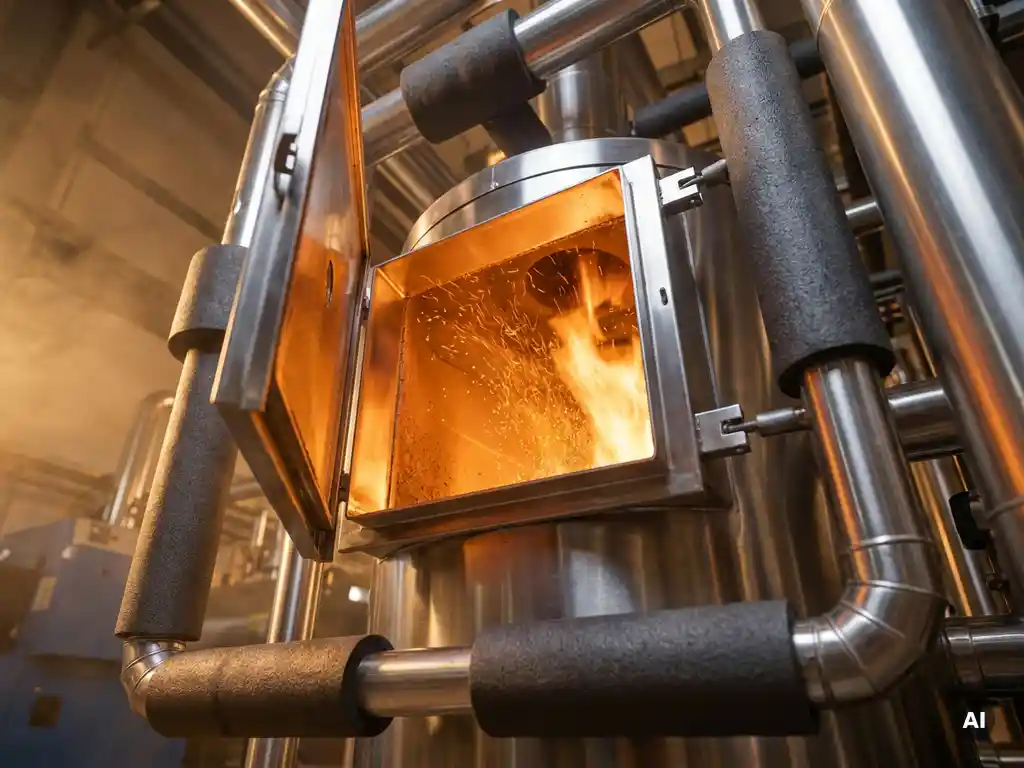
The energy efficiency of modern industrial boilers running on alternative fuels ranges from around 80% to 95%, depending on the fuel type and system design. Iron fuel boilers, for example, achieve up to 95% energy efficiency at demonstration scale, while hydrogen and biomass systems typically land between 85% and 92% under real operating conditions. Fuel characteristics, combustion chemistry, and integration with existing infrastructure all play a role in determining where a given system falls within that range. Below, we unpack the key questions sustainability managers are asking when evaluating alternative fuel boilers for industrial heat.
How does fuel type affect industrial boiler efficiency?
Fuel type is one of the most significant determinants of industrial boiler efficiency because it directly influences combustion temperature, heat transfer characteristics, and the amount of auxiliary energy needed to run the system. Different fuels release energy at different rates and temperatures, and some require additional processing steps – compression, pre-heating, or drying – that consume energy before a single joule reaches the process.
Natural gas, the current workhorse of industrial heat, benefits from decades of boiler engineering optimised around its specific combustion properties. When you switch to an alternative fuel, you are not just swapping one substance for another – you are working with a different flame temperature, a different combustion product profile, and often a different delivery and storage infrastructure. Each of these factors feeds directly into the energy balance of the system.
For sustainability managers evaluating the decarbonisation of industrial heat, the practical implication is straightforward: do not assume that a high-efficiency rating for one fuel translates automatically to another. The boiler design, burner configuration, and heat recovery systems all need to be matched to the specific fuel being used. A system optimised for natural gas will not extract the same efficiency from hydrogen or biomass without modification.
What efficiency ranges do alternative fuel boilers actually achieve?
In practice, alternative fuel industrial boilers achieve energy efficiency ratings broadly between 80% and 95%, though the actual figure depends heavily on the specific technology and operating conditions. Biomass boilers typically operate in the 82-88% range. Hydrogen-fired systems can reach up to 90-92% under optimal conditions, though real-world performance is often lower. Iron fuel boilers have demonstrated up to 95% energy efficiency at Technology Readiness Level 7 (TRL7) in industrial demonstration settings.
It is worth being precise about what these percentages represent. Boiler efficiency is usually measured as the ratio of useful thermal energy delivered to the process versus the total energy content of the fuel consumed. A 95% efficiency rating means that 95% of the fuel’s energy content is converted into usable heat, with only 5% lost through exhaust gases, radiation, or other pathways.
The gap between headline efficiency figures and real-world performance is where many projects encounter surprises. Auxiliary electricity consumption, for example, is sometimes excluded from top-line efficiency claims. A system that requires significant electrical input to run its operational equipment may look highly efficient on paper but less so when the full energy balance is calculated. Transparency on these numbers matters when making investment decisions under pressure from EU ETS obligations and internal sustainability targets.
Why don’t hydrogen boilers always deliver high efficiency in practice?
Hydrogen boilers face several practical constraints that can reduce their real-world efficiency below the theoretical maximum. The most significant are the energy losses associated with hydrogen compression and storage, NOₓ formation at high flame temperatures, and the infrastructure requirements that can limit operational flexibility. When these factors are accounted for in a full system energy balance, the net efficiency of a hydrogen-based heat solution is often meaningfully lower than the boiler efficiency figure alone suggests.
Hydrogen burns at very high temperatures, which is useful for generating heat but also promotes the formation of nitrogen oxides (NOₓ), a regulated pollutant that many facilities are working to reduce. Managing NOₓ emissions from hydrogen combustion typically requires either excess air dilution or catalytic treatment, both of which introduce energy penalties or capital costs.
There is also the question of supply security. Hydrogen infrastructure in Europe is still developing, and grid congestion in the electricity network, which is needed to produce green hydrogen at scale, creates real uncertainty around reliable supply. For industrial operators who cannot afford process interruptions, dependence on an infrastructure that is not yet fully mature introduces operational risk that efficiency figures alone do not capture. Volatile energy prices compound this challenge, since hydrogen costs are closely tied to electricity market fluctuations.
How does iron fuel compare to hydrogen and biomass for industrial heat?
Iron fuel delivers competitive or superior energy efficiency compared to both hydrogen and biomass, while also addressing several of the practical limitations those fuels face. At demonstration scale, the Iron Fuel Boiler achieves up to 95% energy efficiency, with an auxiliary electricity consumption of just 43 kWh per megawatt-hour of thermal energy (MWhth) produced. Carbon emissions during combustion are near-zero: the only CO₂ output comes from a pilot safety flame, resulting in just 10 kg of CO₂ per MWhth, a figure that represents a near-complete elimination of combustion-related carbon emissions compared to fossil fuels.
On NOₓ, RIFT states that the Iron Fuel Boiler achieves less than 5 mg/MJ, which the company claims is the lowest NOₓ output of any fuel. This is a meaningful advantage for facilities operating under tightening air quality regulations, though it is worth noting this is RIFT’s own claim based on demonstration-scale results rather than an independently verified industry benchmark.
Compared to biomass, iron fuel avoids the challenges of moisture content variability, feedstock supply chain complexity, and the land-use sustainability questions that regulators are increasingly scrutinising. Compared to hydrogen, iron fuel is stored and transported as a solid powder in standard containers – no compression, no cryogenic storage, no dedicated pipeline infrastructure required. This makes it far less dependent on grid capacity and far more compatible with existing industrial logistics, which is a practical advantage in regions where grid congestion and volatile energy prices are active concerns.
The fuel cycle is also fully circular: iron powder burns to produce heat, leaving only iron oxide, which is then regenerated into iron fuel using hydrogen. The production system achieves an 86% hydrogen-to-iron-fuel energy efficiency, and when low-carbon hydrogen is used as feedstock under EU greenhouse gas methodology, the full chain delivers a CO₂ reduction of 0.55 tonnes of CO₂ equivalent per tonne of iron fuel. This figure applies specifically when low-carbon hydrogen is used – the reduction will vary depending on the hydrogen source.
What factors should industrial operators consider when evaluating boiler efficiency?
When evaluating the efficiency of an alternative fuel boiler, industrial operators should look beyond the headline thermal efficiency figure and assess the full system energy balance, including auxiliary power consumption, fuel supply reliability, and total cost of ownership over the asset’s lifetime. Efficiency in isolation is a poor basis for a capital investment decision.
Here are the key factors worth assessing in any boiler efficiency evaluation:
- Full system energy balance: Include auxiliary electricity consumption, not just the boiler’s thermal output-to-fuel-input ratio.
- Fuel supply security: Consider whether the fuel supply is dependent on grid infrastructure subject to congestion or price volatility.
- Emissions profile: Evaluate both CO₂ and NOₓ emissions, since both carry regulatory and financial implications under frameworks like the EU ETS.
- CAPEX versus OPEX trade-offs: High-efficiency systems may carry higher upfront investment but deliver lower operating costs over time. Model both scenarios.
- Integration with existing infrastructure: A boiler that requires complete process redesign carries hidden costs and risks that reduce the effective efficiency of the transition.
- Technology readiness: Understand where the technology sits on the maturity curve. Demonstration-scale performance (TRL7) is a strong signal, but commercial-scale results may differ.
- Regulatory trajectory: Energy efficiency obligations under the EU Energy Efficiency Directive are tightening, and large industrial energy consumers are increasingly subject to mandatory energy management systems and audit requirements.
Sustainability managers who are building the internal business case for a new heat technology will find that combining efficiency data with supply security and emissions compliance arguments tends to be more persuasive to finance and operations teams than efficiency numbers alone.
Which industries benefit most from switching to high-efficiency alternative fuel boilers?
Industries that rely on continuous, high-temperature process heat and face the greatest pressure to reduce Scope 1 emissions stand to benefit most from switching to high-efficiency alternative fuel boilers. Food and beverage, specialty chemicals, and pulp and paper are among the strongest candidates – all three sectors operate energy-intensive processes where heat demand is constant, temperatures are high, and the cost of process interruption is significant.
These sectors share a common challenge: full electrification is often not technically or economically viable at the scale and temperature required, and hydrogen infrastructure is not yet available or affordable in many locations. For these companies, a high-efficiency alternative fuel boiler that integrates with existing process equipment offers a more pragmatic path to decarbonisation than a complete infrastructure overhaul.
The business case is further strengthened by the financial exposure these industries face under the EU Emissions Trading System (EU ETS). As carbon prices rise, the cost of continuing to burn fossil fuels increases year on year. A switch to a near-zero-carbon heat source with competitive efficiency directly reduces that exposure, turning a compliance cost into a competitive advantage. The VEKI subsidy scheme in the Netherlands also provides additional financial support for energy efficiency investments in industry, which can improve the CAPEX versus OPEX balance for qualifying projects.
- Food and beverage: High steam demand, strict hygiene requirements, and growing customer and retailer pressure on supply chain emissions make this sector a strong fit for clean, reliable industrial heat.
- Specialty chemicals: Process heat at precise temperatures is critical, and the sector faces significant regulatory scrutiny on both carbon and air quality emissions.
- Pulp and paper: Energy-intensive drying and heating processes create large heat loads that are difficult to electrify, making alternative fuel boilers an attractive option for decarbonisation.
How We Help Industrial Companies Achieve High-Efficiency, Carbon-Free Heat
We develop and deliver industrial Iron Fuel Boilers, purpose-built systems that replace fossil fuel-fired heat generation with a circular, carbon-free alternative. For sustainability managers who need to decarbonise industrial heat without sacrificing operational reliability or taking on unacceptable infrastructure risk, our Iron Fuel Boiler solutions offer a practical path forward. Here is what makes the technology relevant to your situation:
- Up to 95% energy efficiency at demonstration scale (TRL7), with an auxiliary electricity requirement of just 43 kWh per MWhth.
- Near-zero CO₂ combustion – only 10 kg of CO₂ per MWhth, attributable solely to the pilot safety flame, not the iron fuel itself.
- Grid-independent operation – iron fuel is stored and transported as a solid powder, with no dependency on electricity grid capacity or hydrogen pipeline infrastructure.
- Drop-in compatible design – the Iron Fuel Boiler is engineered to complement existing boiler infrastructure, reducing integration complexity and capital risk.
- Long-term fuel supply – backed by a fuel supply agreement model, so you are not exposed to spot market volatility.
- Backed by €113.8 million in funding, including an €83.1 million Series B and a €30.7 million EU Innovation Fund grant, supporting our path from demonstration to commercial scale.
If you are evaluating your options for decarbonising industrial heat and want to understand whether Iron Fuel Technology is the right fit for your process, we would be glad to have that conversation. Get in touch with our team to discuss your specific heat requirements and explore what a transition to iron fuel could look like for your facility.
Frequently Asked Questions
How long does it typically take to transition an existing industrial boiler setup to an alternative fuel like iron fuel?
The timeline varies depending on the complexity of your existing infrastructure and the scale of heat demand, but a transition to an iron fuel boiler is generally designed to complement rather than replace existing systems, which reduces integration time significantly. For most industrial facilities, the process involves an initial feasibility and engineering assessment, followed by equipment installation and commissioning — typically spanning several months rather than years. Because the Iron Fuel Boiler is engineered for drop-in compatibility with existing boiler infrastructure, facilities can often phase the transition without disrupting ongoing production.
What happens to the iron oxide produced after combustion — does it create a waste disposal challenge?
No — iron oxide is not a waste product in the iron fuel cycle; it is the feedstock for the next stage of the fuel loop. After combustion, the iron oxide is collected and regenerated back into iron fuel using hydrogen, making the cycle fully circular. This closed-loop model means there is no landfill burden, no hazardous by-product to manage, and no ongoing disposal cost — a meaningful operational advantage over fuels that produce ash, slag, or gaseous emissions requiring treatment.
How does iron fuel perform under variable load conditions, such as when heat demand fluctuates significantly across a shift or season?
Industrial boilers rarely run at a single constant output, so load flexibility is a critical practical consideration. Iron fuel boiler systems are designed to modulate output in response to varying process heat demands, similar to how conventional fuel boilers operate. Because iron fuel is stored as a solid powder on-site, supply to the combustion system can be adjusted without the pressure management complexities associated with gaseous fuels like hydrogen, giving operators more straightforward control over heat output.
What are the most common mistakes companies make when comparing boiler efficiency figures across different fuel types?
The most common mistake is comparing headline thermal efficiency figures without accounting for the full system energy balance — particularly auxiliary electricity consumption, which can vary significantly between technologies and is sometimes excluded from published efficiency claims. A second frequent error is treating demonstration-scale efficiency data as directly equivalent to commercial-scale performance without understanding the technology readiness level behind the figure. Finally, many evaluations overlook the indirect energy costs embedded in fuel supply chains, such as the energy required to compress hydrogen or dry biomass feedstock, which can meaningfully reduce the net efficiency of a system.
Is iron fuel technology compatible with facilities that need to maintain continuous 24/7 operations with no tolerance for supply interruption?
Yes — and supply security is one of the design priorities that distinguishes iron fuel from hydrogen-based alternatives. Because iron fuel is stored on-site as a solid powder in standard containers, facilities are not dependent on real-time grid availability, pipeline infrastructure, or spot market supply. A fuel supply agreement model further reduces exposure to supply disruptions, allowing industrial operators to maintain buffer stock and plan procurement with the same confidence they would apply to conventional solid or liquid fuels.
How does switching to an iron fuel boiler affect a facility's position under the EU Emissions Trading System (EU ETS)?
Switching to a near-zero-carbon heat source like an iron fuel boiler directly reduces a facility’s Scope 1 CO₂ emissions, which are the emissions that fall within the EU ETS compliance boundary for most industrial operators. With combustion-related CO₂ output reduced to just 10 kg per MWhth — compared to roughly 200+ kg per MWhth for natural gas — the volume of carbon allowances a facility needs to purchase drops substantially. As EU ETS carbon prices continue to rise, this reduction translates directly into lower compliance costs and improved cost competitiveness relative to facilities still operating on fossil fuels.
What level of technical expertise or infrastructure investment is required to operate an iron fuel boiler at an industrial facility?
Iron fuel boilers are engineered to integrate with existing industrial heat infrastructure, which means facilities do not need to rebuild their process systems from the ground up. Operational staff will require training on the specific handling and combustion characteristics of iron powder, but the operational model is designed to be manageable within existing industrial maintenance and safety frameworks. The solid-state nature of the fuel also eliminates many of the specialist infrastructure requirements — such as high-pressure gas handling or cryogenic storage — that make hydrogen systems more demanding to operate and maintain.
Related Articles
- How are specialty chemical companies approaching industrial heat decarbonization?
- How does the EU ETS create financial pressure to decarbonize industrial heat?
- What is an EIA assessment?
- Who uses the EIA report?
- What is VEKI?
This content was generated with the help of AI and it may contain mistakes