

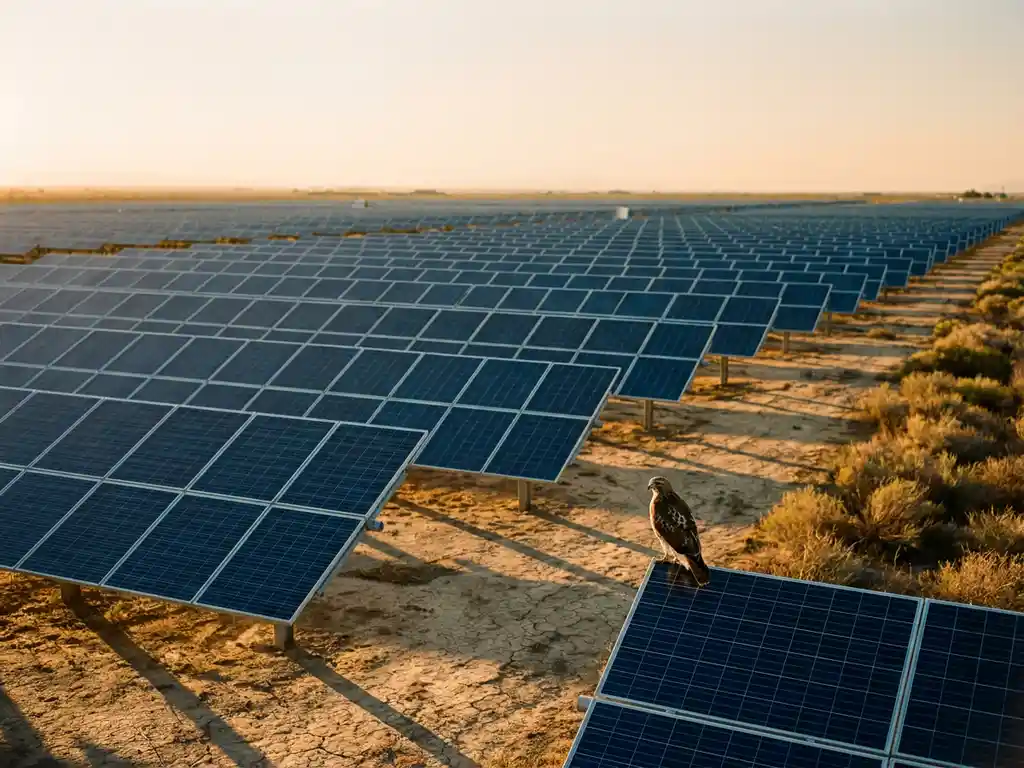
Large-scale solar farms generate electricity with far lower lifetime emissions than fossil fuels, but they are not without environmental trade-offs. Land use, habitat disruption, and the energy and materials required to manufacture solar panels all carry real ecological costs. Understanding both sides of that picture helps industries and policymakers make better decisions about where solar fits — and where it falls short.
Ignoring land use is quietly undermining solar’s green credentials
Solar farms require significant amounts of land — typically between 5 and 10 acres per megawatt of installed capacity for utility-scale projects. When that land was previously biodiverse habitat, agricultural land, or natural grassland, converting it to solar infrastructure removes those ecological and food-production functions entirely. The carbon stored in the soil can also be disturbed during construction, partially offsetting early emissions savings. The fix is not to abandon solar, but to prioritise degraded land, brownfield sites, and dual-use models in which solar panels coexist with agriculture or natural vegetation rather than replacing it.
Manufacturing emissions are delaying solar’s true carbon payback
Solar panels are not carbon-free to produce. Mining silicon, aluminium, and rare materials, along with the energy-intensive manufacturing process, generates a carbon debt that takes several years of clean electricity generation to repay. For industries evaluating renewable energy as part of a broader decarbonisation strategy, this matters. The payback period for a typical silicon photovoltaic panel is roughly one to four years, depending on location and technology — after which the system genuinely delivers net carbon savings. Knowing this helps set realistic expectations and strengthens the case for complementary clean energy solutions with a smaller manufacturing footprint.
How much CO₂ do large solar farms actually offset?
Over its operational lifetime, a large solar farm offsets significantly more CO₂ than it produces during manufacturing and installation. The lifecycle carbon intensity of utility-scale solar is roughly 20 to 50 grams of CO₂ equivalent per kilowatt-hour, compared with 400 to 900 grams per kilowatt-hour for coal and gas. That represents a reduction of 85 to 95% in carbon emissions per unit of energy.
The exact offset depends on the energy mix used to manufacture the panels, the solar irradiance at the installation site, and the system’s lifespan. Panels installed in high-sunshine regions with longer operational lives deliver a greater total offset than those in low-irradiance locations with shorter service periods.
It is also worth noting that solar farms offset CO₂ primarily in electricity generation. They do not directly address emissions from industrial heat, which accounts for a large share of global energy-related carbon output and is largely generated by burning fossil fuels.
What are the negative environmental effects of solar farms?
The main negative environmental effects of large solar farms include land transformation, habitat loss, soil disturbance, water use for panel cleaning, and the environmental costs of manufacturing and end-of-life disposal. While these impacts are considerably smaller than those of fossil fuel infrastructure, they are real and worth managing carefully.
Construction phases carry the highest risk. Grading land, removing vegetation, and installing foundations can disturb topsoil, alter drainage patterns, and displace local species. Once operational, the physical footprint of panels can change local microclimate conditions, affecting temperature, humidity, and the types of plants and animals that can survive nearby.
End-of-life disposal is a growing concern. Most solar panels have a lifespan of 25 to 30 years, and the recycling infrastructure for photovoltaic materials is still developing. Without proper recycling pathways, panels risk ending up in landfill, where materials such as cadmium and lead can leach into soil and groundwater.
How do solar farms affect local wildlife and ecosystems?
Solar farms can disrupt local wildlife through habitat loss, altered vegetation cover, and physical barriers to animal movement. Birds and insects are particularly affected. Reflective panel surfaces can disorient birds and aquatic insects that mistake them for water, while fencing around large installations can fragment habitats used by mammals and reptiles.
The scale of impact depends heavily on what was there before. A solar farm built on degraded farmland or a former industrial site typically causes far less ecological harm than one built on species-rich grassland or wetland. In some cases, solar installations have been managed to support pollinators by planting native wildflowers beneath and around panels, turning the site into a net positive for local biodiversity.
Careful site selection, ecological surveys before construction, and ongoing habitat management during operation are the most effective ways to reduce wildlife impacts. These are increasingly required under planning regulations in many countries.
How does the environmental impact of solar farms compare to fossil fuels?
On almost every environmental metric, large solar farms perform significantly better than fossil fuel power plants. Solar generates electricity with a fraction of the lifecycle carbon emissions, produces no air pollution during operation, uses no water for combustion, and does not require extraction of fuel from the ground. The comparison is not close when it comes to climate impact.
Where fossil fuels do have a practical advantage is in energy density and reliability. A gas-fired power plant or industrial boiler can generate continuous high-temperature heat on demand, regardless of weather or time of day. Solar electricity cannot directly replicate this for industrial processes that require constant, high-grade thermal energy.
This distinction matters for industries such as food processing, specialty chemicals, and pulp and paper, where process heat is continuous and temperatures can exceed what solar thermal systems can reliably deliver. Electrification using solar power is possible in some cases, but it often requires costly infrastructure upgrades and cannot always meet the temperature requirements of existing industrial equipment.
What industrial heat alternatives exist beyond solar energy?
For industries that need high-temperature process heat, the main alternatives to solar energy are green hydrogen combustion, biomass, electric boilers powered by renewable electricity, and emerging carbon-free fuels such as iron fuel. Each carries different trade-offs in terms of cost, infrastructure requirements, emissions, and operational fit.
Here is a straightforward comparison of the main options:
- Green hydrogen: Zero direct emissions when burned, but it requires significant new infrastructure for storage and distribution, and current costs are high.
- Biomass: Can use existing combustion infrastructure, but sustainability depends on feedstock sourcing, and combustion still produces CO₂ and particulates.
- Electric boilers: Clean when powered by renewable electricity, but limited to lower temperature ranges and dependent on grid capacity and reliability.
- Iron fuel: Burns as a solid powder to produce high-temperature heat with zero direct CO₂ and ultra-low NOx emissions, and the combustion by-product (iron oxide) is regenerated back into fuel using hydrogen, creating a closed cycle.
No single technology suits every industrial application. The right choice depends on the temperatures required, the existing infrastructure, fuel supply logistics, and the cost of transition. Many industries will need a combination of approaches rather than a single replacement for fossil fuels.
For companies where electrification is constrained by grid limitations or where hydrogen infrastructure is not yet available, solid-fuel alternatives that integrate with existing boiler systems offer a more practical near-term path. You can read more about how different Iron Fuel Technology works as a circular energy system and how it fits into industrial decarbonisation.
How Iron Fuel Technology helps with industrial decarbonisation beyond solar
Solar energy is a powerful tool for decarbonising electricity, but it cannot easily address the high-temperature heat that industrial processes depend on. That is precisely the gap we at RIFT are designed to fill with Iron Fuel Technology.
Here is what makes it a practical option for sustainability managers evaluating their options:
- Drop-in compatibility: The Iron Fuel Boiler integrates with existing boiler infrastructure, so you do not need to overhaul your entire setup to start reducing emissions.
- Zero direct CO₂ combustion: Iron fuel burns to produce high-temperature heat without releasing carbon dioxide. The only CO₂ output comes from a small pilot safety flame, totalling just 10 kg per MWh of thermal energy produced.
- Circular fuel cycle: After combustion, iron oxide is collected and regenerated back into iron fuel using low-carbon hydrogen, completing a closed loop with no waste.
- High energy efficiency: The system achieves up to 95% energy efficiency, meaning very little input energy is lost in the process.
- Long-term fuel supply: We offer supply agreements that give industrial operators the certainty they need to plan and budget confidently.
If your operations rely on continuous process heat and you are weighing up which decarbonisation path makes sense, we are ready to talk through the options. Get in touch with our team to discuss how Iron Fuel Technology could work within your existing setup, or explore our industrial heat solutions to see where it fits.
Related Articles
- How long do solar panels last?
- What is energy poverty and can renewables help solve it?
- What is the future of energy storage technology?
- What is geothermal energy used for?
- Why are renewable energy companies struggling?
This content was generated with the help of AI and it may contain mistakes