

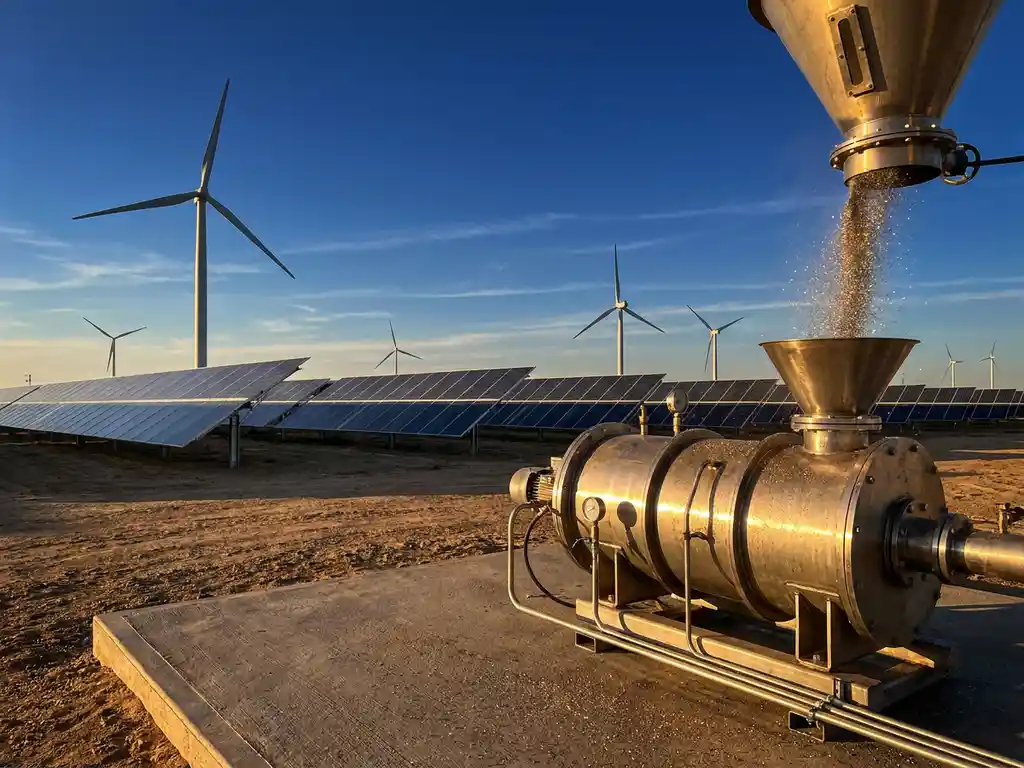
The most efficient form of renewable energy depends on what you are measuring and what you need it for. For electricity generation, solar and wind lead in deployment, but neither converts energy at particularly high rates. For industrial heat, the picture changes significantly. Technologies like iron fuel can achieve up to 95% energy efficiency, outperforming most fossil-fuel systems and many renewable alternatives. The right answer depends on your application, infrastructure, and decarbonization goals.
Chasing electricity-based solutions is leaving industrial heat behind
Most conversations about renewable energy efficiency focus on electricity generation. That framing works well for powering homes and offices, but it misses the largest energy challenge in industry: heat. Two-thirds of industrial energy consumption goes toward heat generation, and roughly 80% of that heat still comes from fossil fuels. When sustainability managers focus exclusively on electrification or solar capacity, they risk optimizing the wrong problem. The practical fix is to evaluate renewable energy efficiency not just in terms of electricity output, but in terms of thermal output for the specific temperatures your processes actually require.
Sticking with fossil-fuel boilers is making your Scope 1 targets harder to reach
Many industrial companies have net-zero commitments on paper but continue running fossil-fuel boilers because viable alternatives feel out of reach. The longer that gap persists, the harder Scope 1 targets become to defend to boards, regulators, and customers. EU Emissions Trading System costs are rising, and pressure from supply chain partners is increasing. The concrete step forward is to evaluate drop-in compatible heat solutions that work alongside existing boiler infrastructure, rather than waiting for a full system replacement that may never be financially viable.
What is renewable energy efficiency and why does it matter?
Renewable energy efficiency refers to how effectively a renewable energy system converts its input—whether sunlight, wind, hydrogen, or another source—into usable energy output. It matters because a less efficient system requires more resources, more infrastructure, and more cost to deliver the same amount of energy. Higher efficiency means lower operational costs and a smaller environmental footprint per unit of energy produced.
Efficiency is measured differently depending on the technology. For solar panels, it describes how much sunlight becomes electricity. For a boiler system, it describes how much of the fuel’s energy content becomes usable heat. These are not directly comparable numbers, which is why efficiency claims across different renewable technologies can be misleading without context.
For industrial operators, efficiency has a direct financial consequence. A system that converts 95% of its energy input into usable heat means very little is wasted. A system operating at 60% efficiency means you need significantly more fuel, more supply chain logistics, and more capital to deliver the same thermal output. Over time, that difference compounds into real cost.
What are the most common forms of renewable energy available today?
The most common forms of renewable energy today are solar photovoltaic (PV), onshore and offshore wind, hydropower, biomass, geothermal, and green hydrogen. Each converts a different natural resource into usable energy, and each has distinct efficiency characteristics, infrastructure requirements, and suitable applications.
- Solar PV: Converts sunlight into electricity. Commercial panels typically achieve 15 to 22% conversion efficiency, though this is improving steadily.
- Wind energy: Converts kinetic energy from wind into electricity. Turbines typically operate at a 35 to 45% capacity factor, depending on location.
- Hydropower: Uses flowing water to generate electricity. Mature and reliable, but geographically constrained.
- Biomass: Burns organic material for heat or electricity. Carbon accounting is complex and often disputed.
- Geothermal: Taps heat from the Earth. Highly efficient where available, but access is limited to specific regions.
- Green hydrogen: Produced by electrolysis using renewable electricity. Increasingly used as an energy carrier for hard-to-electrify sectors.
None of these technologies is universally superior. The best choice depends on your location, energy demand type, and whether you need electricity or heat.
How do different renewable energy sources compare in efficiency?
Renewable energy sources vary widely in efficiency depending on the technology and the type of energy output. Solar PV converts roughly 15 to 22% of incoming sunlight into electricity. Wind turbines extract around 35 to 45% of available wind energy. Hydropower is among the most efficient electrical generators, often exceeding 90% conversion at the turbine level. Green hydrogen production via electrolysis typically achieves 60 to 80% efficiency.
These numbers can be misleading when compared out of context. A solar panel’s 20% efficiency is measured against total incoming solar radiation, which is free and abundant. A hydrogen electrolyzer’s 70% efficiency represents a conversion loss from electricity to a storable fuel. The relevant question is not which number is highest, but which technology delivers the right type of energy at the right efficiency for your specific use case.
For industrial heat applications specifically, the comparison shifts. Technologies designed for thermal output, rather than electricity generation, can achieve much higher end-use efficiency. A well-designed industrial boiler system, whether fueled by gas, hydrogen, or iron fuel, can convert over 90% of its energy input into usable heat. That matters more to a production facility than the upstream efficiency of the fuel source.
Which renewable energy source is best for industrial heat?
For industrial heat, the best renewable energy source is one that delivers high-temperature thermal output at high efficiency, with reliable supply and manageable infrastructure requirements. Green hydrogen can work but requires significant pipeline or storage infrastructure. Electrification is viable for low-temperature processes but struggles with high-temperature industrial heat above 500°C. Iron fuel is a newer option that generates heat up to 2,000°C with near-zero emissions.
The challenge with industrial heat is that it is not a single category. A food processing plant needs steam at relatively moderate temperatures. A specialty chemicals facility may need sustained high-temperature heat for hours at a time. A pulp and paper operation has different pressure and flow requirements. The best renewable heat source for each of these contexts may differ.
What most industrial operators share is an existing boiler infrastructure they cannot afford to replace overnight. This makes compatibility a practical criterion alongside efficiency. A solution that integrates with existing systems, rather than requiring a full replacement, reduces both capital expenditure and operational disruption. You can explore clean heat solutions designed for industrial compatibility to understand what that looks like in practice.
How does iron fuel technology work as a clean energy carrier?
Iron fuel technology uses fine iron powder as a solid-state energy carrier. When burned, iron powder reacts with oxygen to produce high-temperature heat, reaching up to 2,000°C, with zero direct CO₂ emissions. The only by-product is iron oxide, which is then collected, transported to a production facility, and regenerated back into iron fuel using hydrogen. The cycle then repeats.
The process works in four stages:
- Storage and transport: Iron powder is stored and transported as a solid, making it safe and straightforward to handle without the pressurized infrastructure that hydrogen requires.
- Combustion: Iron fuel burns inside an industrial boiler to generate heat for steam, hot water, or hot air. The Iron Fuel Boiler achieves up to 95% energy efficiency.
- Collection: Iron oxide, the combustion by-product, is collected directly from the boiler chamber and transported back to a production facility.
- Regeneration: The iron oxide is reduced back into iron fuel using low-carbon hydrogen, completing the closed loop. The production system achieves 86% hydrogen-to-iron-fuel energy efficiency.
The full chain, from hydrogen input through combustion and back to regeneration, delivers a CO₂ reduction of 0.55 tonnes of CO₂ equivalent per tonne of iron fuel produced, calculated using EU GHG methodology, including transport. The technology has been demonstrated at megawatt scale at Technology Readiness Level 7 (TRL 7) in the Netherlands, with boiler operations in Helmond and production operations in Arnhem. You can read more about how Iron Fuel Technology works in detail.
What should industrial companies consider when choosing a renewable energy solution?
Industrial companies should evaluate renewable energy solutions on five practical criteria: process temperature requirements, infrastructure compatibility, supply reliability, total cost of ownership, and emissions reduction credibility. A solution that scores well on one dimension but fails on another—such as a technology with excellent efficiency but no reliable fuel supply—is not viable at scale.
Process temperature is often the first filter. Many renewable electricity-based solutions work well below 200°C but become economically or technically impractical above that threshold. If your process requires sustained high-temperature heat, your shortlist narrows quickly.
Infrastructure compatibility matters because most industrial facilities cannot afford extended downtime or complete system overhauls. Solutions that integrate with existing boiler systems, rather than replacing them entirely, reduce both capital risk and transition complexity. This is particularly relevant for companies in food and beverage, specialty chemicals, and pulp and paper, where production continuity is critical.
Supply reliability is often underestimated in technology evaluations. A renewable energy source that depends on weather, grid availability, or a fragile logistics chain introduces operational risk. Long-term fuel supply agreements, like those offered alongside the Iron Fuel Boiler, provide the kind of supply certainty that industrial procurement teams require.
How RIFT helps with industrial renewable energy efficiency
We developed Iron Fuel Technology specifically to address the gap that electrification and hydrogen cannot fill for many industrial operators. Our Iron Fuel Boiler delivers:
- Up to 95% energy efficiency, outperforming most fossil-fuel boiler systems
- Zero direct CO₂ emissions and ultra-low NOₓ emissions during combustion
- High-temperature heat up to 2,000°C, suitable for demanding industrial processes
- Drop-in compatibility with existing boiler infrastructure, reducing capital risk
- Long-term fuel supply agreements that guarantee operational continuity
- A fully circular energy cycle, with iron oxide regenerated back into iron fuel using hydrogen
We have already signed the first commercial contract worldwide for industrial Iron Fuel Technology, and our systems have been demonstrated at TRL 7 scale in the Netherlands. If you are evaluating renewable heat options for your facility, we are ready to talk through what this looks like for your specific process. Get in touch with our team to start the conversation.
Related Articles
- How can manufacturers reduce upfront investment when switching to clean heat?
- Can renewable energy replace fossil fuels?
- What are the benefits of renewable energy?
- How recyclable are solar panels and wind turbines?
- What is the energy transition and why does it matter?
This content was generated with the help of AI and it may contain mistakes