

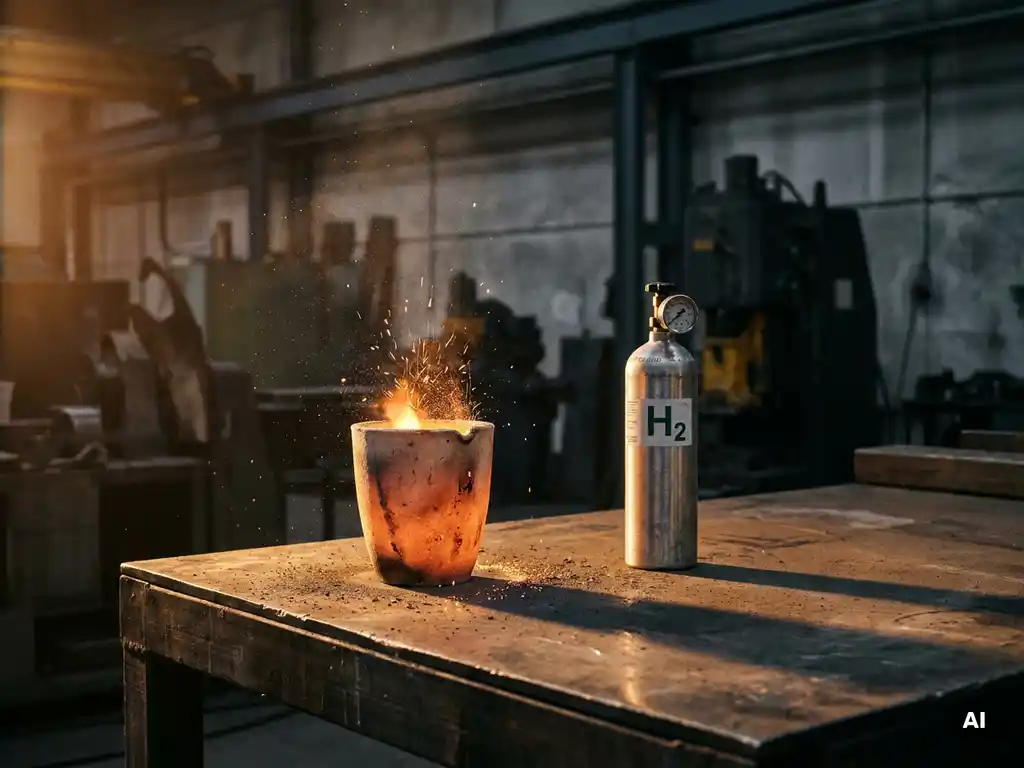
Iron fuel and hydrogen both offer carbon-free routes to industrial heat, but they serve different needs. Iron fuel is better suited to industries that require reliable, high-temperature heat without dependence on hydrogen infrastructure at the point of use, while hydrogen combustion is more established in sectors already connected to gas networks. The questions below unpack the key differences across efficiency, safety, cost, and strategic fit.
Which industries are better suited to iron fuel than hydrogen?
Iron fuel is particularly well suited to energy-intensive industries where grid congestion makes full electrification impractical, hydrogen infrastructure is unavailable or too costly to build, and process heat demands are continuous and high-temperature. Food and beverage, specialty chemicals, and pulp and paper are the clearest examples of sectors where iron fuel offers a pragmatic, drop-in alternative to fossil fuels.
These industries share a common challenge: they need reliable, high-temperature heat around the clock, and they cannot afford to wait for hydrogen pipelines or expanded grid capacity to reach their facilities. Hydrogen combustion requires significant infrastructure investment, compressors, dedicated storage, safety-rated pipework, and in many cases a connection to a hydrogen supply network that simply does not yet exist at scale across Europe. For a food processing plant or a paper mill that needs to decarbonize its heat today, that timeline is a real barrier.
Iron fuel sidesteps these constraints. It is transported in standard containers as a fine iron powder, stores safely at ambient conditions, and combusts in a boiler designed to integrate with existing industrial setups. This makes it especially attractive for companies facing EU ETS compliance pressure that need to reduce Scope 1 emissions without rebuilding their entire energy infrastructure. Industries dealing with volatile energy prices and grid congestion also benefit from the energy security that a storable, physical fuel carrier provides, something hydrogen, in its current infrastructure state, cannot always guarantee.
How does iron fuel produce heat without CO₂ emissions?
Iron fuel produces heat through the combustion of fine iron powder with ambient air. When iron burns, it reacts with oxygen to generate a high-temperature flame, reaching up to 2,000°C, and releases thermal energy without producing any carbon dioxide, because iron contains no carbon. The only combustion byproduct is iron oxide, a solid material that can be collected and regenerated back into iron fuel using hydrogen.
This is what makes the technology genuinely circular. Iron oxide, essentially rust, is reduced back into iron powder using low-carbon hydrogen, completing a closed loop in which the fuel is effectively recharged rather than consumed. The iron powder then re-enters the combustion cycle, and the process repeats indefinitely.
In practice, RIFT’s Iron Fuel Technology produces just 10 kg of CO₂ per megawatt-hour of thermal energy (MWhth), and that small amount comes exclusively from the pilot safety flame, not from the iron combustion itself. It is important to be precise here: the system is not 100% CO₂-free, but it achieves near-complete elimination of combustion-related carbon emissions compared to any fossil fuel-fired boiler. RIFT also claims that its Iron Fuel Boiler achieves NOx emissions of under 5 Mg/MJ, which RIFT states is the lowest NOx output of any fuel, a significant advantage for regulatory compliance under increasingly stringent air quality standards.
What are the energy efficiency differences between iron fuel and hydrogen?
Iron fuel boilers achieve an energy efficiency of up to 95%, which is competitive with or better than most industrial fossil fuel systems and compares favourably to many hydrogen combustion setups. Hydrogen, when burned directly, can achieve high flame temperatures but faces efficiency losses in compression, storage, and transport that reduce its overall chain efficiency. Iron fuel’s advantage is that it stores and transports energy as a stable solid, avoiding those losses.
To put this in concrete terms: RIFT’s Iron Fuel Boiler consumes 0.52 tonnes of iron fuel per MWhth of thermal energy produced, with an auxiliary electricity draw of just 43 kWh per MWhth. That low parasitic electrical load is part of what keeps the system’s overall efficiency high. Crucially, this efficiency is achieved at Technology Readiness Level 7 (TRL7), demonstrated at megawatt-industrial scale in Helmond, the Netherlands, which means these are real operational figures, not theoretical projections.
Hydrogen’s chain efficiency depends heavily on how the hydrogen is produced, compressed, transported, and then combusted. Green hydrogen in particular suffers significant energy losses at each step of that chain. Iron fuel, by contrast, locks energy into a stable physical carrier that requires no special pressurization or cryogenic storage, which helps preserve more of the original energy input through to the point of use.
Is iron fuel or hydrogen safer to store and transport?
Iron fuel is significantly easier and safer to store and transport than hydrogen. Iron powder is a stable solid at ambient temperature and pressure, requires no pressurized vessels or cryogenic equipment, and can be transported in standard containers using existing logistics infrastructure. Hydrogen, by contrast, must be stored under high pressure or at extremely low temperatures, and requires purpose-built infrastructure at every point in the supply chain.
This practical difference matters enormously for industrial operators. Hydrogen’s safety requirements drive up both capital costs and operational complexity. Facilities need to meet strict safety standards for leak detection, ventilation, and pressure management. Insurance and permitting processes can be lengthy. For companies in regions without existing hydrogen distribution networks, the logistics challenge is even more pronounced.
Iron fuel eliminates most of these concerns. Because it is chemically inert until combusted, it poses no explosion risk during storage or transit. It can be stockpiled on-site, giving industrial operators a meaningful buffer against supply disruptions, a direct answer to security of supply concerns that are increasingly prominent in a volatile energy market. This storability also means companies are not dependent on real-time pipeline delivery, which is a significant resilience advantage.
What does switching from hydrogen to iron fuel actually cost?
The capital investment for an Iron Fuel Boiler system is €0.5 million per megawatt thermal (MWth), with iron fuel priced at €140 per tonne from RIFT’s production system and annual operations and maintenance costs of 2.5% of the system investment. For companies evaluating a switch from hydrogen, or from fossil fuels, these figures provide a concrete starting point for a CAPEX versus OPEX assessment.
To put the fuel cost in context: the Iron Fuel Boiler consumes 0.52 tonnes of iron fuel per MWhth. At €140 per tonne, that translates to approximately €72.80 in fuel cost per MWhth of heat produced. Whether that is competitive depends on the local cost of hydrogen, natural gas, or electricity, all of which vary significantly by region and are subject to EU ETS carbon pricing that increasingly penalises fossil fuel use.
Hydrogen combustion systems tend to carry higher infrastructure costs, particularly where hydrogen supply networks are not yet established. The cost of green hydrogen itself remains elevated in most European markets, and the compression and storage equipment required adds further capital expenditure. Iron fuel’s advantage is that the boiler investment is relatively contained, the fuel is delivered at a fixed price, and the system integrates with existing boiler infrastructure rather than requiring a complete facility overhaul. For sustainability managers building an internal business case, that combination of moderate CAPEX, predictable fuel costs, and integration compatibility is a meaningful differentiator.
It is worth noting that the full-chain CO₂ reduction of iron fuel, calculated at 0.55 tonnes of CO₂ equivalent per tonne of iron fuel produced, applies when low-carbon hydrogen is used in the regeneration process, following EU GHG methodology. This figure is relevant for carbon accounting, EU ETS compliance, and subsidy eligibility under frameworks such as the VEKI scheme.
Can iron fuel and hydrogen work together in a decarbonization strategy?
Yes, iron fuel and hydrogen are complementary rather than competing technologies. Hydrogen plays a role inside the Iron Fuel Technology chain itself: it is used to regenerate iron oxide back into iron powder at the production stage. This means that a company investing in iron fuel is, in effect, participating in a system that creates demand for low-carbon hydrogen, while benefiting from the practical advantages of a solid fuel carrier at the point of use.
For industrial companies with a broader decarbonization roadmap, this opens up a sensible sequencing strategy:
- Deploy iron fuel boilers to replace fossil fuel-fired heat generation immediately, achieving near-zero direct CO₂ emissions without waiting for hydrogen infrastructure to reach your site.
- Support hydrogen scale-up indirectly by participating in a fuel cycle that depends on and incentivises low-carbon hydrogen production at the supply end.
- Maintain energy security by holding iron fuel stocks on-site, insulating operations from grid congestion, volatile energy prices, and hydrogen supply bottlenecks.
- Align with regulatory timelines, EU ETS carbon costs are rising, and iron fuel provides a credible Scope 1 reduction pathway that can be implemented now, ahead of stricter compliance deadlines.
For sectors where electrification is constrained by grid capacity and hydrogen is not yet commercially viable at the point of combustion, iron fuel offers a practical bridge, one that does not require abandoning a longer-term hydrogen strategy, but that delivers decarbonization of industrial heat in the near term.
How RIFT helps decarbonize your industrial heat
We develop and deliver industrial Iron Fuel Boilers that replace fossil fuel-fired heat generation with a circular, carbon-free alternative without requiring a complete overhaul of your existing infrastructure. Our Iron Fuel Boiler solutions are designed for energy-intensive industries where electrification and hydrogen are not yet viable, and where reliable, high-temperature heat is non-negotiable.
Here is what working with us looks like in practice:
- Near-zero direct CO₂ emissions, just 10 kg of CO₂ per MWhth, attributable solely to the pilot safety flame
- Up to 95% energy efficiency, demonstrated at TRL7 megawatt-industrial scale
- Ultra-low NOx emissions, RIFT claims under 5 Mg/MJ, which we state is the lowest of any fuel
- Drop-in compatibility with existing boiler infrastructure, reducing integration complexity and capital risk
- Long-term fuel supply agreements, giving you price predictability and energy security in a volatile market
- A credible Scope 1 reduction pathway that supports EU ETS compliance and internal net-zero commitments
We have already signed the world’s first commercial contract for industrial Iron Fuel Technology with Kingspan Unidek, and we are actively working with companies in food and beverage, specialty chemicals, and pulp and paper to bring this technology to scale. If you are evaluating your options for decarbonizing industrial heat, we would welcome the conversation. Get in touch with our team to discuss what Iron Fuel Technology could mean for your operations.
Frequently Asked Questions
How long does it take to install an Iron Fuel Boiler and get it operational?
Because Iron Fuel Boilers are designed for drop-in compatibility with existing industrial boiler infrastructure, installation timelines are significantly shorter than those associated with hydrogen combustion systems, which require dedicated pipework, pressure management equipment, and safety certification. The exact timeline will depend on the scale of your facility and your current setup, but the integration-first design philosophy means you are not rebuilding from scratch. Reaching out to RIFT’s team early in your planning process is the best way to get a site-specific installation estimate.
What happens to the iron oxide after combustion — do we manage that on-site?
The iron oxide produced during combustion is a dry, stable solid, essentially a form of rust, that poses no hazardous waste concerns and does not require specialist disposal. In RIFT’s circular model, the iron oxide is collected and returned to the production facility, where it is regenerated back into iron powder using low-carbon hydrogen. This means your on-site waste management burden is minimal: you are returning a recyclable material, not disposing of a byproduct. RIFT’s long-term fuel supply agreements are structured to include this collection and regeneration loop.
Can iron fuel boilers handle variable heat demand, or are they best suited to continuous baseload processes?
Iron fuel boilers are particularly well matched to continuous, high-temperature industrial heat processes, which is where their efficiency and reliability advantages are most pronounced. That said, like conventional combustion systems, they can be modulated to respond to varying demand within a facility’s operational envelope. If your process involves significant load swings or intermittent heat demand, this is worth discussing directly with RIFT’s engineering team, as system sizing and configuration will affect how well the boiler responds to fluctuations.
How does iron fuel perform under EU ETS carbon accounting rules — does the full-chain emission reduction count toward our Scope 1 targets?
The direct combustion emissions from an Iron Fuel Boiler are just 10 kg of CO₂ per MWhth, attributable solely to the pilot safety flame, which represents a near-complete elimination of Scope 1 combustion emissions compared to fossil fuel alternatives. For full-chain carbon accounting, the system achieves a reduction of 0.55 tonnes of CO₂ equivalent per tonne of iron fuel produced when low-carbon hydrogen is used in the regeneration process, calculated in line with EU GHG methodology. This figure is relevant for EU ETS compliance reporting and may also support eligibility under subsidy frameworks such as the VEKI scheme. Your sustainability or compliance team should verify applicability with your regulatory advisors based on your jurisdiction and accounting framework.
What are the most common mistakes companies make when evaluating iron fuel against hydrogen for their decarbonization roadmap?
The most common mistake is treating the two technologies as a binary, either-or choice rather than recognising that they operate at different points in the energy chain and can be sequenced strategically. Companies also frequently underestimate the true infrastructure cost of hydrogen at the point of combustion, focusing on hydrogen production costs while overlooking compression, storage, pipework, and permitting expenses. A third pitfall is delaying a decision while waiting for hydrogen infrastructure to mature, which carries real EU ETS cost exposure in the interim. Iron fuel offers a near-term Scope 1 reduction pathway that does not foreclose a longer-term hydrogen strategy.
Is iron fuel commercially available now, or is it still in a pilot or demonstration phase?
Iron Fuel Technology has been demonstrated at megawatt-industrial scale in Helmond, the Netherlands, at Technology Readiness Level 7 (TRL7), meaning the performance figures cited, 95% efficiency, sub-10 kg CO₂ per MWhth, and under 5 Mg/MJ NOx, are real operational results, not theoretical projections. RIFT has also signed the world’s first commercial contract for industrial Iron Fuel Technology with Kingspan Unidek, confirming that the technology is moving beyond demonstration into commercial deployment. Companies in food and beverage, specialty chemicals, and pulp and paper are already in active discussions with RIFT, making now a practical time to begin your own evaluation.
How does iron fuel's price stability compare to hydrogen and natural gas over a multi-year planning horizon?
One of iron fuel’s structural advantages is price predictability: RIFT offers long-term fuel supply agreements at a fixed price per tonne, which insulates buyers from the commodity price volatility that affects both natural gas and green hydrogen markets. Natural gas prices have proven highly sensitive to geopolitical events, while green hydrogen costs remain elevated and variable depending on renewable energy availability and electrolyser capacity. For sustainability managers building multi-year CAPEX and OPEX models, a fixed fuel cost at €140 per tonne, translating to approximately €72.80 per MWhth of heat produced, provides a stable planning baseline that hydrogen and gas cannot currently match.
Related Articles
- What is the best clean energy?
- How long do solar panels last?
- What is the difference between solar and wind energy?
- How does biomass energy work?
- What state has the most clean energy?
This content was generated with the help of AI and it may contain mistakes