

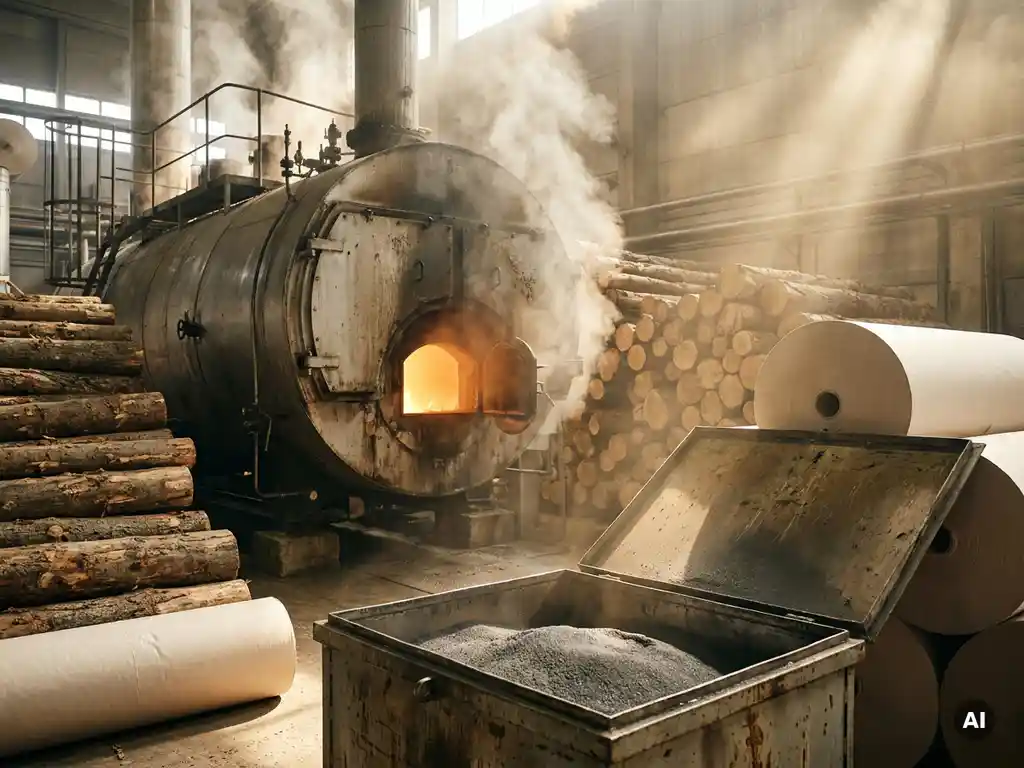
Several decarbonization options exist for pulp and paper heat processes, including electrification, green hydrogen, biomass, and emerging solutions like iron fuel. Each technology has different cost profiles, infrastructure requirements, and emissions outcomes. The right choice depends on your mill’s existing setup, energy demand, and access to grid or fuel infrastructure. This article walks through the main options and compares their real-world practicality for paper and pulp operations today.
Why is heat decarbonization so difficult in pulp and paper?
Heat decarbonization in pulp and paper is difficult because the sector requires large volumes of high-temperature heat continuously, and most of that heat is currently generated by burning fossil fuels deeply embedded in existing infrastructure. Replacing that heat without disrupting production is technically complex, capital-intensive, and constrained by the limitations of available alternatives.
Paper and pulp mills are among the most energy-intensive industrial facilities in the world. Processes like kraft pulping, drying, and bleaching demand sustained high-temperature steam, often above 150°C and sometimes significantly higher. These aren’t intermittent heating needs; they run around the clock, which means any replacement technology must be equally reliable and consistent.
The challenge is compounded by the EU Emissions Trading System (EU ETS), which is steadily raising the cost of carbon. Mills that continue burning natural gas face rising carbon costs, but switching technologies requires capital expenditure that many operators are reluctant to commit to when the commercial track record of alternatives is still limited. This tension between regulatory pressure and investment risk sits at the heart of the decarbonization challenge for the sector.
What decarbonization technologies are available for industrial heat?
The main decarbonization technologies available for industrial heat are electrification, green hydrogen, biomass, and iron fuel. Each addresses the challenge of replacing fossil fuels differently, and none is a universal solution; they vary significantly in cost, infrastructure demand, emissions profile, and suitability for high-temperature applications.
Here is a summary of the primary options:
- Electrification: Uses electric boilers or heat pumps to generate process heat. Clean when powered by renewable electricity, but limited by grid capacity and typically more suited to lower-temperature applications.
- Green hydrogen: Burns hydrogen to produce high-temperature heat with no direct CO₂. Highly effective in theory, but storage, transport, and infrastructure costs remain significant barriers.
- Biomass: Burns organic material such as wood pellets or residues. Already widely used in pulp and paper, but questions around sustainability, supply chain reliability, and residual emissions are growing.
- Iron fuel: Burns iron powder to generate high-temperature heat with near-zero CO₂ emissions. The iron oxide byproduct is regenerated using hydrogen, creating a circular fuel cycle. Still scaling toward widespread commercial deployment.
For sustainability managers evaluating these options, the key variables are energy efficiency, carbon reduction potential, upfront investment, and how well each technology integrates with existing boiler infrastructure.
How does electrification compare to hydrogen for paper mill heat?
Electrification and hydrogen both offer pathways to low-carbon heat, but they suit different mill configurations. Electrification is more accessible where grid capacity is available and temperatures are moderate, while hydrogen can deliver the high-temperature heat that paper mills need but faces significant infrastructure and cost hurdles in 2026.
The case for electrification
Electric boilers and industrial heat pumps are commercially mature and can be installed relatively quickly. However, grid congestion is a growing constraint across much of Europe, meaning many mills cannot access the additional electricity capacity they would need. Energy prices tied to electricity markets are also more volatile than long-term fuel contracts, introducing cost uncertainty. For mills in locations with limited grid access or high electricity costs, full electrification is simply not viable in the near term.
The case for hydrogen
Green hydrogen can produce the high-temperature heat that pulp and paper processes require, and it emits no direct CO₂ at the point of combustion. But the hydrogen economy is still developing. On-site storage requires specialized infrastructure, transport logistics are complex, and the cost of green hydrogen remains high relative to fossil fuels. For most mills today, hydrogen is a promising long-term option rather than an immediate solution. Security of supply is also a concern; hydrogen supply chains are less established than those for conventional fuels.
Can biomass fully replace fossil fuels in pulp and paper?
Biomass can partially replace fossil fuels in pulp and paper, and it already does so in many mills, but it cannot fully replace them in a sustainable and scalable way. Supply constraints, sustainability certification requirements, and residual emissions from combustion all limit biomass as a complete decarbonization solution.
The pulp and paper sector has historically been one of the largest users of biomass energy, often burning black liquor and wood residues as part of the kraft process. This gives the sector a head start compared to other industries. However, relying on biomass at greater scale raises legitimate concerns:
- Feedstock competition: As more industries turn to biomass, competition for sustainable feedstocks increases, which drives up costs and puts pressure on supply chains.
- Sustainability criteria: EU regulations increasingly require biomass to meet strict sustainability and greenhouse gas criteria. Not all biomass qualifies, and compliance adds administrative burden.
- Residual emissions: Biomass combustion still produces CO₂ at the stack. While this is often classified as biogenic, regulators and investors are scrutinizing these emissions more carefully.
- Land use concerns: Large-scale biomass demand can conflict with biodiversity and land use goals, creating reputational and regulatory risk.
For mills already using biomass, it remains a valuable part of the energy mix. But treating it as the sole answer to industrial heat decarbonization is increasingly difficult to justify from both a supply and sustainability standpoint.
What is iron fuel and how does it work for industrial heat?
Iron fuel is a circular, CO₂-free energy carrier that uses fine iron powder as its fuel. When burned, iron powder reacts with oxygen to produce high-temperature heat, up to 2,000°C, releasing no direct CO₂. The combustion byproduct is iron oxide, which is then regenerated back into iron fuel using hydrogen, completing a fully closed loop.
The technology works much like a rechargeable battery. Iron powder is the “charged” state: it holds energy that is released as heat during combustion. Iron oxide is the “discharged” state: it is collected after burning and sent to a regeneration facility where hydrogen converts it back into iron powder, ready to be used again. This circular cycle means iron fuel is not consumed; it is continuously reused.
For industrial heat applications, the Iron Fuel Boiler system achieves an energy efficiency of up to 95%. The only CO₂ output comes from a pilot safety flame, resulting in just 10 kg of CO₂ per megawatt-hour of thermal energy (MWhth), a near-zero emissions profile. RIFT states that the system also achieves the lowest NOₓ emissions of any fuel, at under 5 Mg/MJ, though this is based on demonstration-scale results at Technology Readiness Level 7 (TRL7).
Importantly, iron fuel is safe to transport in standard containers and does not require specialized gas infrastructure. This makes it a practical option for mills in locations affected by grid congestion or limited hydrogen pipeline access. You can learn more about how the technology works on the Iron Fuel Technology page.
Which decarbonization option is most practical for pulp and paper mills today?
The most practical decarbonization option for a pulp and paper mill today depends on its specific location, existing infrastructure, and energy demand profile. However, for mills facing grid congestion, high hydrogen costs, or biomass supply constraints, iron fuel is emerging as a compelling alternative that combines high-temperature heat delivery, near-zero emissions, and infrastructure compatibility with existing boiler setups.
There is no single answer that fits every mill, but a practical evaluation should weigh the following factors:
- Grid access: If local grid capacity is limited, electrification is not a near-term option. Iron fuel and biomass do not depend on grid infrastructure.
- Temperature requirements: High-temperature processes above 150°C narrow the field. Heat pumps are typically unsuitable; hydrogen, biomass, and iron fuel can all deliver at these levels.
- Capital versus operating costs (CAPEX vs OPEX): Each technology has a different investment profile. Iron fuel boiler systems require upfront capital but offer long-term fuel supply agreements that provide cost predictability.
- EU ETS exposure: As carbon prices rise, the cost of inaction increases. Technologies with near-zero direct emissions reduce ETS liability most effectively.
- Integration with existing infrastructure: Iron fuel boilers are designed to complement existing fossil fuel boilers, reducing the disruption and cost of transition.
For many mills, a phased approach makes the most sense, maintaining existing infrastructure while introducing cleaner technologies progressively. The key is to start evaluating options now, given the lead times involved in procurement, permitting, and installation.
How we help pulp and paper mills decarbonize industrial heat
We at RIFT develop and deliver industrial Iron Fuel Boilers specifically designed for energy-intensive sectors like pulp and paper. Our solution addresses the core challenges that make heat decarbonization difficult: high-temperature requirements, grid independence, and the need to integrate with existing production infrastructure.
Here is what our Iron Fuel Boiler system offers for pulp and paper mills:
- Near-zero CO₂ emissions: Just 10 kg of CO₂ per MWhth, stemming only from a pilot safety flame, not from the combustion of iron fuel itself
- Up to 95% energy efficiency: Outperforming many conventional fossil fuel systems
- Grid-independent operation: Iron fuel is transported in standard containers, requiring no gas pipeline or expanded electricity infrastructure
- Drop-in compatibility: Designed to integrate alongside existing boilers, so production continuity is maintained during transition
- Long-term fuel supply agreements: Providing cost predictability and security of supply from day one
Our technology is demonstrated at TRL7 and backed by €113.8 million in funding, including a €30.7 million EU Innovation Fund grant. The first commercial contract has already been signed with Kingspan Unidek. If you are a sustainability manager evaluating decarbonization solutions for your mill’s heat processes, we would be glad to explore whether Iron Fuel Technology is the right fit for your operation. Get in touch with our team to start the conversation.
Frequently Asked Questions
How long does it typically take to implement a new heat decarbonization technology in a pulp and paper mill?
Implementation timelines vary by technology, but mills should generally plan for 2–5 years from initial feasibility assessment through to full commissioning, accounting for procurement, permitting, engineering, and installation phases. Technologies like iron fuel boilers, which are designed to integrate alongside existing infrastructure, can reduce transition disruption, but early planning is critical. Starting the evaluation process now is strongly advisable given how lead times interact with rising EU ETS carbon costs.
What happens to production continuity during the switch to a low-carbon heat technology?
Production continuity is one of the biggest practical concerns for mill operators, and it is a key reason why phased or parallel installation approaches are preferred. Technologies like iron fuel boilers are specifically designed to operate alongside existing fossil fuel boilers, meaning mills can transition progressively without taking production offline. A thorough transition plan developed with your technology provider should include contingency arrangements for any planned downtime.
How do rising EU ETS carbon prices affect the business case for heat decarbonization?
As EU ETS carbon prices increase, the cost of continuing to burn fossil fuels rises in parallel, which steadily improves the financial case for low-carbon alternatives. Mills that delay investment are effectively locking in higher operating costs over time, while those that act earlier benefit from longer amortization periods on their capital investment and reduced ETS liability. Running a carbon cost sensitivity analysis alongside your CAPEX and OPEX modelling is a practical first step in quantifying this exposure.
Can a mill combine multiple decarbonization technologies rather than committing to just one?
Yes, and for most mills a blended approach is likely to be the most resilient and cost-effective strategy. For example, biomass can cover baseline heat demand where sustainable feedstock is available, while iron fuel handles high-temperature process heat that electrification cannot reach, and grid-connected electric boilers absorb demand during periods of low electricity prices. The right combination depends on your mill’s specific energy profile, location, and existing infrastructure, which is why a site-specific feasibility assessment is an essential starting point.
Is iron fuel technology commercially available right now, or is it still in the research phase?
Iron fuel technology is beyond the research phase but is still scaling toward full commercial deployment. RIFT’s Iron Fuel Boiler system is demonstrated at Technology Readiness Level 7 (TRL7), meaning it has been validated in a relevant industrial environment, and the first commercial contract has already been signed with Kingspan Unidek. Mills evaluating the technology today should engage with RIFT’s team to understand current availability, delivery timelines, and how the technology fits their specific operational requirements.
What sustainability certifications or regulatory requirements should we be aware of when evaluating these technologies?
The regulatory landscape varies by technology. Biomass is subject to increasingly stringent EU sustainability and greenhouse gas criteria under the Renewable Energy Directive (RED III), and not all biomass feedstocks qualify. Green hydrogen must meet specific renewable origin criteria to be classified as low-carbon under EU taxonomy rules. For iron fuel, the near-zero direct CO₂ emissions profile aligns well with EU ETS obligations and Green Deal targets, though mills should work with their legal and compliance teams to confirm how each option maps to their specific reporting and certification requirements.
What should a sustainability manager's first practical step be when starting to evaluate heat decarbonization options?
The most effective first step is conducting a detailed energy audit of your mill’s heat demand, mapping temperature requirements, consumption volumes, and the timing and continuity of heat use across all processes. This data forms the foundation for comparing technologies on a like-for-like basis and identifying which options are technically compatible with your operation. From there, engaging directly with technology providers for site-specific feasibility assessments will give you the cost and integration information needed to build a credible business case for leadership and investors.
Related Articles
- How do rising carbon costs change the economics of industrial heat decarbonization?
- How can manufacturers reduce upfront investment when switching to clean heat?
- What is an EIA assessment?
- What is the importance of green energy?
- Is renewable energy affordable for the average household?
This content was generated with the help of AI and it may contain mistakes